Fiskars vs Estwing Axe: Modern Engineering Meets American Tradition
One is a space-age composite tool from Finland; the other is a solid steel tank from Illinois. We pit these two titans against each other to find the ultimate wood-processing tool.
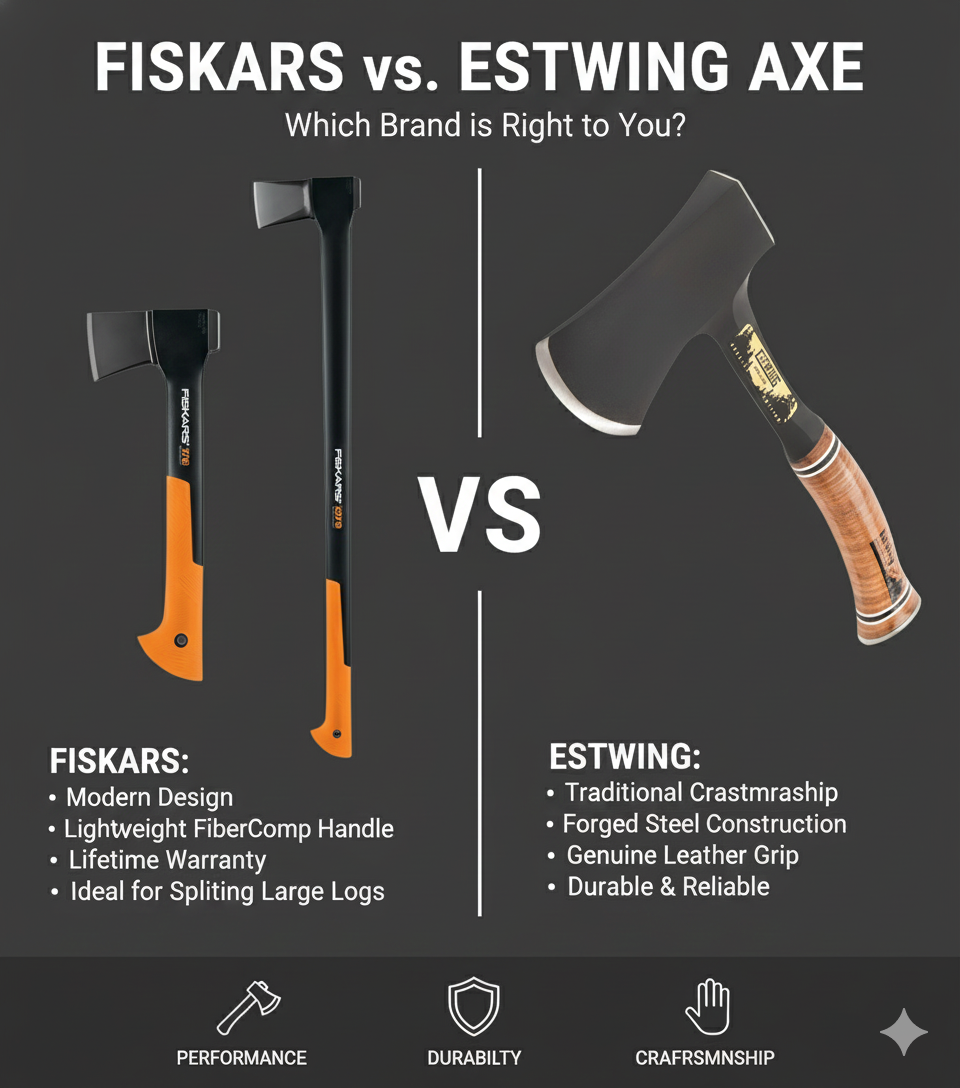
Introduction: The Clash of Philosophies
If you ask a group of woodsmen to recommend a durable, affordable axe, the room will immediately split into two camps. On one side, you have the Fiskars loyalists, who swear by the lightweight, indestructible FiberComp handles and modern wedge geometry. On the other side, you have the Estwing purists, who believe that an axe should be forged from a single piece of American steel and last long enough to be buried with you.
This isn’t just a comparison of two brands; it is a comparison of two completely different engineering philosophies. Fiskars represents the modern approach: using advanced materials to reduce weight and maximize kinetic energy. Estwing represents the traditional approach: using brute strength, mass, and time-tested metallurgy to create a tool that literally cannot fail.
In this comprehensive Fiskars vs Estwing axe comparison, we are going to break down everything—from vibration dampening and edge retention to splitting efficiency and price. Whether you are looking for a Fiskars X7 for your backpack or an Estwing Fireside Friend for your hearth, this guide will help you decide.
Quick Comparison: At A Glance
Before we start swinging, let’s look at the tale of the tape. Here are the fundamental differences between these two manufacturing giants.
| Feature | Fiskars (X-Series) | Estwing (Sportsman/Camper) |
|---|---|---|
| Construction | Two-piece (Insert Molded Head) | One-piece Solid Forged Steel |
| Handle Material | FiberComp (Hollow Polymer) | Leather Washers or Blue Vinyl |
| Weight Distribution | Head-heavy (Max Velocity) | Balanced/Handle-heavy |
| Shock Absorption | Excellent (Dampens vibration) | Poor (Transmits vibration) |
| Maintenance | Zero (Weatherproof) | Low to Medium (Rust prone) |
| Durability | High (Handle is unbreakable) | Extreme (Literally a steel bar) |
| Origin | Finland (mostly) | USA (Rockford, IL) |
Round 1: Construction & Materials
Fiskars: The Composite Revolution
Fiskars axes are famous for their orange and black handles made from FiberComp. This is a fiberglass-reinforced polyamide that is lighter than wood and stronger than steel (by weight). The handle is hollow, which unnerves traditionalists, but this design shifts the balance point towards the head.
Because the handle is light, you can swing a Fiskars axe faster. In physics terms, kinetic energy equals $1/2 mass \times velocity^2$. By increasing velocity, Fiskars generates massive splitting power without needing a heavy tool. The head is “insert molded,” meaning the plastic is formed around the steel head, making it impossible for the head to fly off.
Estwing: The Solid Steel Bar
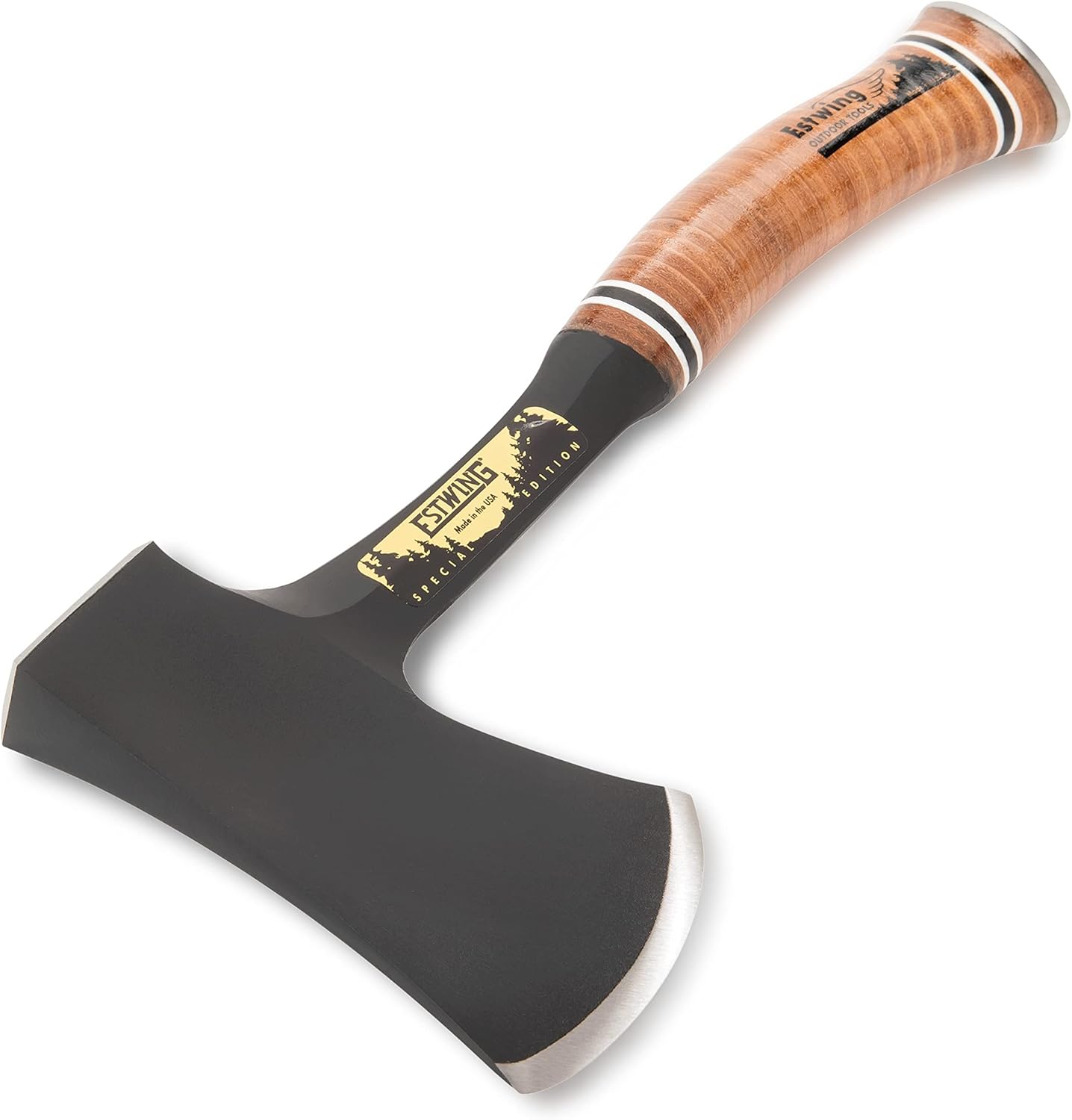
Estwing axes are forged from a single piece of tool steel. From the cutting edge to the bottom of the handle, it is one continuous bar of metal. There is no joint to fail. There is no head to loosen. This construction makes Estwing axes arguably the most durable striking tools on the planet.
The handle is typically wrapped in their iconic stacked leather washers (lacquered for protection) or their blue shock-reduction vinyl grip. While this makes the tool heavy, it gives it a feeling of invincibility that plastic simply cannot replicate.
Round 2: Ergonomics and Shock Reduction
If you are processing a cord of wood, how your arm feels afterwards matters more than how cool the axe looks.
The Estwing “Sting”
The biggest criticism of Estwing axes is the vibration. Because they are solid steel, when you strike a hard log, the shockwave travels straight down the handle and into your elbow. Estwing’s “Shock Reduction Grip” (the blue vinyl) helps, but it cannot eliminate the resonance of a steel bar. The leather-handled versions are beautiful, but they offer even less damping. Extended use can lead to elbow fatigue faster than with other handles.
The Fiskars “Flow”
Fiskars FiberComp handles are naturally shock-absorbing. The composite material dampens the vibration before it reaches your hand. Furthermore, because the handle is lighter, there is less mass for your wrist to arrest at the end of a swing. For high-repetition tasks, like using the Fiskars X25 or X27, the ergonomic advantage is undeniable.
Round 3: Splitting vs. Chopping
Splitting Firewood
Fiskars dominates the splitting game. Their X-series axes feature a distinct wedge geometry with a convex grind. The cheeks of the axe flare out rapidly. Combined with the high swing speed and the low-friction PTFE (Teflon-like) coating, a Fiskars axe rarely gets stuck. It pops wood apart explosively.
Estwing axes generally have a thinner, more traditional profile (except for the Fireside Friend). While they are capable splitters, the painted coating on Estwing heads creates more friction than the Fiskars coating, meaning they are more likely to bind in green or knotty wood.
Chopping and Felling
For chopping down small trees or limbing branches, the contest is closer. The Fiskars X7 is a biting machine due to its razor-sharp factory edge. However, the weight of an Estwing Sportsman’s axe can be advantageous here. The momentum of the heavy steel handle helps drive the cut through dense hardwoods, whereas the light Fiskars handle requires you to provide all the power.
Fiskars X27 Super Splitting Axe

The King of Splitting.
If your main goal is processing firewood, nothing beats the efficiency of the X27.
Round 4: Durability and Longevity
The Myth of Plastic Fragility
Skeptics often worry the Fiskars handle will snap in cold weather. In reality, FiberComp is rated for temperatures as low as -40°F and is widely used in the Nordic arctic. It is incredibly difficult to break. However, if you do manage to break it (usually by a massive overstrike on a steel wedge), the axe is finished. You cannot re-handle a Fiskars.
The Estwing Guarantee
You can run an Estwing over with a tank. You can leave it in a fire (though you’ll ruin the temper). It is a crowbar with an edge. The only failure point is the grip. Leather washers can rot if left in the rain, and vinyl grips can eventually peel after decades of abuse. But the steel core? It will outlive your grandchildren.
One distinct advantage Estwing has is the poll (the back of the axe). You can use an Estwing to hammer in tent stakes or even light nails. Fiskars warns against using the back of their axes as a hammer, as the polymer housing can crack.
Specific Model Matchups
1. The Hatchet Battle: Fiskars X7 vs Estwing Sportsman
The Fiskars X7 is the ultralight backpacker’s choice. It weighs 1.4 lbs and disappears in a pack. It cuts aggressively but lacks “soul.” The Estwing Sportsman (leather handle) is a piece of Americana. It is heavier but feels balanced and looks beautiful in a leather sheath.
Verdict: X7 for hiking; Estwing for car camping and nostalgia.
2. The Splitting Battle: Fiskars X27 vs Estwing Fireside Friend
This is apples and oranges, but they are often compared. The X27 is a 36-inch monster meant for two-handed splitting of large rounds. The Fireside Friend is a handheld 4lb maul designed for kindling. A better comparison is the Fiskars X11 vs the Fireside Friend.
Verdict: For large logs, the Fiskars X27 is unmatched (see our X27 vs Super Splitting Axe guide). For kindling at the hearth, the Estwing Fireside Friend is safer and more effective due to its weight.
Estwing Sportsman’s Axe

The Heritage Choice.
Beautiful leather grip, forged steel, and made in the USA.
Pros and Cons Summary
✅ Fiskars Pros
- Efficiency: Splits wood with less effort than any other axe.
- Weight: Extremely light, perfect for mobile use.
- Ergonomics: Absorbs shock, saving your joints.
- Weatherproof: Leave it in the rain, it doesn’t care.
- Price: Generally cheaper than Estwing.
❌ Fiskars Cons
- Repairability: Cannot replace the handle if broken.
- Utility: Cannot use the back as a hammer.
- Aesthetics: Looks like a gardening tool, not a heritage piece.
✅ Estwing Pros
- Indestructible: One-piece forged steel construction.
- Multipurpose: Can be used for light hammering tasks.
- Heritage: Beautiful leather options that age well.
- Made in USA: Supports American manufacturing.
❌ Estwing Cons
- Vibration: Transmits shock to the hand (“the sting”).
- Weight: Heavy to carry for long distances.
- Binding: Painted heads tend to stick in wood more than Teflon.
- Rust: Requires oiling to prevent corrosion.
Are There Other Options?
If neither of these fits your style, there is a third way: Traditional Swedish Axes.
Brands like Hultafors and Hults Bruk offer hand-forged heads on hickory handles. They offer the vibration dampening of wood (like Fiskars) with the heritage feel of steel (like Estwing). However, they require maintenance (oiling the wood) and are generally more expensive. If you are interested, check out our comparison of Hultafors vs Hults Bruk or our Hultafors Hatchet review.
Frequently Asked Questions
Which axe is better for beginners, Fiskars or Estwing?
Fiskars is generally better for beginners. It is lighter, comes sharper out of the box, and the wedge geometry makes splitting success much easier, which builds confidence. The shock absorption is also more forgiving on untrained muscles.
Can I leave my Estwing axe outside?
It is not recommended. Estwing axes are made of carbon steel, which will rust if exposed to moisture. Leather handles can also rot or dry rot. Fiskars axes, however, are largely impervious to weather.
Why does my arm hurt after using my Estwing axe?
This is likely due to the lack of shock absorption in the solid steel handle. The vibration from impact travels up the arm (often called “axe sting”). Using gloves or switching to the blue vinyl grip version can help, but Fiskars or wooden handles are superior for joint comfort.
Do Fiskars axes really hold an edge?
Yes, Fiskars uses decent quality carbon steel. It is slightly softer than premium Swedish steel to prevent chipping, meaning it may roll if it hits a rock, but it is very easy to sharpen back to a razor edge.
Can I re-handle a Fiskars axe if it breaks?
No. Because the head is molded into the handle, they are permanently fused. However, Fiskars offers a lifetime warranty, and breakage is extremely rare under normal use conditions.
Final Verdict: Which One Should You Buy?
The battle of Fiskars vs Estwing ends not with a knockout, but with a preference of style.
Buy a Fiskars IF:
- You prioritize performance and efficiency above all else.
- You want the best wood splitting capability on the market.
- You are hiking or backpacking and need to save weight.
- You have joint issues and need shock reduction.
Buy an Estwing IF:
- You want a tool that is virtually indestructible.
- You need an axe that can double as a hammer for tent stakes.
- You appreciate American-made heritage tools.
- You are doing general camp chores rather than splitting cords of wood.
Ultimately, many outdoorsmen own both: an Estwing for the belt and a Fiskars for the woodpile. You can’t go wrong with either legend.