Fiskars X27 vs. Super Splitting Axe: Clearing the Confusion
Are they the same tool? Or is there a hidden difference? We break down the X27, the mysterious “Super Splitting Axe,” and the real heavyweight contender: the IsoCore Maul.
Introduction: The Identity Crisis
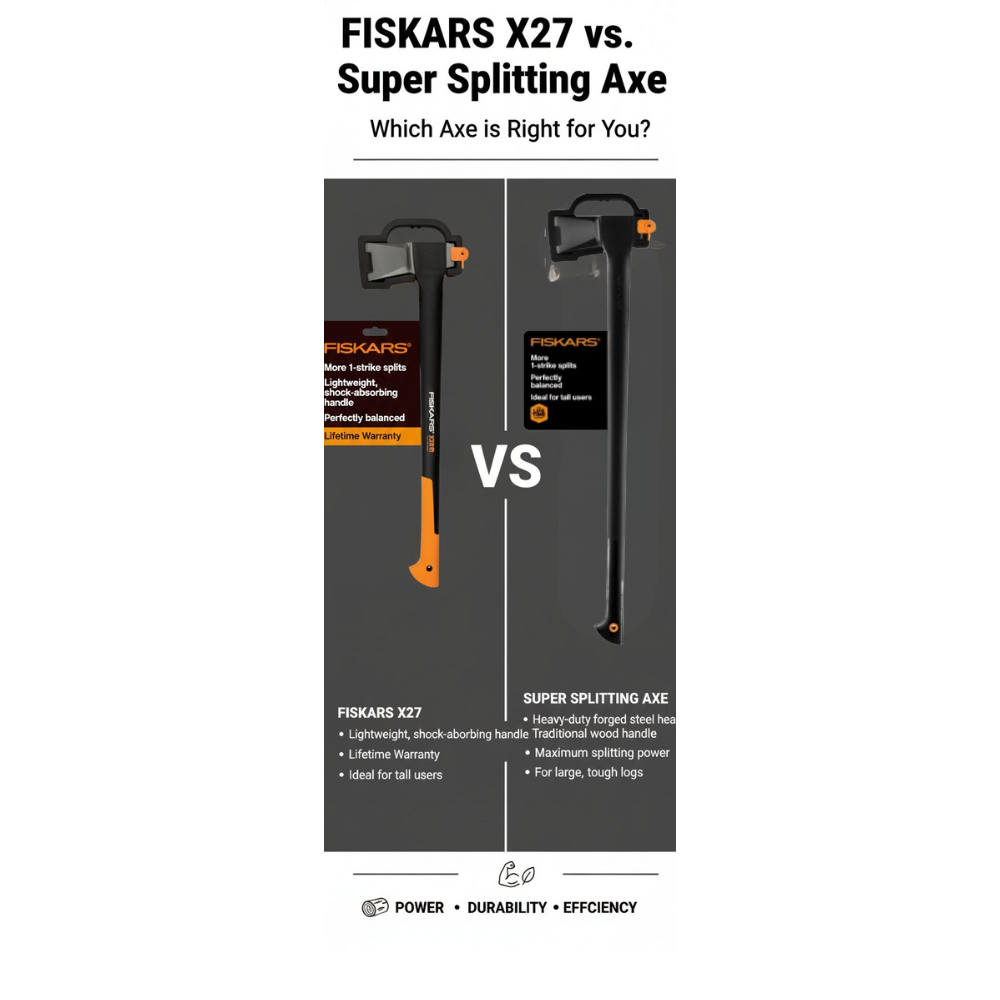
If you are browsing online hardware stores or standing in the aisle of a home center, you might find yourself staring at two very similar looking tools. One is labeled the Fiskars X27. The other is simply labeled the Fiskars Super Splitting Axe (often with a 36-inch handle). Sometimes, one has an orange grip, and the other is all black.
The question plagues forums and firewood groups every year: “Is the Super Splitting Axe better than the X27? Are they the same thing?”
The short answer is: Yes, they are essentially the same tool. The “Super Splitting Axe” is often the retail packaging name for the X27, or refers to the slightly older model with a black handle rather than the orange rubberized grip.
However, the real comparison you should be making isn’t between two versions of the same axe. It is between the X27 (The Speed Axe) and its big brother, the Fiskars IsoCore 8lb Maul (The Powerhouse). In this article, we will first clear up the X27 vs. Super Splitting Axe confusion, and then dive into the actual battle that matters: Speed vs. Mass.
Part 1: Fiskars X27 vs. “Super Splitting Axe”
Fiskars marketing can be slightly inconsistent across different regions and retailers. Here is the definitive breakdown of the differences you might see on the shelf.
The “Black Handle” vs. “Orange Grip”
Occasionally, you will find a cheaper version of the 36-inch splitting axe that is all black. This is often sold simply as the “Fiskars Super Splitting Axe” (Model 375581-1001 or similar variants). The X27 (Model 378841-1002) features the signature orange rubberized grip at the bottom of the handle.
- The Head: Identical. Both use the same forged steel wedge geometry designed to pop wood apart.
- The Handle Material: Identical. Both use FiberComp (fiberglass reinforced polyamide), which is virtually unbreakable.
- The Grip (The Real Difference): The X27 has a textured, orange, shock-absorbing rubber overmold. The basic “Super Splitting Axe” (Black) usually has a textured plastic pattern molded directly into the handle. The rubberized grip on the X27 is superior for reducing hand fatigue and preventing blisters during long splitting sessions.
Verdict: If the price difference is small ($5–$10), buy the X27. The rubber grip significantly reduces vibration shock, which your elbows will thank you for later. If the black version is half the price, grab it—it splits wood exactly the same way.
Fiskars X27 Super Splitting Axe

The gold standard. 36-inch handle, shock-absorbing grip, and legendary durability.
Check Price on AmazonPart 2: The Real Battle – X27 vs. IsoCore Maul
Now that we’ve established that the X27 and the Super Splitting Axe are siblings, let’s look at the real competition. Many people buy the X27 thinking it can handle anything. Then they meet a 30-inch knotty oak round, and the X27 bounces off.
This is where the Fiskars IsoCore 8lb Maul enters the ring. This tool is often what people should be comparing the X27 against.
| Feature | Fiskars X27 (Super Splitting Axe) | Fiskars IsoCore Maul (8lb) |
|---|---|---|
| Philosophy | Speed & Velocity | Brute Force & Mass |
| Total Weight | ~6 lbs (Light) | ~10.5 lbs (Heavy) |
| Head Weight | 4 lbs | 8 lbs |
| Handle Tech | Hollow FiberComp (Light) | Steel Core + IsoCore (Dampening) |
| Head Geometry | Sharp Wedge | Blunt Wide Wedge / Sledge |
| Best For | 80% of Firewood (Straight grain) | The nasty 20% (Knots, massive rounds) |
The Physics: Speed vs. Mass
Understanding why these tools feel so different requires a quick physics lesson. Force equals Mass times Acceleration ($F = ma$).
The X27 Approach: Kinetic Energy
The X27 is incredibly light for its size. The handle is hollow. This allows you to swing it at lightning speeds. When that 4lb head hits the wood at 50 mph, it creates an explosive “pop.” The thin, sharp edge penetrates slightly, and the widening cheeks blast the fibers apart. Because it is light, you can swing it all day without exhaustion. It relies on Tip Velocity.
The IsoCore Approach: Momentum
The IsoCore Maul is a sledgehammer with a blade. It is heavy. You cannot swing it fast. instead, you lift it and let gravity assist the drop. It relies on Mass. When 8lbs of steel hits a log, it doesn’t care if the wood is knotty or stringy; it crushes through using sheer momentum. It doesn’t “pop” the wood as much as it drives through it.
Deep Dive: Fiskars X27 (The Super Splitter)
The X27 is arguably the most popular splitting axe in modern history. Its design changed the game by moving away from heavy wooden handles to lightweight composites.
Why It Wins
For straight-grained wood like Ash, Pine, or straight Oak, the X27 is unbeatable. You can process a cord of wood in half the time it takes with a maul because you aren’t fighting the tool’s weight. The 36-inch handle allows tall users (over 6ft) to strike the ground safely if they miss the log, rather than their shin. (For shorter users, see our Fiskars X27 vs X25 comparison).
The Weakness
The X27 struggles with “stringy” wood (like Elm) or massive rounds with interlocking knots. Because it relies on speed, if the wood absorbs the impact (like a sponge), the X27 loses all its energy and gets stuck. It lacks the mass to plow through resistance.
Deep Dive: Fiskars IsoCore Maul
The IsoCore Maul is built like a tank. Unlike the X27’s hollow handle, the IsoCore has a steel rod running through the handle, encased in vibration-dampening materials.
The “IsoCore” Technology
Standard mauls are notorious for sending a painful “sting” up your arms when you hit a hard knot. Fiskars’ IsoCore system isolates the steel core from the grip, reducing shock by 2X compared to wood handles. It genuinely works. You feel a “thud” rather than a “crack” in your elbows.
The Sledge Hammer Function
One massive advantage of the IsoCore Maul over the X27 is the poll (the back of the head). The X27 has a small, unhardened poll—you cannot hammer with it. The IsoCore Maul has a massive, hardened driving face. You can use it to drive steel wedges into the toughest logs, effectively giving you two tools in one.
Fiskars IsoCore 8lb Maul

The heavy hitter for knotty wood. Features a steel-reinforced handle and a sledgehammer face.
Check Price on AmazonWhich One Is Right For You?
We often recommend a “Two-Tool System,” but if you can only buy one, here is how to choose.
Choose the Fiskars X27 IF:
- You split volume: You need to process cords of firewood quickly for winter.
- You value endurance: You want to split for 2 hours without your back giving out.
- Your wood is decent: You mostly have rounds under 20 inches diameter that are relatively straight-grained.
- You are tall: The 36-inch length is safer for users over 6’0″.
Choose the IsoCore Maul IF:
- You have “Nasty” wood: You deal with huge rounds, crotches, knots, and stringy Elm or Gum.
- You use wedges: You need a tool that can double as a sledgehammer to drive wedges.
- You are strong: Swinging 10lbs repeatedly requires significant upper body strength.
- You split casually: You only split a few logs for a campfire and want guaranteed success on every swing, regardless of technique.
Pros & Cons Breakdown
✅ Fiskars X27 Pros
- Extremely lightweight and fast.
- Best-in-class vibration absorption (FiberComp).
- Virtually unbreakable handle.
- Sharp edge cuts fibers cleanly.
- Lifetime Warranty.
❌ Fiskars X27 Cons
- Bounces off large, knotty rounds.
- Cannot be used as a hammer.
- Edge can chip on rocks (softer steel).
✅ IsoCore Maul Pros
- Unstoppable splitting force.
- Can drive wedges (Sledge face).
- IsoCore tech reduces shock significantly.
- Handles the wood the X27 can’t.
❌ IsoCore Maul Cons
- Heavy (10+ lbs total).
- Causes fatigue quickly.
- Slower cycle time (fewer swings per minute).
Are There Other Options?
If the X27 feels too long (36 inches) but you love the design, look at the Fiskars X25 (28 inches). It is safer for shorter users. (Read more: Fiskars X27 vs X25).
For handling kindling (small sticks), do not use the X27 or the Maul. It is dangerous to swing a long tool at small pieces of wood. Use a dedicated hatchet like the Fiskars X7 or a safe splitter like the Estwing Fireside Friend.
For those who prefer traditional tools, the debate of Gransfors Bruk vs Hults Bruk offers beautiful, wooden-handled alternatives, though they lack the indestructibility of the Fiskars X-series.
Frequently Asked Questions
Is the “Super Splitting Axe” different from the X27?
Functionally, no. The X27 is the modern version of the Super Splitting Axe. The only difference is usually the handle grip (Orange rubber on X27 vs Black textured plastic on older Super Splitters). The head geometry and weight are identical.
Can I use the back of the X27 to hit a wedge?
No. Never strike a metal wedge with the back of the X27, and never hit the back of the X27 with a sledgehammer. The steel around the eye is not hardened for impact and can deform, potentially loosening the head or cracking the composite handle housing. Use the IsoCore Maul for this task.
Does the Fiskars X27 come sharp?
Yes, surprisingly sharp for a splitter. Unlike traditional mauls which are blunt, the X27 has a knife-like edge to help it bite into the wood before the wedge shape takes over. This makes it efficient but means you should keep it out of the dirt to avoid dulling it.
Will the plastic handle break in cold weather?
It is extremely rare. Fiskars tests their FiberComp handles in temperatures down to -40°F. While standard plastics get brittle, this composite material remains durable. They are arguably more reliable in freezing temps than wooden handles, which can shrink and loosen the head.
Final Verdict: The Winner
So, Fiskars X27 vs. Super Splitting Axe? They are the same hero with different capes. Buy the X27 for the better grip.
But between the X27 and the IsoCore Maul? The winner depends on your woodpile.
For 90% of homeowners, the Fiskars X27 is the best tool. It transforms wood splitting from a grueling chore into a satisfying workout. It is fast, efficient, and fun.
However, keep an IsoCore Maul (or a wedge and sledge) in the corner for those 10% of logs that refuse to crack. You don’t want to be fighting a knotted oak round with a lightweight axe—you want the nuclear option.