Gransfors Bruk vs Hults Bruk: The Battle of Swedish Steel
Two legendary forges, one country, and centuries of rich forestry history. We dive deep into the metallurgy, handle dynamics, fit-and-finish, and field performance of the world’s finest axes to decide which one belongs in your bushcraft kit.
Introduction: The Swedish Axe Renaissance
In the world of bushcraft, traditional woodworking, and forestry, there is a distinct, heavy line drawn in the sawdust. On one side, you have the highly modern, composite-handled utility tools—the indestructible plastic splitters and campers like those we analyzed in our Fiskars vs Estwing comparison. On the exact opposite side, you have the absolute “soul” of the woods: traditional, hand-forged Swedish axes featuring premium American hickory handles and high-carbon steel heads.
If you have decided to graduate from hardware store hatchets and invest in a true heritage tool—one you intend to pass down to your grandchildren—you have likely narrowed your search down to the two undisputed heavyweights of the industry: Gransfors Bruk (often abbreviated as GB) and Hults Bruk (HB). Both are meticulously forged in Sweden. Both are globally revered for their uncompromising quality. And both carry a premium price tag that reflects their artisanal nature.
But the axe community is fiercely divided. Is Gransfors Bruk genuinely worth the premium “status” price tag? Or is Hults Bruk the sleeping giant that offers a more authentic, utilitarian value? What about other famous Swedish names like Wetterlings or Husqvarna? In this exhaustive comparison, we strip away the marketing romance and aggressively scrutinize the steel, the edge geometry, the wedging techniques, and the handle quality to help you make an informed decision.
History, Pedigree, and the Industry Landscape
Before analyzing the steel, we must look at the history. The Swedish axe industry underwent a massive crisis in the mid-20th century with the widespread adoption of the chainsaw. To survive, these forges had to adapt.
Hults Bruk: The Ancient Master
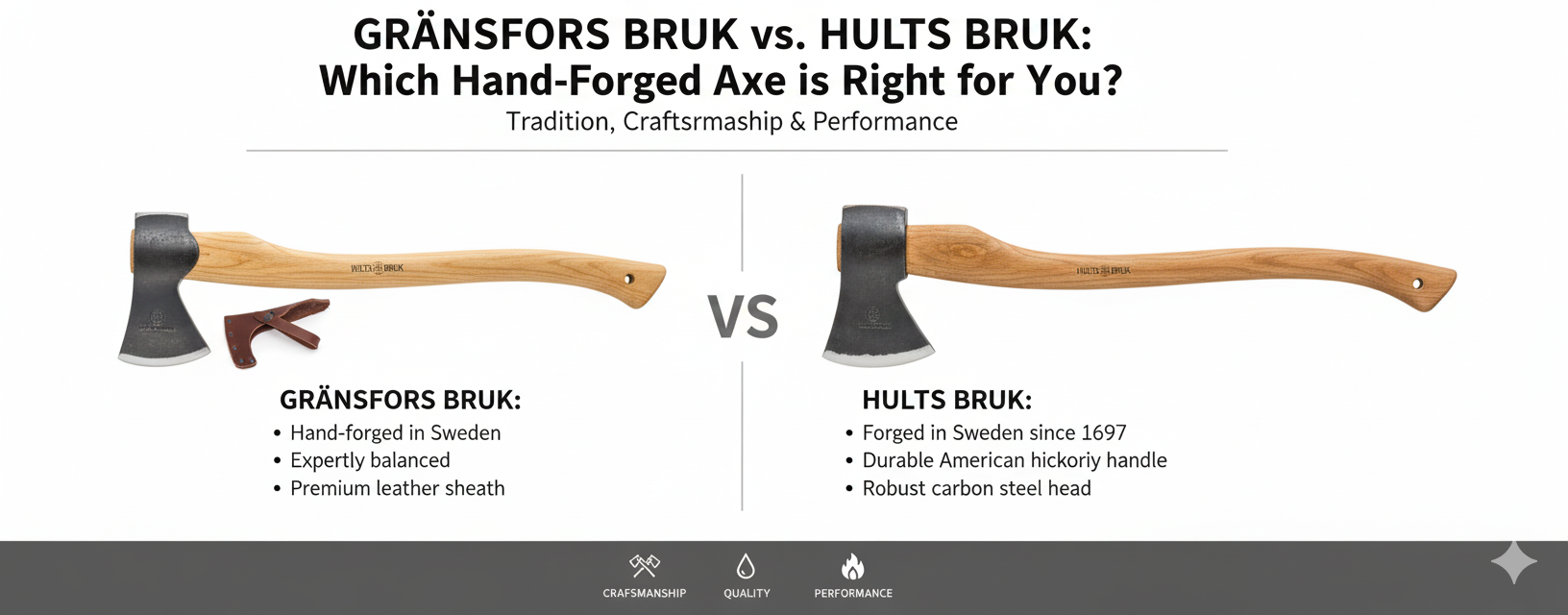
It is virtually impossible to discuss Hults Bruk without acknowledging a staggering historical fact: they have been continuously forging steel in the Hulta Valley since 1697. They are widely recognized as the oldest active axe manufacturer in the world. Today, they operate under the massive Hultafors Group umbrella.
If you are actively shopping online, you might be highly confused by the branding. Here is the secret: In the United States market, the premium axes are branded as “Hults Bruk.” In Europe, those exact same premium axes are often branded as “Hultafors Premium.” They are forged in the exact same facility by the exact same smiths. For a deeper dive into this corporate lineage, check out our guide on Hultafors vs Hults Bruk.
Gransfors Bruk: The Artisanal Perfectionist
Founded relatively recently in 1902, Gransfors Bruk is the “younger” company, but they are almost entirely responsible for the modern premium axe renaissance. During the 1980s, when chainsaws made axes practically obsolete for professional loggers, Gransfors made a radical pivot. Instead of competing on price and mass-producing cheap, painted axes, they focused heavily on artisanal, eco-friendly quality.
Gransfors stopped grinding off the raw forging marks, allowing the hammer strikes to remain visible as a badge of honor. Most importantly, they introduced the concept of the blacksmith stamping their personal initials directly into the axe head alongside the company crown—a guarantee of personal responsibility and craftsmanship. This brilliant move single-handedly saved the premium axe market.
What about Wetterlings and Husqvarna? Wetterlings was another legendary Swedish forge, but they were acquired by the owner of Gransfors Bruk and officially ceased producing axes under their own name in 2017 (their forge now helps meet Gransfors’ massive demand). Husqvarna, famous for chainsaws, does not forge their own axes; they contract them out. Currently, a Husqvarna wooden hatchet is widely known to be manufactured in the Hults Bruk forge, utilizing standard-line finishes at a budget price point.
Quick Comparison: At A Glance
Before we meticulously inspect the grain orientation and edge geometry, here is a high-level breakdown of how these two legendary brands operate today.
| Feature | Gransfors Bruk | Hults Bruk (Premium Line) |
|---|---|---|
| Established | 1902 | 1697 (Oldest in the world) |
| Signature Aesthetic | Polished, Razor Sharp, “Perfect” | Rugged, Brut de Forge, Utilitarian |
| Head Finish | Smooth grey scale, Blacksmith Initials Stamped | Rougher dark forged finish, Clear Lacquer, HB Stamp |
| Handle Quality & Treatment | Grade A+ Hickory, deeply soaked in hot Linseed Oil | Grade A Hickory, wiped with Linseed Oil |
| Out-of-Box Sharpness | Terrifyingly Shaving Sharp (Highly Consistent) | Sharp, but often requires a quick strop |
| Price Point | High / Luxury ($$$$) | Moderate to High ($$ – $$$) |
| Availability | Often backordered or Out of Stock | Generally widely available |
The Forge and The Steel: Metallurgy Explained
When you are paying over $150 for an axe, you are paying for the quality of the steel and the heat treatment.
Gransfors Bruk: Recycled Ovako Steel
Gransfors Bruk is deeply committed to environmental sustainability. They utilize a proprietary, high-carbon steel sourced from the Swedish steelworks Ovako. Remarkably, this steel is derived entirely from 100% recycled scrap metal. The steel is heated to roughly 1200°C (2192°F) before the blacksmith quickly works it under a massive pneumatic press delivering 180 tons of force at 80 strikes per minute.
After the shaping is complete, Gransfors utilizes a highly specific heat treatment. The lower part of the blade (the bit) is heated to 820°C and rapidly quenched in cold running water. Because this makes the steel brittle, they then anneal (temper) the head in an oven at 195°C for exactly 60 minutes. This relieves the extreme internal stress and yields an optimal, highly durable Rockwell Hardness of 57 HRC. Finally, they tumble the head with ceramic balls to remove excess scale and prevent rust.
Hults Bruk: Swedish Axeblade Steel
Hults Bruk utilizes their own proprietary blend simply known as “Swedish Axeblade Steel,” heavily rumored to be functionally identical to 1055 or 1060 high-carbon steel. Hults Bruk relies on open-die drop forging, where the glowing billet is repeatedly struck to align the molecular grain structure of the steel with the shape of the axe head, increasing its density and absolute strength.
Like Gransfors, Hults Bruk axes sit comfortably in the 55-57 HRC range. This is the absolute sweet spot for axes: it is hard enough to hold a brilliant edge through hours of hardwood chopping, but soft enough that if you strike a hidden rock or nail, the steel will safely “roll” or dent rather than catastrophically shattering. Furthermore, this hardness allows the user to easily touch up the edge in the deep wilderness using only a basic bastard file or puck stone.
Axe Anatomy: Head Patterns & Geometry
While both brands make beautiful tools, their approach to the physical shape of the axe head (the pattern) dictates how the tool will perform in your hands.
The Patterns: Yankee vs. Turpentine
Hults Bruk has a clear distinction between their two primary lines. Their highly affordable Standard Line (often branded as Agdor) uses an American Yankee pattern head. These are thicker, heavier, wedge-shaped heads painted blue or grey. They are fantastic, unpretentious workhorses designed for heavy splitting and felling, but they lack refinement.
The Hults Bruk Premium Line and virtually all Gransfors Bruk axes utilize variations of the Swedish Turpentine pattern. These heads are characterized by a distinct “beard” (the lower portion of the blade that drops down past the eye). A bearded axe allows the user to “choke up” on the handle, wrapping their fingers directly behind the cutting edge. This effectively turns a chopping tool into a highly precise carving knife, perfect for making feather sticks, fashioning trap triggers, or skinning large game.
Edge Geometry: Thin vs. Meaty
Gransfors Bruk axes consistently feature a slightly thinner bit profile and a highly polished convex grind. This makes them bite incredibly deep into the wood with minimal effort, which is fantastic for deep chopping and felling. However, a thinner edge is inherently more fragile. If you twist the handle while the bit is buried in a frozen log, you risk rolling that fine edge.
Hults Bruk (even in their Premium line) tends to leave a slightly “meatier” cheek directly behind the cutting edge. While they still utilize a convex grind, this added thickness acts as a wedge. For users who are exceptionally hard on their tools—or who are primarily processing and splitting firewood rather than carving spoons—the Hults Bruk profile is often much more forgiving and less prone to sticking deep in the wood.
Handle Dynamics: Hickory, Grain, and Wedging
The soul of an axe lies in its handle (the haft). Both Gransfors Bruk and Hults Bruk exclusively use premium American Hickory. Hickory is universally chosen because its long, dense wood fibers absorb tremendous amounts of shock, protecting your elbows and shoulders from repetitive impact vibrations.
Grain Orientation and Runout
A high-quality axe handle must have straight grain running parallel to the axe bit. If the grain runs perpendicular, or if it runs diagonally out the side of the handle (known as “runout”), the handle is exponentially more likely to snap under heavy impact. Gransfors Bruk is legendary for their ruthless quality control regarding grain orientation; you will rarely find a bad handle. Hults Bruk is generally excellent, but due to slightly higher production volumes, you will occasionally encounter a handle with minor grain runout.
The Wedging System
How the head is attached to the handle is critical for safety. Both companies eschew cheap epoxy glues. Instead, they use a hydraulic press to force the hickory handle into the eye of the axe head along with a hardwood wedge.
To ensure the head never flies off, both companies drive a secondary steel wedge into the wood. Gransfors Bruk uses a proprietary three-legged steel staple, while Hults Bruk uses a traditional circular steel ring wedge. Both methods are historically proven and bomb-proof, allowing the handle to stay completely tight through drastically changing humidities and seasons.
Maintenance & Care (The Bushcraft Way)
If you purchase a Swedish forged axe, you are committing to a relationship of maintenance. These are not stainless steel tools.
Protecting the Carbon Steel Head
The non-stainless heads will aggressively rust if put away wet or stored in a damp leather sheath. After every camp trip, you must wipe the head clean. We highly recommend wiping the steel down with a non-toxic, multi-purpose oil like Ballistol or applying a thin coat of beeswax. Over time, the steel will develop a dark, greyish-blue patina from sap and wood tannins—this is a badge of honor and actually helps protect against destructive red rust.
Oiling the Hickory Handle
Gransfors Bruk axes arrive deeply soaked in hot linseed oil, while Hults Bruk axes are usually just wiped down. To prevent your hickory handle from drying out, shrinking, or splintering, you must treat it. The golden rule of the woodsman is to apply Boiled Linseed Oil (BLO): “Once a day for a week, once a week for a month, once a month for a year, and once a year for the rest of your life.”
⚠️ Critical Fire Warning: Rags soaked in Boiled Linseed Oil undergo an exothermic chemical reaction as they dry and can spontaneously combust, burning down your house or garage. Never crumple up an oily rag. Always hang them completely flat outside to dry until they are stiff and hard before disposing of them.
Leather Masks and Sheaths
Both brands provide beautiful, vegetable-tanned leather masks (sheaths) with sturdy welts to prevent the blade from cutting the rivets. Treat this leather exactly like a fine pair of boots. Apply a high-quality leather conditioner like Nikwax or mink oil a few times a year to keep the leather supple and prevent it from cracking and shrinking around the axe head.
Head-to-Head: The Specific Model Match-Ups
To make this comparison genuinely fair, we have to look at the specific tools designed for identical tasks.
1. The Compact Bushcraft Hatchet
Gransfors Bruk Wildlife Hatchet vs. Hults Bruk Almike
The GB Wildlife hatchet is arguably the most famous hatchet in the world. It is incredibly light, nimble, and terrifyingly sharp, perfect for strapping to a daypack. The HB Almike is its direct identical competitor. The Almike is generally $30-$40 cheaper. For 95% of campers cutting kindling and carving tent pegs, the Almike performs identically. However, the GB Wildlife Hatchet boasts a thinner profile for slightly better carving and holds its secondary resale value much better.
2. The Ultimate Camp Tool (Mid-Size)
Gransfors Bruk Small Forest Axe vs. Hults Bruk Aneby
The GB Small Forest Axe (SFA) is a legend. Featuring a 19-inch handle, it is long enough for two-handed swings but short enough to fit entirely inside a hiking backpack. The Hults Bruk Aneby is the direct challenger. The Aneby actually features a slightly heavier head and a stouter, thicker handle. If your primary goal is fine carving and lightweight travel, the SFA wins. If your primary goal is aggressively splitting campfire wood and chopping thicker logs where extra head weight helps, the Aneby is a superior workhorse.
Gransfors Bruk Small Forest Axe

The Bushcraft Gold Standard.
19-inch handle, 2lb head. Universally praised for its flawless balance, capable of both delicate feather-stick carving and aggressive limbing.
Hults Bruk Aneby Hatchet

The Robust Alternative.
20-inch handle, slightly heavier head profile than the GB. An absolute, unpretentious workhorse for the serious camp site.
3. The Full-Size Felling Axe
Gransfors Bruk Scandinavian Forest Axe vs. Hults Bruk Kisa / Agdor 28
When you need to bring down mid-sized trees or clear massive deadfall from a trail, you need a 25+ inch handle. The GB Scandinavian Forest axe provides a curved, highly ergonomic handle and a biting thin edge. However, Hults Bruk dominates this space with variety. Their premium Kisa offers similar finesse, while their standard-line Agdor 28 Yankee provides massive, raw chopping power and durability for less than half the price of the Gransfors. For heavy forestry work, the HB Agdor line is an unbeatable value.
Pros and Cons Summary
Here is the definitive summary of the trade-offs between these two Swedish giants.
Gransfors Bruk Pros
- Artisanal Perfection: Flawless fit and finish, straight grain, and perfect alignment almost every single time.
- Razor Sharpness: Scarily sharp out of the box, capable of dry-shaving arm hair.
- Resale Value: They are highly collectible and retain value on the secondary market like a Rolex.
- Ergonomics: Exceptionally slim, perfectly shaped handles that prevent hot-spots.
- Accountability: Features the initials of the exact blacksmith who forged it, backed by a 20-year guarantee.
Gransfors Bruk Cons
- Luxury Price: Very expensive, often crossing the $200+ threshold for small tools.
- Availability: Due to low production volume, highly desired models are often sold out globally for months.
- Theft Magnet: They are almost too nice to leave laying around a public or crowded campsite.
- Fragility: The highly thinned-out cheeks and edge geometry can roll or chip if abused on knots or twisted aggressively in dense wood.
Hults Bruk Pros
- Deep History: Owning a tool from the oldest continuous axe maker in the world (since 1697).
- Unbeatable Value: The Premium line is often 20-30% cheaper than GB, while delivering 95% of the exact same field performance.
- Utilitarian Durability: Slightly thicker cheek geometry and edges are far more forgiving to poor swinging technique and abuse.
- Availability: Generally much easier to find in stock at online retailers and outdoor outfitters.
- Line Variety: Offers both highly polished Premium lines and rugged, budget-friendly Standard (Agdor) lines.
Hults Bruk Cons
- QC Variance: You will occasionally encounter a handle with minor grain runout or a slightly thicker, clunky varnish.
- Factory Edge: While sharp, they usually do not arrive hair-shaving sharp and require a quick session with a leather strop upon arrival.
- Industrial Finish: The forging marks are often rougher and darker, lacking the highly refined, meticulous polish of a Gransfors.
Are Hand-Forged Swedish Axes Too Expensive?
Let’s be ruthlessly honest—spending $150 to $250 on an axe is a luxury. It is a purchase driven by an appreciation for heritage craft, tradition, and the tactile feel of wood and carbon steel. If you simply need to split firewood to heat your home, you absolutely do not need hand-forged Swedish steel.
- For pure, brute splitting efficiency: A modern composite tool like the Fiskars X27 Super Splitting Axe will significantly outperform both GB and HB in splitting massive rounds of firewood, simply due to its modern wedge geometry, frictionless Teflon coating, and indestructible fiberglass handle.
- For budget bushcraft & camping: A Standard Hultafors Hatchet or a Husqvarna Wooden Hatchet costs a fraction of the premium price, requires no babying, and is forged in the exact same facility as the premium Hults Bruk models.
- For ultra-lightweight packing: If you are hiking miles into the backcountry and weight is your primary concern, compare the Fiskars X11 vs X7. They are hollow, feather-light, and completely impervious to rust and weather.
Expert Frequently Asked Questions
Why are Gransfors Bruk axes so expensive compared to hardware store axes?
You are paying for highly skilled, ethical labor and environmental sustainability. Instead of being stamped out by the thousands on a machine in a low-wage factory, one specific Swedish master smith forges the axe from start to finish. They hand-grind the bit, hand-sharpen the edge, and hand-haft the hickory tool. The rejection rate for imperfections is incredibly high to ensure quality, which naturally drives up the final retail cost.
Is Hults Bruk the exact same company as Hultafors?
Yes and no. The massive Hultafors Group formally acquired the historic Hults Bruk forge in 1992. In the United States market, “Hults Bruk” is the brand name used exclusively for their premium, hand-finished line of axes. In Europe, these exact same premium axes are often branded as “Hultafors Premium.” Conversely, the standard, painted, budget-friendly axes are often branded as Hultafors Standard or Agdor globally. Regardless of the sticker, they are forged in the same facility.
Can I use the poll (the flat back) of a Swedish axe to hammer metal tent stakes or wedges?
Absolutely not. While you can safely use the poll to hammer soft wooden or plastic tent stakes, you should never use it to strike steel wedges or rocks. The eye (the hole where the wood handle enters the steel) of a felling axe or hatchet is not hardened to withstand heavy metal-on-metal impact. Striking steel will deform and mushroom the eye, crushing the wood handle inside, causing the head to loosen permanently and ruining the axe. If you need to drive steel splitting wedges, you must purchase a dedicated “Splitting Maul,” which has a specially hardened, massive poll designed exactly for that task.
Do these premium axes come with a sheath?
Yes, every single Gransfors Bruk axe, and every axe in the premium line of Hults Bruk, comes standard with a high-quality, vegetable-tanned leather sheath (often referred to as a “mask”). These masks feature thick leather welts and snap closures to protect the razor-sharp edge from damage while in your pack, and to protect you from the blade.
Final Verdict: Which Swedish Forge Should You Choose?
Choosing between Gransfors Bruk vs Hults Bruk is much like choosing between a Porsche and a Mercedes. Both represent the absolute pinnacle of their respective engineering fields, both will last a lifetime if properly cared for, but the overall “vibe” and execution are distinctly different.
Buy the Gransfors Bruk IF: You are an uncompromising perfectionist. You want a tool that arrives visually flawless, features impeccable grain orientation, holds its monetary value forever, and feels like a highly refined, surgical extension of your arm. You appreciate the romantic “story” and guarantee of the specific master smith who proudly stamped their initials into the steel.
Buy the Hults Bruk IF: You desperately want a high-performance, hand-forged heritage tool but want to save $40 to $60. You don’t mind a slightly rougher, darker forged finish, or running a leather strop over the edge for five minutes when it arrives in the mail. You want a durable tool that feels rugged, slightly meatier, and completely ready for unabashed, hard work—not a museum piece you are afraid to scratch.
Our Final Recommendation
For the vast majority of users who want a tool to actively use in the dirt, the Hults Bruk undeniably offers the superior value proposition. However, for serious collectors, dedicated craftsmen, and bushcraft purists, the Gransfors Bruk remains the only choice.