Misen Chef Knife Review: Is the Viral Kickstarter Blade Actually Worth It?
An exhaustive metallurgical and real-world performance breakdown of the internet’s most aggressively marketed kitchen knife.
In the highly competitive, historically saturated world of kitchen cutlery, very few modern brands have managed to disrupt the established market quite like Misen. Launching initially on Kickstarter with a bold, uncompromising promise to entirely “cut out the middleman and deliver premium culinary tools for an honest price,” they raised well over a million dollars and captured the collective imagination of home cooks and aspiring chefs everywhere.
Their marketing campaigns are ubiquitous across social media, featuring sleek aesthetics, modern color palettes, and bold claims of professional-tier performance at a fraction of the cost of traditional European imports. But as any seasoned culinary enthusiast knows: marketing hype is one thing; actual, unyielding performance on a chaotic cutting board is another beast entirely.
Does the Misen Chef Knife truly possess the metallurgical chops to rival centuries-old giants like Wüsthof, Zwilling, and Shun, or is it merely a well-marketed, overseas-manufactured budget blade masquerading as luxury? We purchased the knife anonymously and put it through weeks of rigorous, unforgiving kitchen testing—chopping, slicing, dicing, and rock-mincing everything from delicate garden herbs to dense, frozen butternut squash—to give you the definitive, unbiased answer.
If you are currently hunting for one of the best affordable chef knives on the market, this exhaustive review will brutally break down exactly what you get for your hard-earned money with Misen.
Product Overview: The Technical Specifications
The Misen Chef Knife deliberately positions itself as a strategic hybrid, attempting the difficult engineering feat of marrying the heavy-duty durability of traditional Western knives with the razor-thin, scalpel-like precision of Japanese design. Before we dive into the physical performance, let’s analyze the raw metallurgical data and factory specs.
| Blade Length | 8 Inches (20.3 cm) – The industry standard “Goldilocks” size. |
|---|---|
| Steel Type | AUS-10 (Premium Japanese High-Carbon Stainless Steel) |
| Rockwell Hardness (HRC) | 58-60 HRC (Significantly harder than standard German steel) |
| Factory Edge Angle | 15 degrees per side (30 degrees inclusive / 50-50 bevel) |
| Handle Material | Synthetic TPE (Thermoplastic Elastomer) |
| Construction Style | Full Tang, Stamped Blade with Molded Sloped Bolster |
| Manufacturing Origin | Manufactured in China (using imported Japanese Steel) |
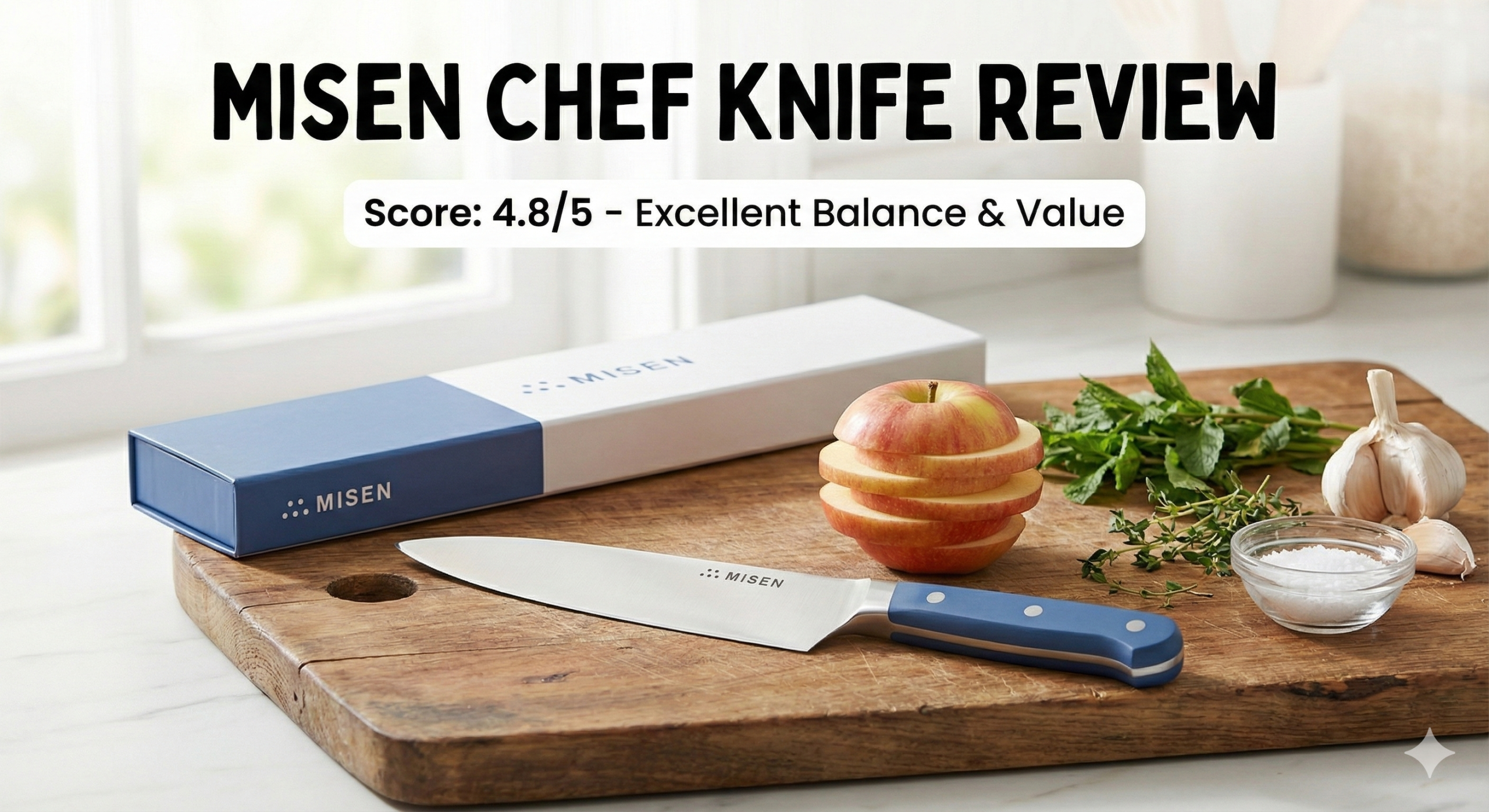
Official KnivesReview.com Score
A phenomenal, highly capable entry-level upgrade for the home cook, though it understandably lacks the artisanal “soul” and generational longevity of true, hand-forged heritage cutlery.
 Check Availability on Amazon
The Blade: Japanese Steel Meets Global Design
The beating heart of any knife is its steel, and this is where Misen makes its strongest value proposition. Instead of using cheap, generic Chinese alloys, Misen imports AUS-10 steel directly from Japan. If you are deeply familiar with the nuances of the AUS-10 steel vs VG10 debate, you know that AUS-10 is a serious, highly respected step up from the soft, rolling steels found in generic supermarket block sets.
Sharpness, Geometry, and Edge Retention
Straight out of the box, the Misen is terrifyingly sharp. It easily passes the industry-standard paper test (slicing magazine paper without snagging or tearing) and the ripe tomato test (slicing horizontally without crushing the delicate skin). The blade is factory-ground to a steep, highly acute 15-degree angle per side.
Contextualizing the Angle: Traditional, heavy German kitchen knives like Henckels or Wüsthof are typically ground to a wider, blunt 20-22 degrees for maximum durability against bones. Conversely, delicate Japanese kitchen knives sit around an acute 10-15 degrees for pure slicing precision. Misen adopts the Japanese angle.
This acute 15-degree edge makes the Misen feel incredibly agile, lightweight, and precise on the cutting board. Furthermore, because AUS-10 is heat-treated to a higher hardness (HRC 58-60) than standard German X50CrMoV15 steel (which sits at HRC 56-58), the Misen holds its razor edge significantly longer between sharpening sessions.
However, physics dictates a trade-off: harder steel is inherently more brittle. While it slices vegetables like a dream, you must absolutely avoid hacking through frozen foods, twisting the blade inside hard squash, or violently chopping through chicken bones. For those specific, high-impact tasks, you still fundamentally require a dedicated, heavy-duty cleaver or butcher knife.
Blade Profile: The True Hybrid
The physical blade profile is a masterful hybrid design. It possesses the sweeping curvature (the “belly”) of a classic Western chef’s knife, which effortlessly allows for the rhythmic “rock-chopping” motion highly favored by Western cooks for mincing herbs and garlic. Simultaneously, it is ground much thinner behind the cutting edge, mimicking the geometry of a Japanese Gyuto. This makes it an exceptional, highly versatile all-rounder, perfectly capable of smoothly handling everything comprehensively discussed in our guide on what a chef knife is actually used for.
Handle and Ergonomics: Mastering the “Misen Shake”
One of Misen’s most heavily advertised and unique selling points is its uniquely sloped bolster. The bolster (the thick junction where the handle physically meets the blade steel) is aggressively angled specifically to naturally encourage and force a “pinch grip.”
The pinch grip—where the thumb and index finger extend past the handle to physically grip the base of the blade face—is the exact technique utilized by all professional chefs to maximize blade control, increase cutting speed, and drastically reduce wrist fatigue. By angling the bolster, Misen effectively trains home cooks to hold the knife correctly. It is a brilliant, highly effective design feature.
The handle itself is molded from a synthetic Thermoplastic Elastomer (TPE). It is available in highly modern, aesthetically pleasing colors like Misen Blue, Crimson Red, Slate Grey, and Classic Black. While it looks undeniably sleek and minimalist in a modern kitchen, the physical texture is quite smooth—perhaps slightly too smooth. When your hands are wet with vegetable juice or slick with olive oil, the grip can occasionally feel a bit compromised compared to the highly aggressive, non-slip textured handle of a commercial workhorse like the Victorinox Fibrox Pro.
However, the balance point of the knife is absolutely perfect. The knife balances dead-center exactly where your fingers rest in the pinch grip, making the blade feel feathery and nimble, completely masking its actual physical weight.
Real-World Performance Test: In The Kitchen Trenches
We acquired the Misen 8-inch Chef Knife and aggressively put it through a grueling series of standardized culinary tasks to see how it performs when the marketing fades and the real cooking begins.
1. The Brutal Onion Test (Fine Dicing)
Meticulously dicing onions requires a knife with a thin spine and a sharp tip to move through the dense layers without wedging or causing the onion to explode outward. The Misen performed flawlessly here. The thin spine glided smoothly through the onion horizontally, and the dropped tip was highly precise for vertical scoring. It utterly humiliated standard, thick-spined big-box store knives.
2. The Dense Carrot Test (Wedging Resistance)
Carrots and root vegetables are notoriously dense and often cause thick, heavy knives (like older German forgings) to physically “crack” or snap the vegetable rather than smoothly slicing it. The Misen’s hybrid geometry is thin enough directly behind the edge to slice cleanly without significant wedging. While it isn’t a frictionless, laser-thin purebred like a Shun or a Miyabi, it is vastly superior to a thick-spined Zwilling Pro in this specific metric.
3. The Chicken Breakdown Test (Agility & Toughness)
Breaking down a whole raw chicken requires a nimble tip to maneuver carefully around complex joints and cartilage. The Misen felt highly maneuverable, and the AUS-10 steel made short work of separating the breast meat from the bone. However, because of the acute 15-degree edge angle, we were highly cautious and deliberate to avoid torquing the blade against the hard rib bones. For heavy, careless bone work, we immediately switched to a dedicated, flexible boning knife to safely protect the Misen’s delicate edge from micro-chipping.
How Does Misen Actually Compare to the Industry Titans?
The Misen is frequently hailed online as a “category killer,” aiming to disrupt both the budget and premium markets. But how does it genuinely stack up when placed side-by-side against the entrenched, historical legends of the cutlery industry?
Misen vs. Victorinox Fibrox Pro
The Victorinox Fibrox (roughly $40-$50) is the undisputed, heavily crowned king of budget commercial kitchens and culinary schools.
- Steel Quality: Misen’s imported AUS-10 is objectively harder and will hold a sharp edge significantly longer than Victorinox’s softer European stainless steel.
- Handle Ergonomics: Victorinox boasts a vastly superior, highly functional non-slip grip, but it admittedly looks incredibly cheap and industrial. Misen looks highly premium and elegant, but sacrifices wet-grip traction.
- The Verdict: If you care deeply about modern kitchen aesthetics and maximizing edge retention, spend the extra money on the Misen. If you want a pure, indestructible, utilitarian beater for a chaotic commercial environment, stick religiously with the Victorinox. (Check out our full Victorinox comparisons here).
Misen vs. Wüsthof Classic
The Wüsthof Classic (roughly $150-$170+) is the heavy, historical standard for German heritage cutlery.
- Construction: Wüsthof is fully hot-forged from a single piece of steel, featuring a massive, heavy bolster. Misen is stamped from a sheet of steel with a molded-on bolster. Wüsthof physically feels much more substantial, authoritative, and virtually indestructible.
- Durability vs. Precision: Wüsthof utilizes softer, tougher steel (58 HRC) that takes heavy abuse brilliantly. Misen utilizes harder, sharper steel that cuts with less resistance but is more brittle.
- The Verdict: Misen is half the price and actually slices vegetables smoother due to its thin geometry. However, the Wüsthof will last for three generations in a rough environment. (See our exhaustive Wusthof vs Victorinox breakdown for deeper context on European steel).
Misen vs. Shun Classic
Shun (roughly $150-$200) is the most popular, highly visible entry point for premium Japanese Damascus knives in the West.
- Metallurgy & Sharpness: Both utilize acute, similar 15-degree cutting angles, but Shun uses proprietary VG-MAX steel (a super-steel variant of VG10) enveloped in stunning Damascus cladding, taking an even finer edge than the Misen.
- Fit and Finish: Shun is a handcrafted piece of functional art; Misen is a highly functional, mass-produced tool.
- The Verdict: If you want a breathtaking knife to impress dinner guests and display proudly, invest in a Shun. If you want 90% of the raw cutting performance for barely 40% of the cost, buy the Misen. (Read our detailed Shun vs Wusthof comparison).
Pros and Cons Summary
The Pros (Why It’s a Great Buy)
- Incredible Value: You are getting genuine, high-carbon Japanese AUS-10 steel for well under the $100 threshold, which is highly unusual.
- Brilliant Design: The sloped, angled bolster actively forces and teaches the user proper, professional pinch-grip mechanics.
- Superior Edge Retention: The 58-60 HRC steel holds a working, razor-sharp edge significantly longer than standard European X50CrMoV15 steel.
- Modern Aesthetics: A beautifully sleek, minimalist, matte-finish look that seamlessly integrates into any modern kitchen decor.
- Generous Warranty: Misen backs their product with a lifetime guarantee and even offers a free lifetime sharpening service (you only pay for the shipping).
The Cons (What You Should Know)
- Slick Handle Texture: The smooth TPE plastic handle can become noticeably slippery and harder to control when your hands are wet with water or greasy from olive oil.
- Quality Control Variance: Because they are mass-produced overseas, some highly critical users have reported receiving blades with slightly uneven factory grinds in early production batches.
- Storage Deficit: The knife does not come with a protective plastic sheath (saya), meaning you will immediately need to figure out how to store the knife safely in a drawer to protect the brittle edge.
- Stamped Construction: It is a stamped blade, and while highly functional, it objectively lacks the heavy, deeply balanced “soul” and heft that traditionalists prefer in forged knives.
Maintenance Protocols: Keeping Your Misen Factory-Sharp
Because the Misen utilizes a harder, high-carbon Japanese steel alloy, proper maintenance is absolutely critical. You cannot abuse it like a cheap IKEA knife and expect it to survive.
Honing vs. Sharpening
You should absolutely hone the knife before or after every heavy prep session to keep the microscopic apex aligned. However, a crucial warning: aggressively using standard, heavily grooved steel honing rods (the kind that come free with cheap knife blocks) can actually chip the harder AUS-10 edge. We strongly, explicitly recommend utilizing a smooth ceramic honing rod instead. Learn the vital metallurgical differences in our comprehensive guide: Sharpening Stone vs Honing Steel.
Proper Sharpening Techniques
Eventually, despite frequent honing, the knife will dull and require actual material removal. When it does, you have two safe options:
- Water Whetstones (Recommended): This is the best, most respectful method for the steel. Invest in a dual-sided 1000/6000 grit combo whetstone and learn the 15-degree angle.
- Electric Sharpeners (Convenient): If you must use a machine, you must ensure you buy an “Asian” style sharpener that supports the acute 15-degree angle. Running a Misen through a 20-degree Western sharpener will ruin its intended geometry. See our top curated picks for safe electric sharpeners.
Cleaning and Safe Storage
Is the Misen Chef Knife dishwasher safe? Technically they claim it is, but practically, the answer is a resounding NO. The extreme heat cycles and caustic powder detergents will quickly degrade the synthetic handle material, and the violent water jets will bounce the delicate 15-degree blade against ceramic plates, instantly dulling the edge. Hand wash only with warm soapy water and towel dry immediately.
For safe storage, never toss it loosely into a utensil drawer. Utilize a dedicated wooden knife drawer organizer or a wall-mounted magnetic strip. (If you are paranoid about magnets scratching the blade, read our myth-busting article: Are magnetic knife strips bad for knife edges?).
Expert Frequently Asked Questions (FAQ)
Is Misen officially considered a Japanese or a German knife?
Misen is fundamentally a strategic hybrid. It utilizes premium Japanese AUS-10 steel and a razor-sharp Japanese-style 15-degree edge angle, but it physically features a distinctly curved belly profile and an ergonomic handle design more typical of heavy Western (German/French) knives. This deliberate hybrid nature makes it highly versatile for both traditional rock chopping and precise Japanese push-cutting.
Do Misen kitchen knives rust easily?
Misen knives are manufactured from high-carbon stainless steel, so they are highly resistant to rust under normal household conditions. However, in the professional culinary world, “stain-less” absolutely does not mean “stain-proof.” If they are left soaking wet in a dirty sink, covered in acidic tomato or citrus juice, or foolishly put in a dishwasher, they can quickly develop ugly brown surface rust. If this happens, do not panic; thoroughly check our guide on how to remove rust from kitchen knives safely.
Where are Misen knives officially manufactured?
Misen knives are manufactured in high-tech facilities located in China (specifically near Shanghai), utilizing high-quality, raw imported Japanese steel. This strategic overseas manufacturing location is precisely the business model that allows them to keep the consumer retail price point significantly lower than heritage knives that are fully manufactured and assembled in high-wage areas like Seki, Japan, or Solingen, Germany.
Is the Misen Chef Knife a true full tang construction?
Yes, the Misen Chef Knife prominently features a robust full tang construction. This means the solid sheet of steel from the blade runs continuously all the way through the synthetic TPE handle to the very butt of the knife. This provides significantly better overall balance, a more authoritative weight distribution in the hand, and vastly superior structural durability compared to cheap, easily broken partial-tang knives found in discount stores.
Final Verdict: Should You Actually Buy the Misen Chef Knife?
After weeks of exhaustive, unbiased testing, our final conclusion is resoundingly clear: The Misen Chef Knife is quite likely the absolute best value hybrid knife currently available on the market for ambitious home cooks.
It sits perfectly in the highly sought-after “Goldilocks” zone. It is lightyears better, sharper, and more durable than the flimsy $30 budget knives found hanging in grocery store aisles, but it costs a mere fraction of the exorbitant price commanded by big-name, centuries-old heritage brands. While it admittedly lacks the hand-finished, artisanal “soul” of a traditional handmade Japanese blade or the heavy, tank-like, indestructible ruggedness of a premium Wüsthof, it confidently delivers 95% of the cutting performance required by 99% of users.
You should absolutely buy the Misen if:
- You are an enthusiastic home cook looking to drastically upgrade from a cheap, dull, hand-me-down knife block set.
- You are a foodie who deeply appreciates high-performance Japanese steel geometry but categorically refuses to spend $200+ on a single tool.
- You are looking for an impressive, beautifully packaged gift for a newlywed couple or a budding chef.
You should probably skip the Misen if:
- You are a professional line cook who requires a highly textured, non-slip rubber grip for fast-paced, greasy, and wet commercial environments.
- You are a dedicated knife collector looking for the unique aesthetic of folded Damascus patterns, exotic wooden Wa-handles, and artisanal craftsmanship.
If you are finally ready to instantly upgrade your daily cooking game and slice tomatoes like a professional, the Misen is a remarkably safe, smart, and razor-sharp investment.
Check Latest Price & Availability on Amazon