Dexter-Russell Knives Review: Why Professional Butchers & Chefs Swear By Them
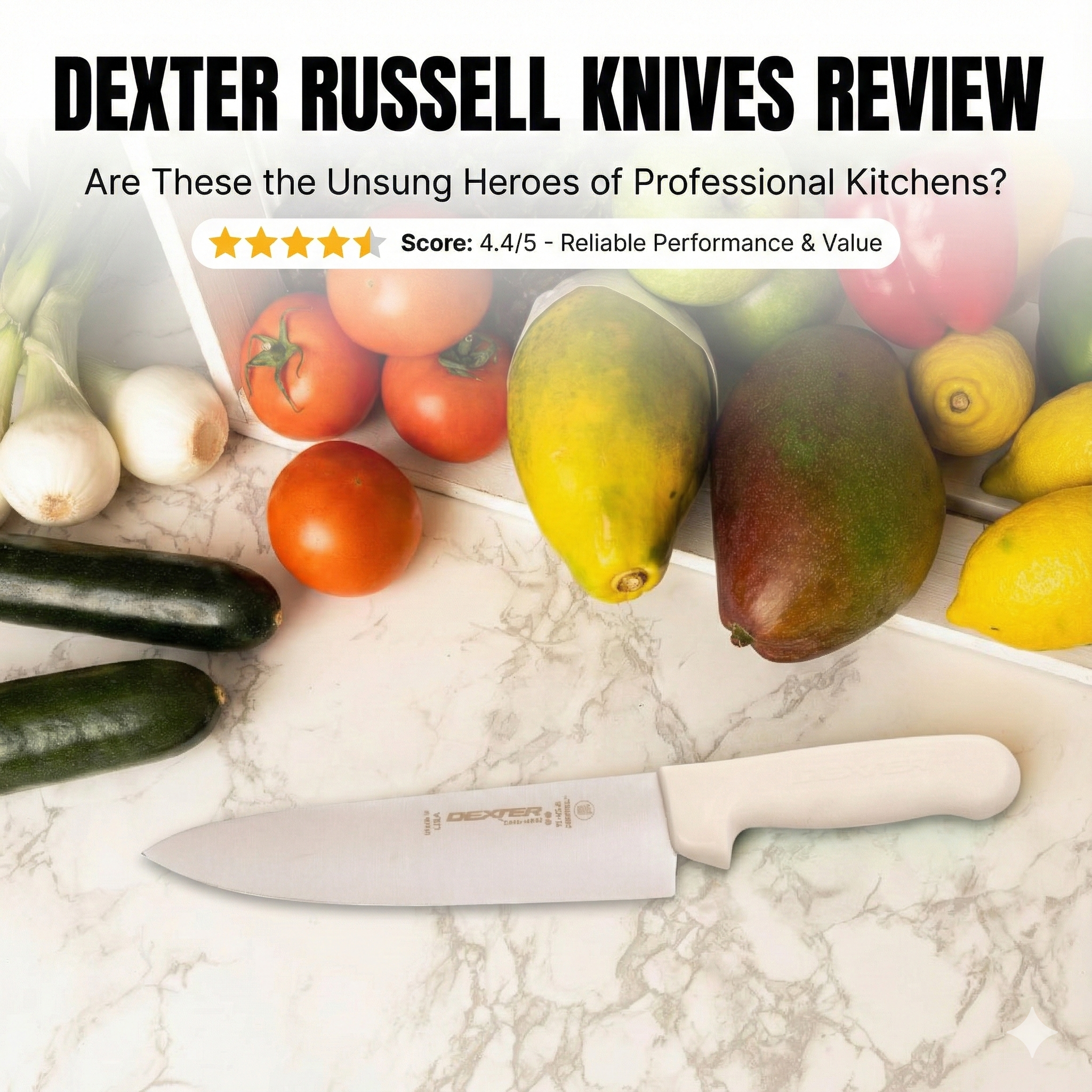
Walk into the pristine, highly visible open kitchen of a Michelin-starred restaurant, and you might see flashing reflections of hand-hammered Japanese Damascus steel or custom-forged German carbon blades. But walk into the gritty back-of-house of a high-volume butcher shop, a busy coastal fish market, a legendary Texas BBQ joint, or the frantic prep line of a 24-hour diner, and you are almost guaranteed to see walls lined with stark white handles bearing the name Dexter-Russell.
Established in 1818, Dexter-Russell holds the prestigious title of being the oldest continuous cutlery manufacturer in the United States. They don’t sell an aspirational culinary lifestyle; they sell absolute, unyielding tools. In this comprehensive, deeply researched Dexter-Russell knives review, we are going to brutally strip away the marketing fluff and examine exactly why these stamped American blades are universally considered the undisputed gold standard for commercial durability and volume prep.
Are they refined enough for the passionate home cook searching for the best affordable chef knives? Or are they strictly industrial implements meant only for breaking down massive sides of beef? We put the Sani-Safe, SofGrip, V-Lo, and Traditional lines to the ultimate test to find out.
Table of Contents
- The Deep History: Born in America
- Metallurgy: The Science of DexSteel™
- Stamped vs. Forged Construction
- Deep Dive: The Dexter Handle Ecosystem
- The Must-Have Dexter-Russell Knife Models
- Dexter-Russell vs. The Commercial Competition
- Maintenance, Honing, and Storage
- Pros & Cons Summary
- Final Verdict
- Expert Frequently Asked Questions
The Deep History: Born in the American Frontier
You cannot fully appreciate a Dexter-Russell knife without understanding its roots. The modern company is the result of a 1933 merger between two legendary New England cutlery titans: Harrington Cutlery Company (founded in 1818 in Southbridge, Massachusetts) and John Russell Cutlery Company (founded in 1834 in Greenfield, Massachusetts).
John Russell Cutlery was historically famous for producing the “Green River” knife. In the mid-19th century, these blades were the absolute favorites of American frontiersmen, mountain men, and buffalo hunters. The phrase “Give it to ’em up to the Green River” (meaning to stab deeply up to the manufacturer’s trademark stamp near the hilt) became a popular pioneer idiom.
Today, Dexter-Russell proudly maintains this incredible legacy. While many historic brands have completely offshored their manufacturing to cut costs, Dexter-Russell still manufactures the vast majority of its product catalog in Southbridge, Massachusetts, employing American steelworkers and maintaining rigorous, localized quality control.
Metallurgy: The Science of DexSteel™
When knife enthusiasts discuss steel, they often fetishize extreme hardness (measuring 62+ on the Rockwell Hardness Scale). High hardness holds a razor edge for a long time, but it also makes the steel brittle and prone to catastrophic chipping if you hit a bone or drop it on a tile floor.
Commercial kitchens do not have the time or patience for brittle knives. Dexter-Russell purposefully utilizes a proprietary high-carbon, high-alloy stainless steel they call DexSteel™.
DexSteel is meticulously heat-treated and ice-tempered to a softer, highly resilient Rockwell Hardness of approximately 54 to 56 HRC. Why is this softer steel a massive advantage for professionals?
- Extreme Toughness: If a butcher violently strikes a beef femur with a Dexter boning knife, the steel will safely “roll” or bend rather than shatter or chip.
- Instant Honing: A rolled edge on a 55 HRC blade can be realigned to shaving-sharp in three seconds with a standard steel honing rod. A line cook can hone their blade between tickets without missing a beat.
- Stain Resistance: The alloy composition is virtually immune to rust and acidic corrosion, enduring the highly caustic environment of commercial dish pits and sanitation buckets.
Stamped vs. Forged Construction
Dexter-Russell is a master of stamped knife manufacturing. Unlike forged knives (like traditional Wüsthofs) that are hammered from a single thick bar of glowing steel to create a heavy bolster, stamped knives are laser-cut from a continuous sheet of high-carbon stainless steel.
This process is highly efficient and significantly reduces the weight of the blade. Because commercial chefs are literally holding and swinging their knives for 8 to 12 hours a day, a lightweight stamped blade dramatically reduces wrist and forearm fatigue. They lack the heavy, finger-protecting bolster of a forged knife, which actually serves as a benefit: a bolsterless heel allows the chef to easily sharpen the entire length of the blade from tip to heel over the lifespan of the knife. If you aren’t entirely sure how this affects long-term performance, check out our extensive guide on the difference between stamped and forged knives.
Deep Dive: The Dexter Handle Ecosystem
Dexter-Russell offers several distinct handle lines, each engineered to solve specific ergonomic and environmental problems in the commercial kitchen.
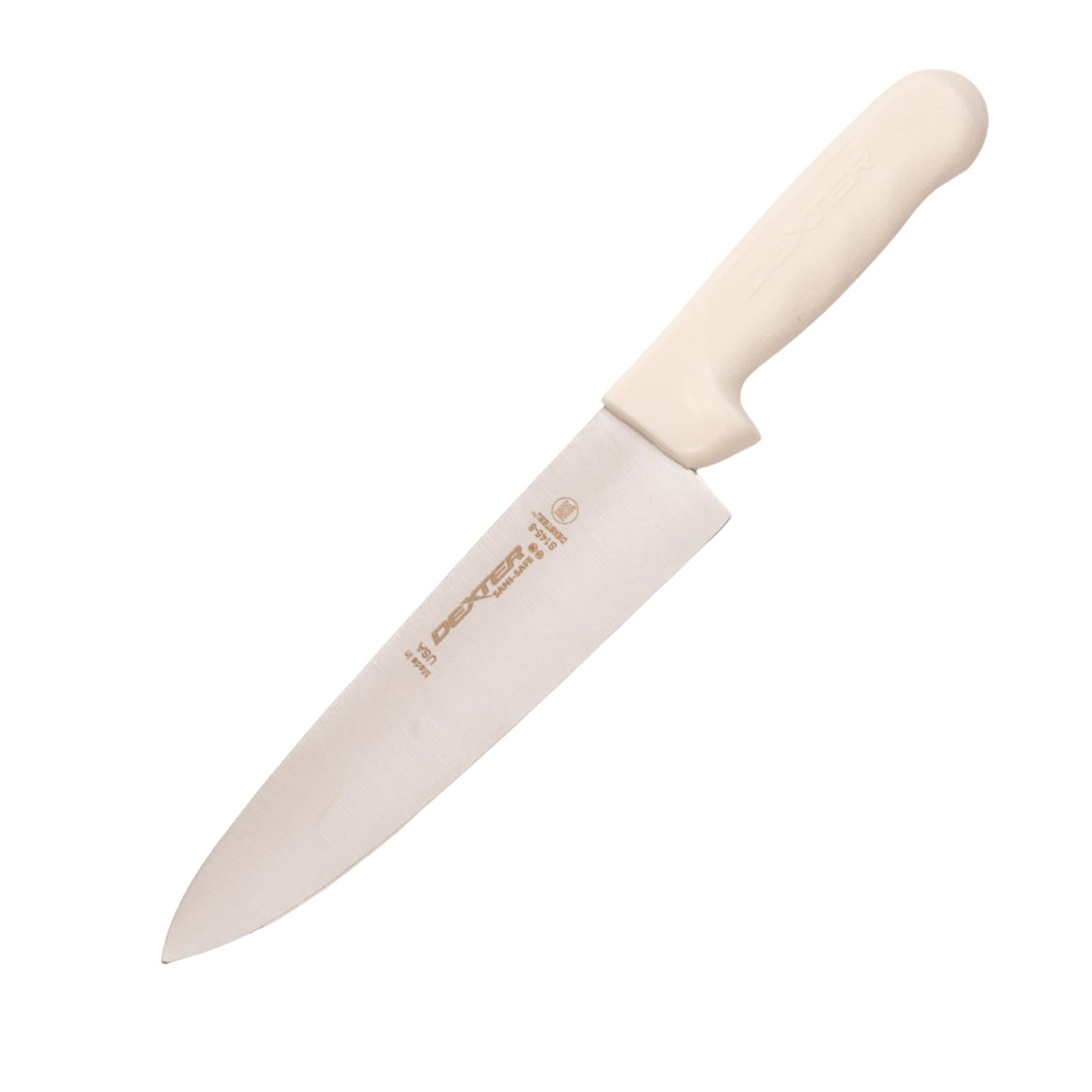
1. Sani-Safe® Series (The Unkillable Industry Standard)
This is the iconic white-handled knife you immediately recognize from every deli counter, pizzeria, and sub shop in America. The handle is made from a highly textured, high-impact polypropylene polymer.
NSF Certification: The Sani-Safe handle is injection-molded and sealed completely flush around the blade tang. There are absolutely no rivets to loosen over time, and zero microscopic gaps or wood pores for deadly bacteria, raw meat juice, or cross-contaminants to hide in. This ironclad NSF certification is exactly why local health inspectors love seeing them.
Performance: In our rigorous testing, the Sani-Safe 8-inch chef knife breezed effortlessly through fifty pounds of onions and potatoes. It feels incredibly lightweight, agile, and slip-resistant. It is arguably the best budget chef knife for home cooks who prioritize clinical hygiene and sheer utility over fancy aesthetics.
2. SofGrip™ Series (The Ergonomic Fatigue Fighter)
If you are aggressively cutting, deboning, or portioning for 10 hours a day, hard plastic can eventually cause blisters and severe hand fatigue. The SofGrip line solves this by featuring a soft, slightly compressible elastomer rubber over-mold.
Best For: Professional fishmongers, butchers, and BBQ pitmasters. It remains unbelievably grippy and secure even when your hands are completely coated in slippery fish slime, olive oil, or hot animal fat. If you need to know how to travel with kitchen knives safely for an offshore fishing trip, a SofGrip narrow fillet knife paired with a hard plastic sheath is your absolute best companion.
3. V-Lo® Series (The Modern Hybrid)
The V-Lo (V-Low) series is Dexter’s modern answer to ergonomic comfort. It combines the firm, unyielding core of the Sani-Safe polypropylene with a softer, tactile Santoprene over-mold on the exterior. It offers a slightly more sophisticated, premium look while retaining all the sanitary benefits of the classic white handle.
4. Traditional™ Series (Old School Carbon & Wood)
For the purists. These feature stunning, natural Rosewood or Walnut handles securely fastened to the blade with large brass compression rivets. Many models in the Traditional line still use non-stainless, raw high-carbon steel. They take a terrifyingly sharp edge and are a favorite among traditional BBQ cooks, but they require strict maintenance. If you don’t oil them, they will rust. Be sure to read our guide on how to remove rust from kitchen knives before committing to this series.
The Must-Have Dexter-Russell Knife Models
While you could outfit an entire kitchen exclusively with Dexter products, there are a few specific blade profiles where the brand absolutely dominates the global market.
The 6-Inch Curved Boning Knife
If you have ever watched legendary Texas BBQ pitmasters (like Aaron Franklin) trim massive briskets, you have seen this exact knife. The curved blade allows you to effortlessly get under the fat cap and make long, smooth, uninterrupted drawing cuts. It is available in stiff (for pork/beef) or flexible (for poultry/fish) variations. It is an absolute necessity for carnivores. Discover the nuances in our boning knife vs fillet knife breakdown.
The 12-Inch Scalloped Slicer
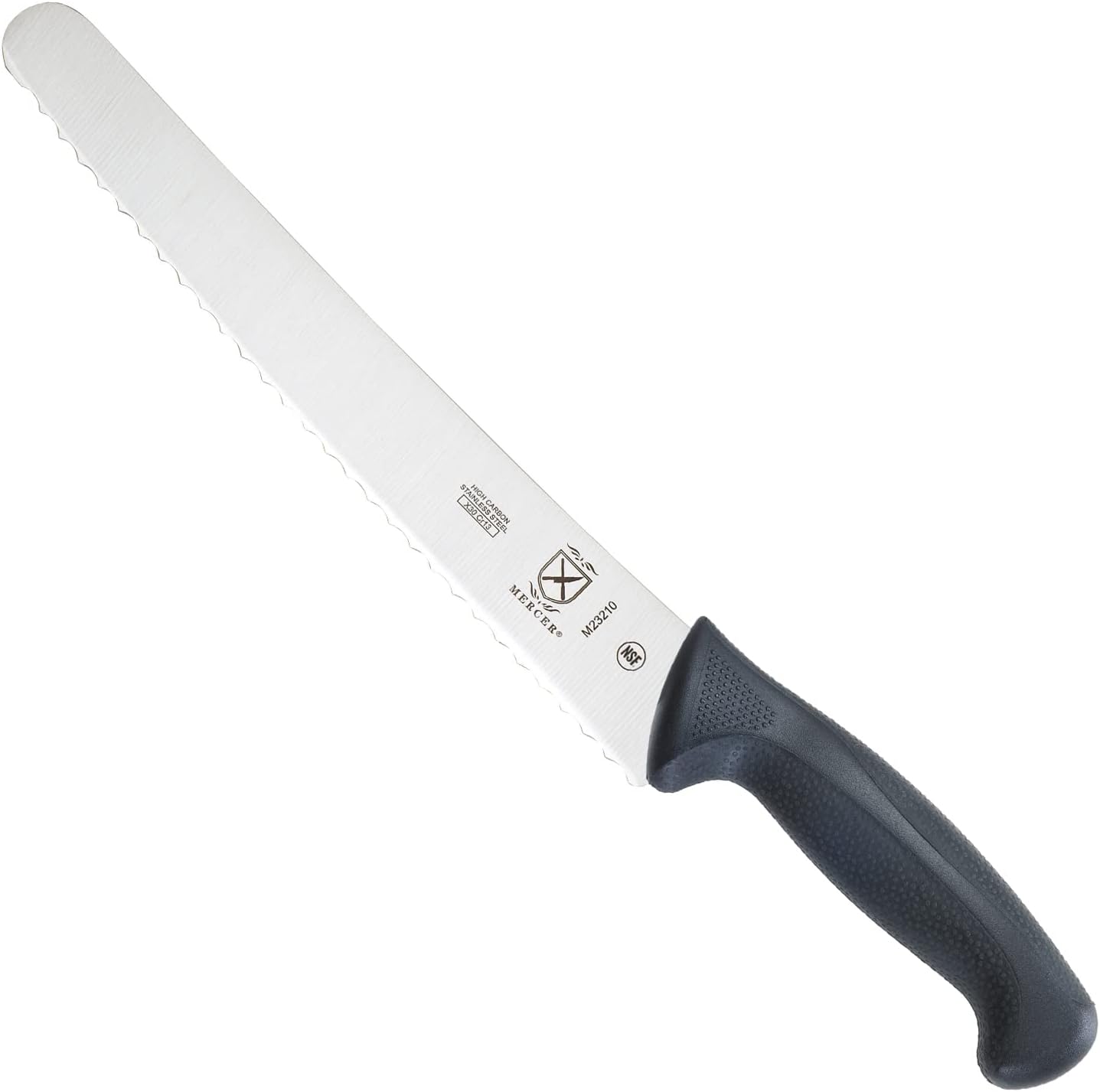
This is not just a bread knife; it is the ultimate roast slicer. The wide scallops (rather than sharp, jagged teeth) allow you to slice cleanly through soft, crusty artisan bread, delicate sponge cakes, or tender, bark-crusted smoked briskets without tearing or shredding the meat fibers.
The Narrow Fillet Knife (7-inch to 9-inch)
Go onto any commercial fishing boat or processing dock on the East Coast, and this is the knife you will find in every scabbard. The DexSteel offers the perfect amount of flex to glide over the rib bones of a flounder or halibut, leaving zero wasted meat behind.
The Heavy Duty Meat Cleaver
Dexter shines brightest when sheer destructive force is required. Their heavy cleavers are legendary for splitting pork spines and beef joints without the edge buckling. If you are confused about the distinct functional differences between a cleaver vs butcher knife, Dexter offers definitive, heavy-duty models of both that clarify the distinction through pure, unadulterated performance.
Dexter-Russell vs. The Commercial Competition
| Brand | Origin | Primary Market | Aesthetic | Price Tier |
|---|---|---|---|---|
| Dexter-Russell | USA | Commercial Kitchens, BBQ, Fishing | Utilitarian, Industrial | Budget / Affordable |
| Victorinox (Fibrox) | Switzerland | Culinary Schools, Commercial Prep | Utilitarian, Textured | Budget / Affordable |
| Mercer Culinary | Taiwan (Sourced) | Culinary Students, Budget Home | Modern / Traditional Clones | Budget |
| F. Dick | Germany | Commercial Butchers, Slaughterhouses | Industrial, High-Grip | Mid-Tier |
Dexter-Russell vs. Victorinox Fibrox
This is the ultimate, hotly debated showdown in the commercial category. The Victorinox Fibrox 8-inch chef knife has long been the darling of prominent food magazines and test kitchens.
- Steel Geometry: Victorinox blades are generally ground slightly thinner behind the edge, making them slightly better pure vegetable slicers. Dexter blades are ground slightly thicker, making them vastly superior workhorses for butchery and heavy root vegetables.
- Handle Feel: Victorinox Fibrox is highly textured but made of hard TPE. Dexter Sani-Safe is easier to wipe clean but feels more industrial. However, Dexter’s SofGrip offers objectively better traction when wet than the Fibrox.
- The Verdict: For pure, delicate vegetable chef work, Victorinox takes a very slight edge. For high-volume butchery, fishing, BBQ prep, and unyielding durability, Dexter wins outright.
Dexter-Russell vs. Mercer Culinary
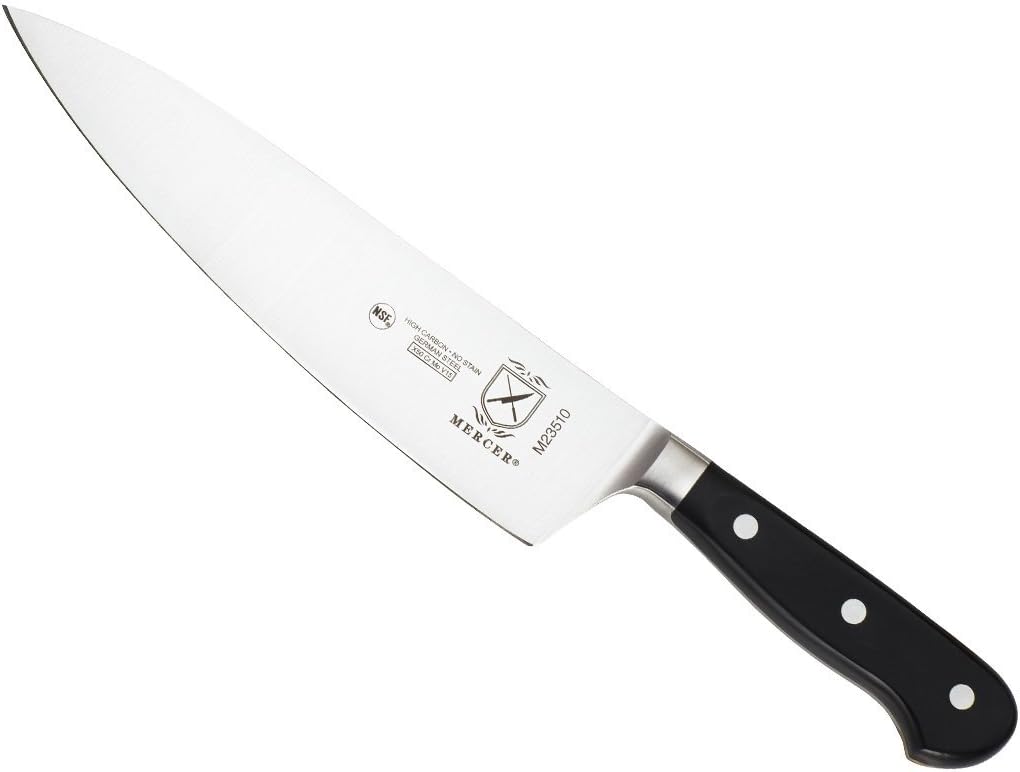
Mercer heavily dominates modern culinary school kits by offering forged options (like the Genesis and Renaissance lines) that successfully mimic the look and feel of high-end German knives at a fraction of the cost. See our Mercer vs Victorinox comparison for deep context.
- Design Goal: Mercer actively tries to look premium. Dexter-Russell stubbornly sticks to its stamped, industrial, function-over-form look.
- The Verdict: If you want a knife that looks highly professional and elegant in a home kitchen magnetic strip, choose Mercer. If you want a knife that could survive a nuclear winter in a restaurant dish-pit, choose Dexter.
Maintenance: Honing, Sharpening, and Storage
Because DexSteel is heat-treated to a softer 54-56 HRC, the microscopic cutting edge will roll to one side after heavy contact with a poly cutting board. Therefore, it responds incredibly well to frequent honing. You should be using a grooved steel honing rod before every single heavy prep session to realign those microscopic steel teeth.
When it comes time for actual material-removal sharpening, these knives are remarkably forgiving. They will not easily chip on whetstones. If you are entirely new to this vital skill, read our primer on sharpening stone vs honing steel. Furthermore, for bustling commercial kitchens processing hundreds of covers a night, utilizing one of the best knife electric sharpeners is a massive time-saver. Dexter knives can handle the aggressive, rapid material removal of electric diamond abrasives much better than thin, delicate Japanese VG-10 blades.
Safe Storage: Never throw these knives loosely into a crowded metal drawer. Even though they are exceptionally tough, the edges will still bang against other tools and dull instantly. Use a wall-mounted magnetic strip or a dedicated block. Are you worried about magnetic fields affecting the steel? Read: Are magnetic knife strips bad for knife edges?
Pros and Cons Summary
| The Pros | The Cons |
|---|---|
| ✔ Proudly Manufactured in the USA (Southbridge, MA). | ✘ Utilitarian, highly industrial aesthetic is not “pretty” for luxury kitchens. |
| ✔ Strict NSF Certification ensures flawless commercial sanitation. | ✘ Lightweight stamped blades lack the weighted balance of heavy forged knives. |
| ✔ Unbeatable handle grip (especially the SofGrip & V-Lo lines). | ✘ Edge retention is average; requires highly frequent steel honing. |
| ✔ Virtually indestructible construction designed for relentless abuse. | ✘ White Sani-Safe handles can permanently stain with heavy turmeric or curry use. |
| ✔ Highly affordable, allowing you to easily build a massive, specialized kit. | ✘ Lacks a thick metal bolster to protect fingers during rapid chopping. |
Expert Frequently Asked Questions
Yes, the vast majority of Dexter-Russell’s commercial product lines are proudly manufactured in their sprawling Southbridge, Massachusetts facility. They remain the largest manufacturer of professional cutlery in the United States, maintaining a 200-year legacy of domestic production.
The Sani-Safe and SofGrip lines are technically commercial-dishwasher safe because the handles are injection-molded directly to the blade, completely preventing water ingress or handle rot. However, we strongly advise against it for home users. The extreme high heat and harsh powder detergents can degrade the plastic over time, and the violent water jets can bang the delicate blade edge against plates and silverware, causing severe dulling. For more context on this, check out our piece on best dishwasher safe steak knives if you strictly require low-maintenance cutlery.
Dexter-Russell knives are factory-ground to an inclusive angle of approximately 40 degrees (20 degrees per side). This is the traditional Western cutting angle, chosen specifically because it creates a robust, durable edge that can chop through dense root vegetables and scrape against cutting boards without easily rolling or chipping.
It depends entirely on the specific culinary use case. Victorinox is generally preferred by test kitchens for general chef tasks (like dicing onions) due to its slightly thinner, flatter blade geometry. Dexter Russell, however, is universally preferred for meat butchery, fish filleting, and heavy-duty tasks due to superior handle grip mechanics and rugged durability. If you are looking for more alternatives, thoroughly check our review comparing Wusthof vs Victorinox.
Final Verdict: The Undisputed Workhorse
Dexter-Russell knives are absolutely not kitchen jewelry. You will not buy a white-handled Sani-Safe blade to impress your dinner guests, and you won’t meticulously polish it before placing it in a velvet display case. You buy a Dexter-Russell because you have 50 pounds of dense brisket to trim before the morning rush, or 20 freshly caught salmon to quickly fillet on a rocking boat, and you desperately need a reliable tool that will simply refuse to fail you.
They are the quintessential “tool for the job.” For serious home cooks and BBQ enthusiasts, we highly recommend adding a Dexter Sani-Safe Curved Boning Knife or a SofGrip Fillet Knife to your personal collection, even if your primary, everyday chef knife is a highly expensive, handcrafted Japanese blade. The sheer utility-to-price ratio they offer for specialized meat and fish processing tasks is simply unbeatable.
Our Final Purchasing Recommendations:
- Buy the Sani-Safe Series for general, high-volume kitchen prep and clinically unbeatable hygiene.
- Buy the SofGrip Series if you constantly work with wet, slippery hands (fishing, heavy butchery, BBQ prep).
- Buy the Traditional Series if you appreciate the developing patina of raw carbon steel and the classic warmth of natural wood handles.
Ready to equip your kitchen with true professional-grade tools?
Check Latest Prices on Amazon