Kiwi Knives Review: The Cult Favorite $5 Thai Blades Explored

Introduction: The Unlikely Icon of the Culinary World
In a deeply passionate culinary world where knife enthusiasts routinely drop hundreds—if not thousands—of dollars on hand-forged, high-carbon Japanese Damascus steel or heavily engineered, full-tang German cutlery, there exists a massive anomaly. It is a kitchen knife that routinely costs less than a fast-food lunch. It features a handle made of incredibly cheap, untreated wood. It usually arrives in a flimsy plastic blister pack rather than a velvet-lined mahogany box. Yet, if you look closely, you will find it hiding in the knife rolls of Michelin-starred executive chefs, on the prep tables of high-volume commercial kitchens, and in the drawers of seasoned home cooks across the globe.
We are talking, of course, about Kiwi Knives.
Originating from the bustling manufacturing hubs of Thailand, these ultra-lightweight, mass-produced stamped blades have mysteriously achieved a mythical cult status that entirely defies conventional economic logic. But the burning question remains: are they actually “good” knives, or are they just an ironic culinary novelty?
In this exhaustively comprehensive Kiwi knives review, we are going to brutally strip away the online hype. We will meticulously analyze the exact steel composition, the fascinating blade geometry, the long-term durability, and the real-world cutting performance to determine if these ultra-budget blades truly deserve a permanent spot in your kitchen arsenal alongside your expensive best chef knife brands.
If you are currently on the hunt for the absolute best budget chef knife on the market, stick around. You might be shocked to discover that the answer isn’t a heavy European forged blade, but rather a remarkably thin sheet of Thai stainless steel.
What Are Kiwi Knives? The Brand History and Philosophy
To understand the knife, you must understand the culture it was built for. Kiwi Brand (and its slightly more premium sibling, Kom-Kom) is manufactured in Bangkok, Thailand by Kiwi & Kom Kom Co., Ltd. For over 40 years, they have focused on producing highly affordable, hyper-functional cutlery designed specifically for the local Southeast Asian market. In this region, the culinary culture heavily emphasizes massive volumes of fresh vegetable preparation, intricate fruit carving, and incredibly fast, high-heat wok cooking.
Unlike traditional Western knives, which are fundamentally designed to be heavy “do-it-all” tools meant to smash through chicken bones, disjoint thick cuts of meat, and endure heavy rocking motions on a cutting board, Kiwi knives follow a vastly different engineering philosophy. They are incredibly thin, absurdly lightweight, and purposefully designed for slicing through herbs, dense root vegetables, and boneless proteins with laser-like precision and minimal wrist fatigue.
They are mass-produced using modern stamped technology. If you are unfamiliar with the functional manufacturing difference, it is highly crucial to understand the difference between stamped and forged knives. Generally speaking, a forged knife is thicker and inherently stronger, but a stamped knife allows for an incredibly thin, uniform profile—and that sheer, uncompromising thinness is the ultimate secret to Kiwi’s legendary cutting performance.
The Secret Sauce: Metallurgy and The “Splitting Effect”
When you buy a $5 to $10 knife, you cannot expect space-age super steels. Kiwi is notoriously quiet about their exact steel formulation, usually just labeling it “Japanese Stainless Steel.” However, metallurgical analysis and industry consensus point strongly to them using SUS420J2 (or 2Cr13) Japanese Martensitic stainless steel.
The Reality of Soft Steel (HRC 50-51)
In the knife enthusiast community, this steel is generally considered bottom-tier. It possesses a very low carbon content (around 0.2% to 0.3%), which results in a very soft blade. On the Rockwell Hardness Scale, Kiwi knives sit around 50 to 51 HRC. To put that in perspective, standard German kitchen knives (like Wüsthof) sit around 58 HRC, and high-end Japanese knives sit at 60-62+ HRC.
Normally, a 50 HRC knife would be a terrible purchase. It loses its razor edge incredibly fast. So why do people love them?
Geometry Overcomes Metallurgy: The Splitting Effect
The magic of the Kiwi knife lies entirely in its geometry. The blade stock is stamped from steel that is scarcely 1mm thick at the spine, and it tapers down to an almost microscopic edge.
When you cut a dense, hard vegetable like a large carrot, a sweet potato, or a butternut squash with a thick, premium forged German knife, the thick spine of the blade often acts like an axe wedge. It pushes the vegetable apart before the cutting edge actually finishes slicing it. This is known as the “splitting effect,” and it requires you to use more physical downward force, often resulting in a loud *crack* as the vegetable breaks.
Because the Kiwi knife is so ridiculously thin, it completely bypasses the splitting effect. It glides through hard cellular structures without displacing any material. Therefore, even when the soft steel edge begins to dull, the knife still feels incredibly sharp because the physical geometry of the blade creates virtually zero friction. It feels like an absolute cheat code in the kitchen.
Deep Dive: Deciphering the Most Popular Kiwi Models
Kiwi manufactures dozens of different blade shapes, sizes, and handles. However, a few specific model numbers have garnered a massive international following. Understanding their numeric system is key to buying the exact tool you need.
The “Bunka” / Nakiri Hybrids: Models #171 and #172
These are undeniably the flagship models—the shapes most people instantly associate with the brand. Visually, they look like a brilliant cross between a traditional Japanese vegetable cleaver (Nakiri) and a specialized chef’s knife, featuring a sharp, dropped point.
- Model No. 171: The smaller, more nimble version (featuring an approx. 6.5-inch blade).
- Model No. 172: The larger, heavier version (featuring an approx. 7.5-inch blade).
This specific blade profile is a masterpiece of utility. The incredibly flat belly allows it to function perfectly as a Nakiri knife, making it an absolute dream for rapid, up-and-down push-cutting of vegetables. Simultaneously, the sharp, aggressively dropped tip (resembling a “K-tip” or reverse tanto) allows for surgical precision work, like finely mincing garlic or delicately scoring shallots. It functions remarkably similarly to a traditional Japanese Bunka or Santoku.
The Western-Style Chef Knives: Model #21 and #22
If you prefer a traditional Western cutting motion, these models strongly resemble a standard European chef knife, but with a fraction of the weight.
- Model No. 21: An 8-inch chef knife featuring a significant curve (belly) towards the tip, allowing for the classic “rock-chopping” motion familiar to Western cooks processing massive piles of herbs.
- Model No. 22: A rectangular, slightly heavier variant often used for butchering and slicing larger cuts of boneless meat.
The Delicate Detailer: Model #503
The #503 is a small, 4-inch nimble paring/utility blade. Because the steel is so incredibly thin, it moves through the skin of apples, potatoes, and kiwis (ironically) with absolutely zero resistance. It is the perfect off-board detailing tool.
The Heavy Hitters: Models #813 and #810 (Cleavers)
These are Chinese-style vegetable and meat cleavers. They offer a much wider blade face, perfect for smashing garlic cloves and scooping up large mounds of chopped ingredients to transfer to a hot wok. If you are confused about their applications, check out our guide on the cleaver vs butcher knife.

Kiwi vs. Kom-Kom: The Ultimate Thai Knife Showdown
One of the most frequently asked questions in knife forums is regarding the difference between the “Kiwi” brand and the “Kom-Kom” brand. They often look identical, leading to massive consumer confusion. Here is the definitive clarification.
They are manufactured by the exact same parent company: Kiwi & Kom Kom Co., Ltd.
While Kiwi is engineered to be the ultimate budget-friendly, mass-market option for local street vendors and home cooks, Kom-Kom is marketed as their premium, export-quality, professional line. If you are looking at a Kiwi #171 and a Kom-Kom #171, here are the physical differences you are paying a few extra dollars for:
- Handle Material & Finishing: Kiwi uses very cheap, often rough, untreated softwoods for their handles. Kom-Kom utilizes significantly higher-quality hardwoods (sometimes exotic Desert Ironwood or durable hard plastics). The wood is sanded smoother and usually treated with oil or varnish from the factory.
- Hardware Construction: Kiwi knives often feature a partial “half-tang” secured with standard stamped rivets. Kom-Kom models frequently boast a longer tang (running 80% down the handle) secured with higher-quality, flush-mounted brass rivets, resulting in a sturdier, better-balanced feel.
- Blade Finishing: The stainless steel on Kom-Kom knives passes through additional polishing and finishing processes, resulting in slightly better edge retention and a more refined look out of the blister pack.
The Verdict on Kom-Kom
If you love the hyper-thin geometry of the Kiwi but absolutely hate the cheap, rough feeling of the wooden handle in your palm, spending an extra $5 to $10 to upgrade to the identical Kom-Kom version is a remarkably smart culinary investment.
Why Do Professional Chefs Obsess Over Them?
You might assume that a chef who owns a $400 handmade Japanese Gyuto would laugh at a $5 stamped blade. The reality is quite the opposite. In professional, high-volume commercial kitchens, Kiwi knives serve a very specific, highly respected purpose: They are the ultimate “Beater Knives.”
In a frantic restaurant kitchen, accidents happen constantly. Knives are dropped on hard tile floors, hastily thrown into industrial stainless steel dish pits, or “borrowed” by careless line cooks who use them to pry open tin cans. If a chef brings their expensive Japanese carbon steel knife to work, it is at constant risk of catastrophic chipping or outright theft.
Therefore, many chefs buy Kiwi knives by the dozen. As Chef Shaun Hurrell (Barrio Comida) noted to The Guardian: “They’re my go-to knives for daily prep – ultra-sharp, super-lightweight and with a very thin blade you can quickly put an edge on. You can pick them up for about £5.”
They are the perfect stress-free tool. If a Kiwi knife breaks, bends, gets deeply rusted, or goes missing, it is easily replaced for the cost of a cup of coffee. Furthermore, their extreme light weight drastically reduces wrist fatigue when a prep cook is tasked with finely brunoising fifty pounds of onions for a dinner service.
Performance Evaluation: The Good, The Bad, and The Bent
We acquired several Kiwi models (specifically the #171 Bunka and the #21 Chef Knife) and put them through a rigorous gauntlet of daily kitchen tasks to see where they excel and where they inevitably fail.
Vegetable Prep: God-Tier Performance
As mentioned earlier, because the blades are paper-thin, they move through vegetables effortlessly. Dicing onions, slicing delicate tomatoes without crushing the skin, and uniformly chopping celery is an absolute joy. They perform identically to knives that cost twenty times as much in this specific category.
Meats and Proteins: A Mixed Bag
For slicing boneless chicken breasts, trimming the fat cap off a steak, or portioning pork loin, the razor edge works beautifully. However, do not attempt any form of butchery. If you try to use a Kiwi knife to cleave through a chicken bone, separate frozen foods, or disjoint a turkey, the incredibly thin, soft steel will immediately fold, bend, or warp permanently. They have a highly noticeable “flex” to the blade when put under lateral stress.
Bread and Hard Crusts: A Warning
Do not use a standard fine-edge Kiwi to saw through a hard, crusty artisan sourdough loaf. The hard crust will rapidly roll the soft steel edge, rendering the knife dull in seconds. You still absolutely need a dedicated serrated blade for baking goods. (See our guide on the best bread knives).
Comparisons: Kiwi vs. The Global Cutlery Market
How does a $5 Thai knife realistically stack up against the established, legacy brands found in Western kitchens?
Kiwi vs. Victorinox Fibrox
The Victorinox Fibrox Pro is universally recognized as the gold standard for budget-friendly commercial kitchens and culinary schools.
- Steel Quality: Victorinox uses vastly superior, harder European stainless steel. It holds its edge significantly longer and resists rust much better.
- Durability: Victorinox is a tank. It can survive commercial dishwashers and mild bone-strikes. A Kiwi handle will rapidly rot in a dishwasher, and the blade will bend on a bone.
- Cutting Feel: Shockingly, the Kiwi is actually thinner and therefore cuts smoother through dense, soft veg.
- The Verdict: If you want one single knife to last a lifetime of abuse, buy the Victorinox. If you want a fun, laser-sharp vegetable slicer to supplement your kit, buy the Kiwi.
Kiwi vs. Mercer Culinary
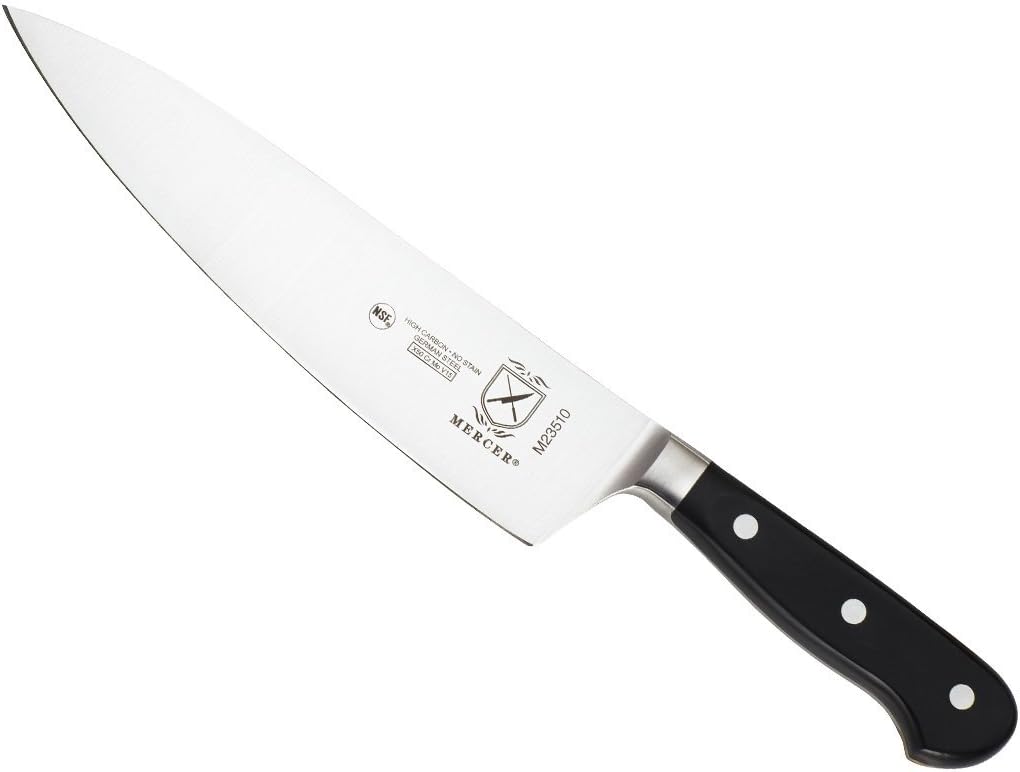
Mercer is the go-to brand for culinary student kits. (See our Mercer vs Victorinox deep dive).
- Mercer’s premium lines (like the Genesis and Renaissance) are fully forged, heavy, and feature substantial bolsters. They feel like traditional, “real” professional tools. A Kiwi knife, by comparison, feels almost like a flimsy toy—until you actually start cutting with it.
Kiwi vs. High-End Japanese Knives (Shun, Miyabi, Tojiro)
Comparing a Kiwi to a Shun is like comparing a reliable bicycle to a Ferrari. High-end Japanese kitchen knives use super-steels (like VG-10 or SG2) that hold a surgical edge for months. However, those expensive knives are brittle and prone to chipping if mishandled. A Kiwi knife acts as the perfect “training wheel” for a Japanese knife—it teaches you the push-cut technique and the feel of a thin blade without risking a $200 investment if you make a mistake.
Maintenance and Care: The Secret to Longevity
Because Kiwi knives are so astonishingly cheap, most consumers treat them as disposable tools. When they dull, they throw them in the trash. However, with just a tiny bit of love and education, a Kiwi knife can easily last for a decade.
1. Sharpening vs. Honing: The Magic of Soft Steel
Because the SUS420J2 steel is so soft, you rarely need to perform a full, aggressive sharpening session on a whetstone. As you use the knife, the microscopic edge doesn’t chip away; it simply folds over to one side.
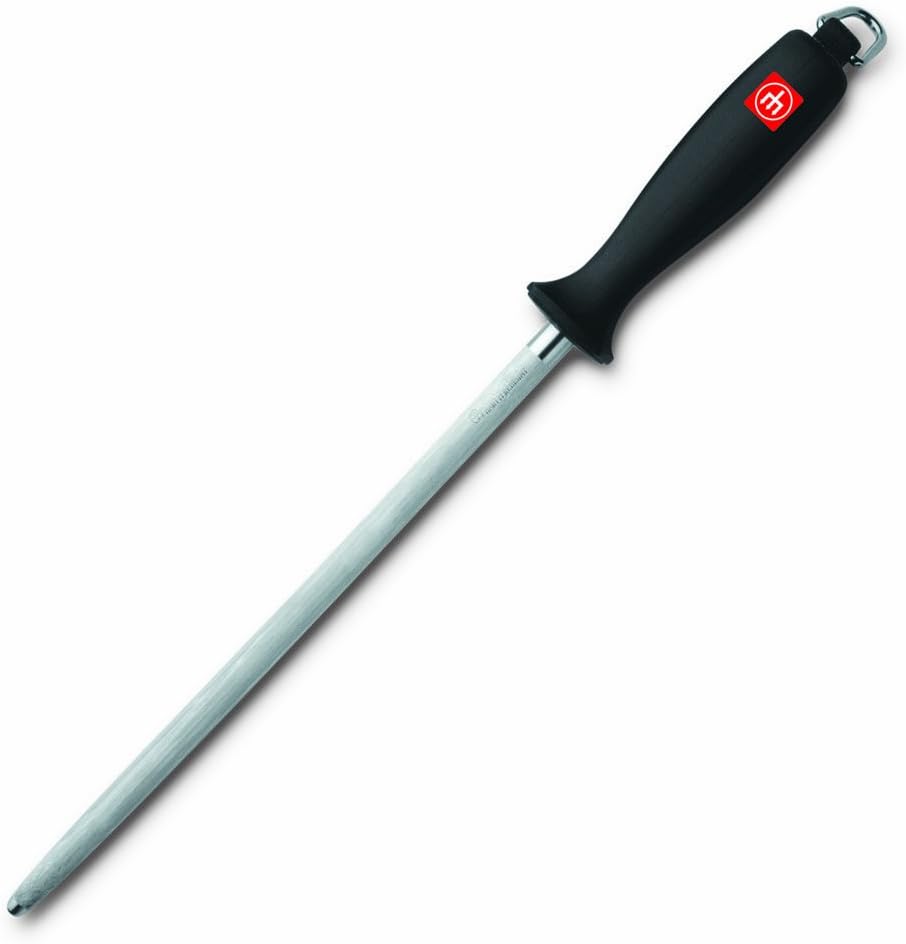
To bring the knife back to life, you simply need a honing rod. A few quick, alternating passes on a steel or ceramic honing rod will instantly force the rolled edge back into dead-center alignment, restoring its shaving sharpness in roughly five seconds. Read our comprehensive guide on sharpening stone vs honing steel to master this technique.
2. Rescuing the Wooden Handle
The biggest flaw of the standard Kiwi knife is the rough, untreated wooden handle. It will quickly absorb dishwater, raw meat juices, and odors, eventually cracking or splintering.
The DIY Fix: When you buy a Kiwi, take a piece of fine-grit sandpaper and lightly sand the handle to remove any rough splinters. Then, heavily coat the wood in food-safe mineral oil or natural beeswax. Let it soak in, then wipe off the excess. This waterproofs the wood, darkens the color beautifully, and makes the knife feel exponentially more premium in the hand.
3. Rust Prevention and Storage
While technically “stainless,” the cheap alloy will develop ugly brown rust spots if left sitting wet in a kitchen sink overnight. Always hand wash and towel dry your Kiwi knife immediately after use.
Never throw these knives loosely into a crowded utensil drawer; the delicate, thin edge will easily dent if it bangs against a metal spoon. Utilize a wooden block, or better yet, a wall-mounted magnetic strip. (If you are worried about magnets damaging your blades, read: are magnetic knife strips bad for knife edges?). If you have a tiny apartment, check out our creative ideas on how to store knives in a small kitchen.
Pros and Cons Summary
| The Pros (Why You Need One) | The Cons (The Dealbreakers) |
|---|---|
| ✅ Unbeatable Price-to-Performance: You can literally purchase an entire 5-piece set of Kiwis for the price of one fast-food dinner. | ❌ Soft Steel Edge Retention: It loses its razor-sharp bite very quickly during heavy prep sessions (but is easily honed). |
| ✅ Flawless Geometry: The extremely thin, 1mm stamped blades glide through dense root vegetables vastly better than thick, expensive forged knives. | ❌ Poor Handle Quality: The untreated, raw wooden handles can feel rough, splintery, and will absorb dirty water if not oiled by the user. |
| ✅ Featherweight Design: Causes virtually zero hand or wrist fatigue during marathon holiday prep sessions. | ❌ Brittle and Flexible: Absolutely cannot be used on hard bones, frozen foods, or dense crusty bread without bending or rolling the edge permanently. |
| ✅ Zero-Stress Maintenance: Takes literally seconds to bring the edge back to life on a cheap honing rod or the bottom of a coffee mug. | ❌ Rust Potential: While technically stainless, the lower-grade steel is highly susceptible to pitting and rust if left wet in a sink. |
| ✅ The Ultimate Beater/Guest Knife: The perfect knife to hand to a helpful houseguest without secretly panicking that they will ruin your expensive Japanese blade. | ❌ Fit and Finish: The rivets are often not flush with the wood, and the spine of the blade can have sharp corners that require filing down for comfort. |
Expert Frequently Asked Questions (FAQ)
Are Kiwi knives completely dishwasher safe?
Absolutely not. The standard handles are typically made of cheap, untreated wood which will rapidly swell, crack, and rot in the extreme high heat and aggressive moisture of a commercial or residential dishwasher cycle. Furthermore, the harsh powdered detergents will quickly pit and rust the cheap steel. Always wash by hand with warm soapy water and towel dry Kiwi knives immediately.
Where are Kiwi knives officially manufactured?
Kiwi knives (and their premium sister brand, Kom-Kom) are proudly manufactured in Bangkok, Thailand by Kiwi & Kom Kom Co., Ltd. They have been an absolute staple tool in Thai kitchens, bustling restaurants, and outdoor street food stalls for over 40 years before quietly becoming a global export phenomenon.
How do you properly sharpen and hone Kiwi knives?
Due to their remarkably soft Japanese martensitic stainless steel (HRC 50-51), Kiwi knives are exceptionally easy and forgiving to sharpen. A few quick passes on a standard steel or ceramic honing rod is usually enough to pull the rolled edge back into alignment. For a deeper sharpening to remove dull metal, a standard 1000 grit whetstone works perfectly. If you are entirely new to this process, highly recommend checking our detailed review of the best knife sharpeners for beginners.
What is the exact difference between Kiwi and Kom-Kom knives?
Both distinct brands are owned and manufactured by the exact same parent company in Thailand. Kom-Kom is deliberately positioned as the higher-end, professional export-quality line. They feature significantly higher quality finishing on the blade spine, longer and thicker steel tangs, and often utilize durable plastics or treated, riveted hardwoods for handles. Kiwi is the ultra-budget-friendly, mass-market option.
Final Verdict: Should You Buy Kiwi Knives?
In a modern culinary review landscape heavily dominated by discussions of $200 imported Japanese super-steels and heavily marketed, forged German heritage brands, Kiwi knives are a profound breath of fresh air. They serve as definitive proof that you absolutely do not need to spend a small fortune to acquire a kitchen tool that cuts beautifully and elevates your cooking experience.
You should absolutely buy a Kiwi Knife if:
- You desperately want a knife that flies effortlessly through dense root vegetables without wedging or cracking them.
- You are actively learning how to freehand sharpen on whetstones (they are the ultimate, consequence-free practice knives).
- You want a reliable backup “beater” knife that clumsy houseguests or roommates can use without you secretly panicking.
- You are on a strict, tight budget (like a college student) but utterly refuse to suffer through meal prep using dangerously dull supermarket knives.
You should skip them if:
- You need a heavy, robust knife for disjointing poultry, cutting through chicken bones, or halving massive frozen winter squashes (invest in a heavy meat cleaver instead).
- You absolutely hate the chore of honing your knife and demand a blade that stays razor-sharp for 6 months straight (you need to look at high-end Japanese knives made of SG2 or VG10 steel).
Ultimately, for the exact same price as a fancy, overly sweetened iced coffee, a Kiwi knife is arguably the single best value-for-money purchase you can possibly make for your culinary arsenal. They are humble, highly effective, easy to maintain, and undeniably, terrifyingly sharp.
Ready to experience the legendary, effortless slicing power of ultra-thin Thai steel?
Check Latest Price for the Essential Kiwi Set on Amazon