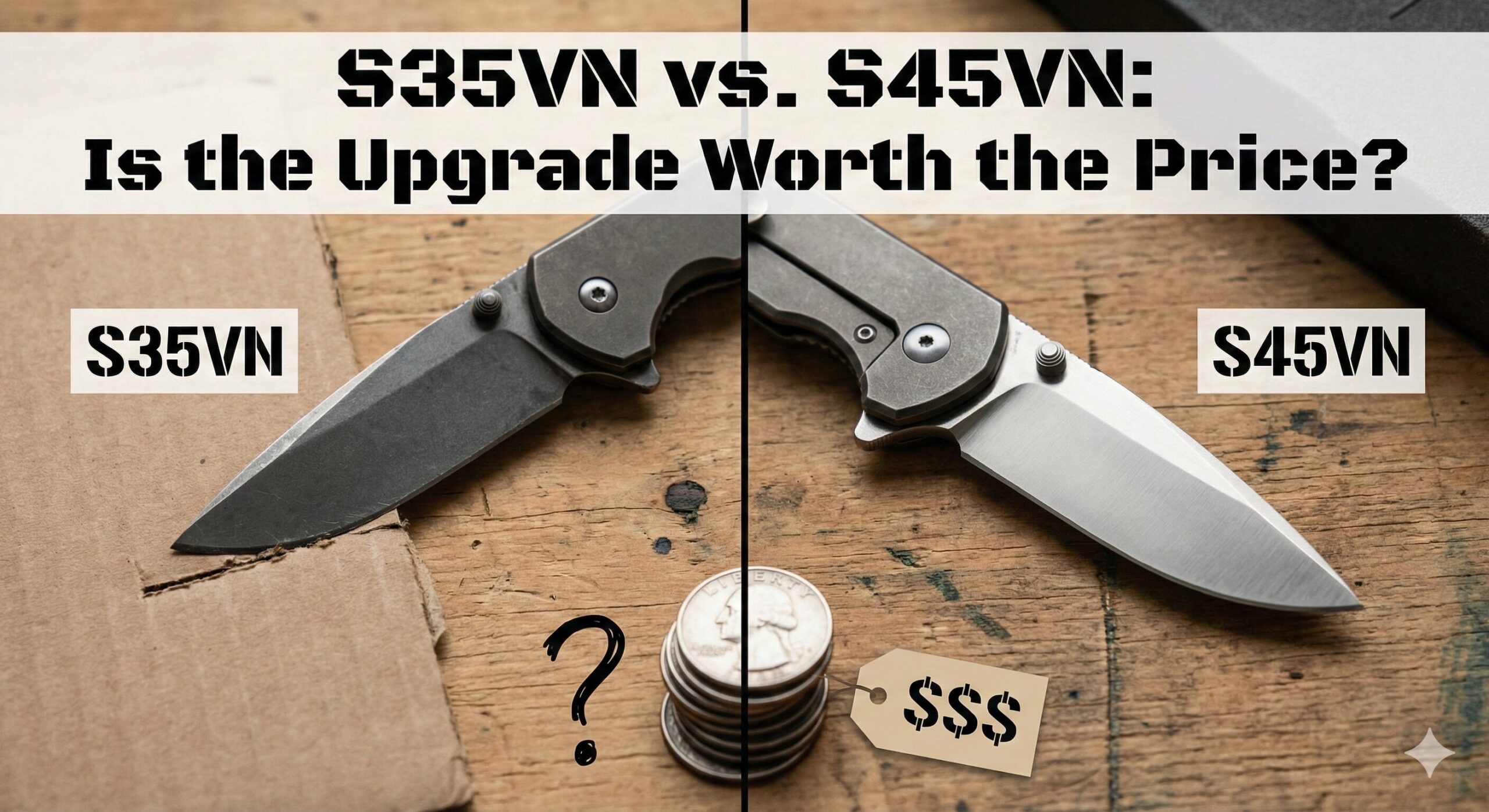
S35VN vs. S45VN: The Ultimate Evolution of EDC Knife Steel
The Legacy: From S30V to the Pursuit of Perfection
To truly understand the fierce debate between S35VN vs S45VN, you must first look backward at the family tree that birthed them both. In the early 2000s, the knife industry experienced a monumental paradigm shift. Crucible Industries, an American specialty steel manufacturer, collaborated intimately with legendary custom knifemaker Chris Reeve to develop CPM-S30V.
Before S30V, most knife makers were forced to borrow steels originally engineered for industrial ball bearings, aerospace turbines, or plastic injection molds (like 440C or D2). S30V was revolutionary because it was the very first premium powder metallurgy steel designed specifically, from the ground up, for cutlery. It offered edge retention and corrosion resistance that blew standard stainless steels out of the water.
However, S30V had a glaring flaw that frustrated users and professional sharpeners alike: it was notoriously prone to micro-chipping. If the edge struck a staple hidden in cardboard, or if a user twisted the blade while carving hard wood, microscopic chunks of the carbide-heavy steel would tear away, leaving a jagged edge that was incredibly tedious to grind out on whetstones.
What Exactly is the CPM Process?
Both of these steels carry the “CPM” prefix, which stands for Crucible Particle Metallurgy. Understanding this process is the key to understanding why these steels perform as “Super Steels.”
In traditional steelmaking (ingot steel), molten steel is poured into a mold and allowed to cool slowly. During this slow cooling process, carbon heavily binds with elements like chromium and vanadium, forming massive, clumpy, uneven structures called “carbides.” These large carbides make the steel brittle and hard to sharpen.
The CPM process solves this by taking the molten steel mixture and forcing it through a high-pressure gas nozzle, instantly atomizing it into a fine, microscopic powder. This powder is then gathered, placed into a sealed canister, and subjected to extreme heat and pressure (Hot Isostatic Pressing) to forge a solid billet of steel. This rapid cooling completely prevents large carbides from forming, resulting in an exceptionally uniform, fine-grained microstructure that massively boosts both toughness and edge stability.
What is CPM-S35VN? The Golden Child
Recognizing the micro-chipping complaints surrounding S30V, Chris Reeve returned to Crucible Industries in 2009 to formulate a definitive solution. The result was CPM-S35VN.
By slightly reducing the carbon and vanadium content, and critically introducing a small but vital amount of Niobium (Nb), Crucible successfully restructured the steel’s matrix. Niobium formed incredibly hard, fine carbides that significantly increased the toughness (impact resistance) of the steel without sacrificing the legendary edge retention of S30V. Furthermore, S35VN proved to be vastly easier for manufacturers to machine and significantly easier for end-users to sharpen at home without specialized diamond equipment.
For an entire decade, S35VN became the undisputed, universal gold standard for premium production knives. It sat squarely in the “Goldilocks Zone” of the cutlery steel triangle, offering a virtually flawless balance of Toughness, Edge Retention, and Corrosion Resistance. If you bought a high-end folder between 2010 and 2020, there is a massive probability it was forged from S35VN.
What is CPM-S45VN? The Refinement
Innovation never rests. In late 2019, exactly ten years after the release of S35VN, Crucible Industries announced its successor: CPM-S45VN. Crucible didn’t attempt to completely reinvent the wheel; instead, they sought to polish and perfect it.
Listening to feedback from knife makers who desired slightly better rust resistance and edge-holding capabilities without returning to the brittle nature of S30V, Crucible carefully tweaked the chemical recipe once again. They increased the Chromium content to boost corrosion resistance and crucially introduced a highly specific dose of Nitrogen into the alloy melt.
Essentially, S45VN was engineered to successfully bridge the narrow performance gap between the highly user-friendly, tough nature of S35VN and the extreme, marathon edge retention of ultra-premium steels like Böhler M390 and CPM-20CV.
Chemistry Breakdown: The Niobium & Nitrogen Tweak
To truly comprehend how these steels differ on the cutting board, we must look at them under the metallurgical microscope. The differences are incremental, but highly impactful in practice.
| Element | CPM-S35VN (%) | CPM-S45VN (%) | Metallurgical Effect |
|---|---|---|---|
| Carbon (C) | 1.40% | 1.48% | A slight increase in S45VN allows for higher peak hardness (HRC) and wear resistance. |
| Chromium (Cr) | 14.00% | 16.00% | The biggest change. This 2% boost significantly increases corrosion resistance. |
| Vanadium (V) | 3.00% | 3.00% | Identical. Forms ultra-hard vanadium carbides, dictating primary edge retention. |
| Niobium (Nb) | 0.50% | 0.50% | Identical. Prevents grain growth during heat treatment, maintaining high toughness. |
| Nitrogen (N) | 0.00% | 0.15% | The secret weapon. Nitrogen acts similarly to carbon (increasing hardness) but simultaneously boosts rust resistance by keeping chromium free in the steel matrix. |
Head-to-Head Performance: The Big Three Metrics
How do these chemical tweaks translate into tangible, real-world utility when you are breaking down cardboard or dressing game?
1. Edge Retention (Wear Resistance)
Edge retention dictates how long a knife will continue to cut cleanly through abrasive materials before requiring sharpening. In standardized CATRA (Cutlery & Allied Trades Research Association) testing—a machine that continuously cuts silica-impregnated cardstock—S45VN consistently outperforms S35VN.
Winner: S45VN (Slightly). Thanks to the extra Carbon and the strategic addition of Nitrogen, S45VN offers a roughly 5% to 10% improvement in sheer edge retention over S35VN. If you are an aggressive EDC user who cuts miles of heavy cardboard daily, you will notice the S45VN edge lasts slightly longer. For the casual user opening amazon packages, this difference is completely imperceptible.
2. Corrosion Resistance (Rust Prevention)
This is where Crucible specifically focused their engineering efforts. Both steels are highly classified as “stainless,” but they react differently to extreme environments like saltwater, fruit acids, and sweaty pockets.
Winner: S45VN (Definite). The massive jump from 14% to 16% Chromium, combined with the 0.15% Nitrogen, makes S45VN exceptionally resistant to environmental rust, pitting, and staining. In highly aggressive saltwater spray tests, S45VN consistently surpasses not only S35VN but frequently matches or beats the highly touted M390/20CV class of steels. If you live in a highly humid coastal environment or frequently forget to wipe your blade down after food prep, S45VN is an immense upgrade.
3. Toughness (Impact Resistance)
Toughness is a steel’s ability to absorb shock, lateral twisting, or hard impacts without suffering from catastrophic micro-chipping or snapping.
Winner: Tie (Leaning slightly to S35VN). In rigorous Charpy C-Notch impact testing, S35VN technically scores marginally higher in raw toughness. This is primarily because S45VN contains a slightly higher volume of hard carbides, which naturally increases brittleness. However, in practical, real-world EDC use, both steels are incredibly tough. Neither steel is prone to the frustrating micro-chipping that plagued the older S30V, provided you aren’t actively using your folding knife as a pry bar or a screwdriver.
The Critical Variable: Heat Treatment & HRC
It is impossible to discuss the performance of premium powder metallurgy steels without heavily emphasizing the role of heat treatment. A steel’s chemical recipe is effectively meaningless if the manufacturer botches the hardening process.
Historically, S35VN performs absolutely best when heat-treated to an optimal Rockwell Hardness (HRC) of 59 to 61. This provides the legendary balance of toughness and edge-holding it is known for. Because S45VN contains more carbon and nitrogen, it is designed to be run slightly harder, finding its absolute “sweet spot” at an HRC of 60 to 62.
Brand Matters: Companies renowned for their meticulous, cryogenic heat-treatment protocols—like Chris Reeve Knives, Spyderco, and Hogue—extract the absolute maximum potential out of these alloys. A perfectly heat-treated S35VN blade from Chris Reeve will almost certainly outperform a poorly executed, mass-produced S45VN blade run too soft (e.g., 58 HRC) to save on manufacturing belt wear.
Where Do They Stand Against MagnaCut and M390?
The cutlery landscape has shifted dramatically since S45VN was introduced in 2019, primarily due to the explosive arrival of CPM MagnaCut. How do the S-series steels fit into the current hierarchy?
- Vs. CPM MagnaCut: MagnaCut was specifically designed to offer the extreme toughness of non-stainless tool steels (like 4V) while providing total rust immunity. MagnaCut is objectively tougher and more corrosion-resistant than both S35VN and S45VN, while offering highly comparable edge retention. However, MagnaCut is currently in massive demand and often commands a significant price premium.
- Vs. Böhler M390 / CPM-20CV: The M390 class heavily prioritizes pure, unrelenting edge retention over toughness. M390 will comfortably out-cut both S35VN and S45VN in a marathon cardboard test. However, M390 is vastly more prone to micro-chipping under hard use and is a nightmare to sharpen for beginners. S35VN and S45VN are much more balanced, user-friendly “everyman” steels.

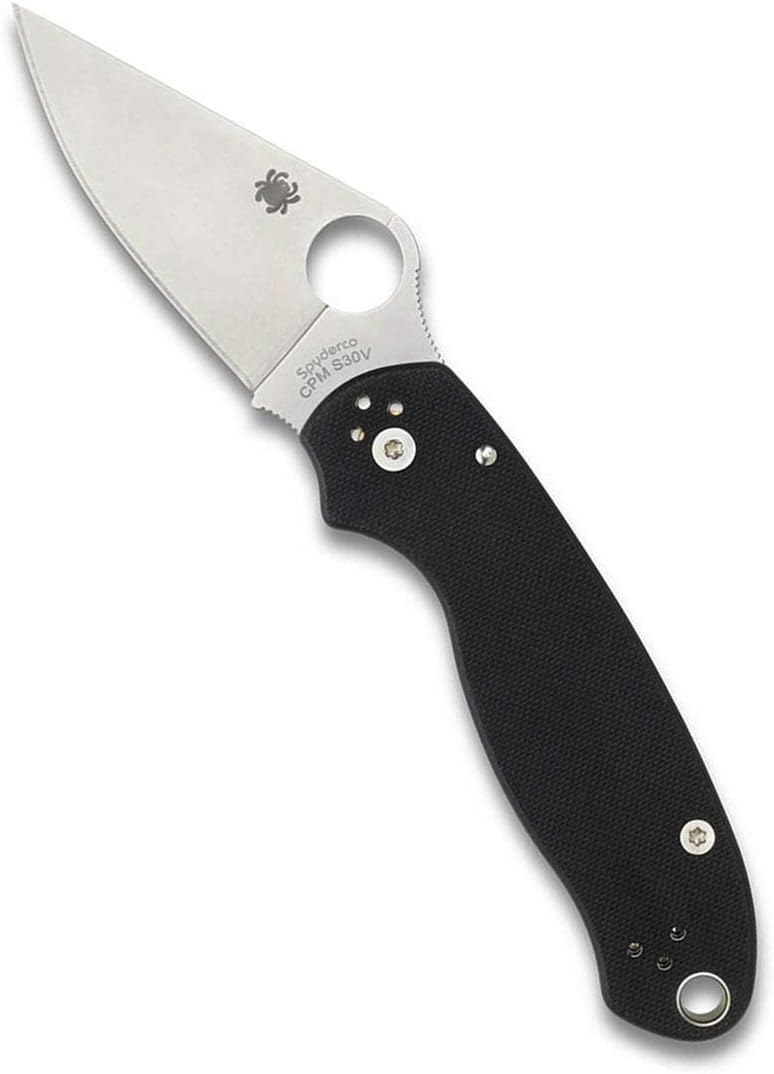
Spyderco aggressively leads the industry in steel adoption, having systematically updated their standard, flagship Golden, Colorado production models (like the legendary Paramilitary 2 and Para 3) directly from S30V to the superior S45VN. The Para 3, featuring the patented Compression Lock and flawless G10 ergonomics, is the absolute perfect, reliable platform to experience the balanced, high-performance nature of this modern steel.
Check Availability on AmazonSpecific Use Case Scenarios: Which is Right For You?
Let’s strip away the metallurgy and apply these steels to real-world tasks:
- The Heavy-Duty Hunter / Outdoorsman: You are field-dressing game, encountering bone and cartilage, and using your knife for hard camp chores. Winner: S35VN. The slight advantage in impact toughness makes it highly reliable when lateral stress is unavoidable.
- The Coastal Resident / Boater: You live in high humidity, work near saltwater, or frequently carry your knife inside a sweaty waistband while hiking. Winner: S45VN. The 16% chromium and nitrogen content will actively prevent the pitting and rust that might plague lesser steels.
- The Urban EDC / Office Worker: You primarily open packages, cut zip-ties, and break down cardboard boxes, valuing a knife that requires infrequent sharpening. Winner: S45VN. The slight bump in wear resistance will keep your edge slicing cleanly through abrasive tape and cardboard longer.
Final Verdict: Should You Actually Upgrade?
The Reality Check for Knife Enthusiasts
If you currently own an expensive, beloved knife forged in S35VN (such as a classic Chris Reeve Sebenza 21 or an older Spyderco PM2), do not sell it or upgrade purely to acquire S45VN. The performance gap between these two exceptional steels is strictly incremental and evolutionary, not revolutionary. Under standard daily use, 99% of users could not blindly tell the difference between them on a cutting board.
However, if you are actively in the market purchasing a brand-new premium knife today, and you are presented with the choice, you should choose S45VN over S35VN every single time. It undeniably offers superior, verifiable rust resistance and measurably better edge holding, with virtually zero noticeable downside in practical toughness or ease of maintenance.
Looking toward the future of the market, S45VN has firmly established itself as the new premium standard for high-end American production knives, while the older S35VN is gracefully transitioning into the “budget premium” category, frequently appearing on highly affordable, sub-$100 knives from overseas brands like Kizer, Civivi, and QSP, representing absolutely astonishing value for the modern consumer.
Expert Frequently Asked Questions (FAQ)
Objectively, no. CPM MagnaCut represents a massive generational leap in powder metallurgy. MagnaCut is vastly superior in both impact toughness and absolute corrosion resistance, while easily matching or slightly exceeding S45VN in edge retention. However, because MagnaCut is highly hyped and difficult to source, S45VN is often significantly cheaper and much more widely available on standard production knives, making it a highly practical alternative.
It is incredibly resistant to rust, but it is vital to remember that all steel can eventually corrode if severely neglected. S45VN is highly stainless and will easily shrug off sweat, ambient humidity, and standard food prep juices. However, if you use it to slice highly acidic foods (like lemons or limes) or expose it to corrosive saltwater and fail to rinse it off, it can develop surface pitting over time.
Chris Reeve Knives has always pursued the absolute optimal balance of performance for their users. They co-developed S35VN and championed it for a decade. They temporarily transitioned their Sebenza and Inkosi lines to S45VN to offer their customers enhanced edge retention and better corrosion resistance. Recently, they have moved almost entirely to MagnaCut, as it finally achieves the ultimate trifecta of toughness, edge holding, and rust immunity that they have sought for 30 years.
Absolutely not. S35VN remains one of the finest, most perfectly balanced, and highly reliable cutlery steels ever created. While it may no longer be the “flavor of the month” for $500 custom knives, its slight age has dramatically lowered its raw material cost. You can now find incredible, high-performance S35VN folding knives for under $100, representing arguably the greatest material value in the entire knife industry today.