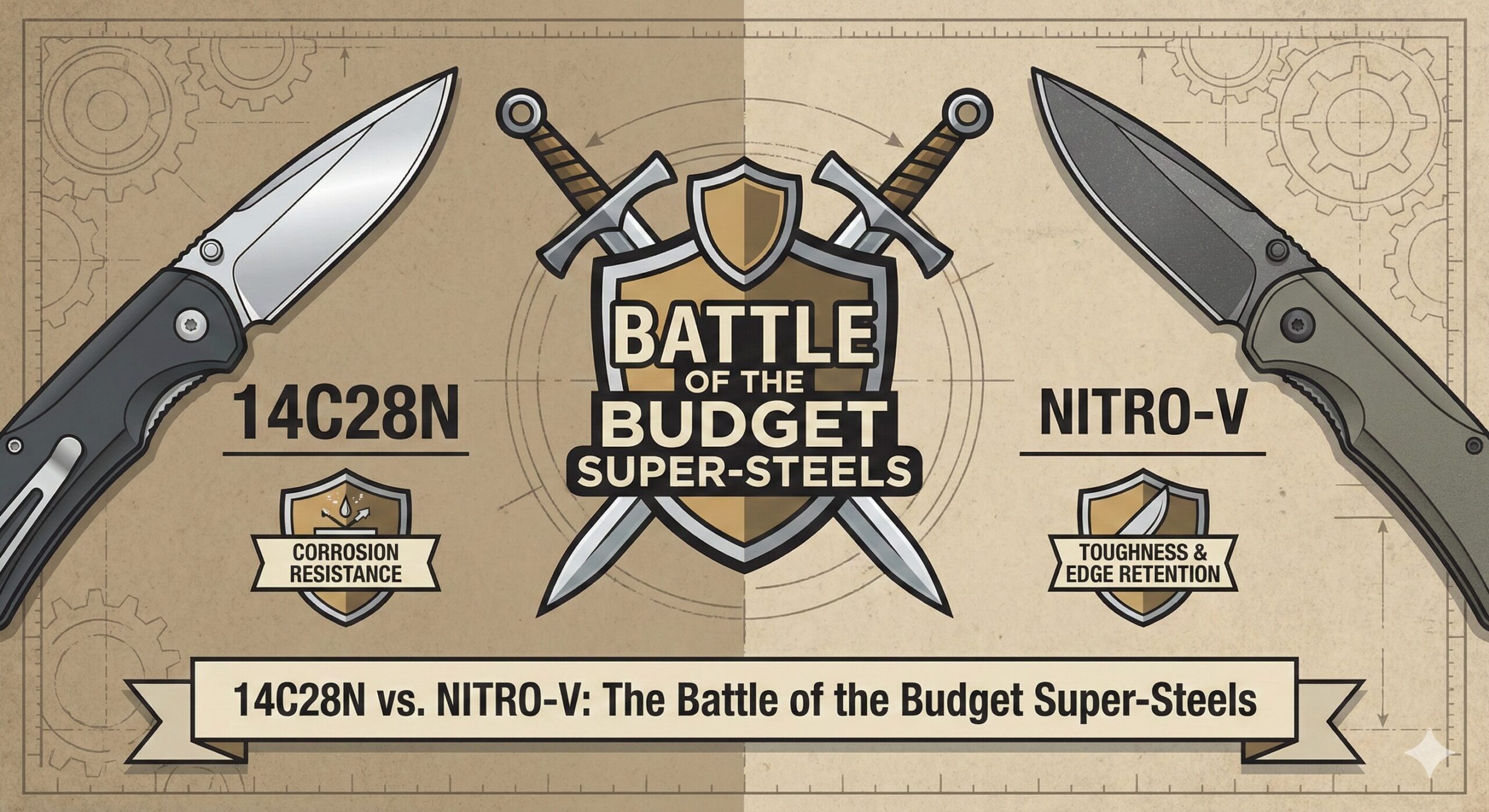
14C28N vs. Nitro-V: The Battle of the Budget Super-Steels
Introduction
In the world of knife steel, we often get distracted by premium “Super Steels” like MagnaCut, M390, or S90V that can easily push the cost of a folding knife past the $200 mark. But for 99% of users, the absolute best value lies in the “Budget Premium” category.
Two steels have completely taken over this segment over the last few years: Sandvik 14C28N and Nitro-V. By uniquely utilizing Nitrogen in their chemical matrix, these alloys manage to achieve incredible performance—high toughness, razor-sharp edge capabilities, and immense corrosion resistance—all at a price point that won’t make you afraid to actually use your knife.
If you are looking at modern knives from brands like Kershaw, Civivi, Kizer, or WE, you are almost certainly going to end up deciding between these two. While they share a nitrogen-enriched DNA, they are tailored for slightly different philosophies of use. This ultimate guide will break down exactly which one is superior for your specific needs.
The Evolution of the Budget Steel Market
To appreciate how good we have it with 14C28N and Nitro-V, we have to look back at what “budget steel” meant just a decade ago. For a long time, the affordable knife market was dominated by steels like 8Cr13MoV, AUS-8, and 440A/440C.
While these older steels were highly rust-resistant and easy to sharpen, they lacked fundamental edge retention and structure. If you cut down a few heavy cardboard boxes, your AUS-8 blade would quickly roll and dull. Knife enthusiasts demanded better performance without the “super steel” tax.
This gap in the market triggered a metallurgical arms race. Knife makers realized that by tweaking the chemical recipes of high-performing razor blade steels, they could create alloys perfect for everyday carry (EDC) without jacking up the price. Enter the Nitrogen Revolution.
The Contenders Explained
Sandvik 14C28N: The Swedish Tank
Developed by the massive materials science company Sandvik in Sweden, 14C28N actually came into existence because of a direct request from Kershaw Knives. Kershaw had been using Sandvik’s 13C26 steel but found it slightly lacking in corrosion resistance for everyday pocket carry.
Sandvik’s metallurgists went to work. By slightly decreasing the carbon and adding a precise dose of nitrogen, they created 14C28N. It maintained the legendary ultra-fine grain structure of Swedish steel but brought corrosion resistance to a level that rivals high-end marine knives. It quickly became the gold standard for budget EDC.
Nitro-V: The American Custom Favorite
Nitro-V has a different, more recent pedigree. It was developed by New Jersey Steel Baron (NJSB) in collaboration with Buderus Steel. They started with a base of AEB-L, a famous steel used in literal razor blades because of its ability to take a microscopic, laser-like edge.
NJSB tweaked the AEB-L formula by adding Nitrogen and Vanadium. The goal was to take that razor-blade sharpness and give it the backbone needed for tactical knives, hunting knives, and EDC folders. Today, it is heavily favored by custom makers and high-volume production companies like Civivi and WE Knife.
Metallurgy & Chemical Composition
The secret sauce in both of these alloys is Nitrogen (N). In traditional steel making, carbon dictates hardness, and chromium dictates rust resistance. But there is a flaw: high amounts of carbon and chromium bind together to form massive “chromium carbides.” While hard, these large carbides make the steel brittle and drain the chromium from the surrounding steel matrix, making it prone to rust.
Nitrogen acts as a “stand-in” for carbon. It allows the steel to achieve high hardness levels without forming those massive, brittle carbides. The result is a fine-grained, tough, and highly stainless steel.
| Element | 14C28N | Nitro-V | Effect on Performance |
|---|---|---|---|
| Carbon (C) | 0.62% | 0.68% | Increases hardness and wear resistance, but decreases toughness. |
| Chromium (Cr) | 14.0% | 13.0% | Provides corrosion resistance (“stainless” quality). |
| Nitrogen (N) | 0.11% | 0.11% | Refines grain structure, boosts hardness, increases rust resistance. |
| Vanadium (V) | – | 0.08% | Forms extremely hard vanadium carbides, increasing edge retention. |
| Manganese (Mn) | 0.60% | 0.65% | Improves grain structure and hardenability during heat treat. |
The Takeaway: The key difference is Nitro-V’s inclusion of Vanadium and slightly higher Carbon. This small amount of vanadium creates hard micro-carbides that give Nitro-V slightly more “bite” and wear resistance. 14C28N relies strictly on its ultra-pure, fine-grain structure.
The Critical Role of Heat Treatment (HRC)
You can have the best chemical composition in the world, but if the heat treatment is poor, the knife will perform terribly. Heat treatment dictates the final Rockwell Hardness (HRC) of the blade.
- 14C28N Sweet Spot (58-60 HRC): Sandvik designed this steel to be tough. Most manufacturers run it between 58 and 60 HRC. At this hardness, the steel is virtually unbreakable under normal EDC conditions, prioritizing toughness over long-term edge holding.
- Nitro-V Sweet Spot (59-62 HRC): Because of the added vanadium and carbon, Nitro-V can be pushed harder. Custom makers often run it at 61-62 HRC, often using cryogenic treatments. At this hardness, it holds a thin edge remarkably well, though it sacrifices a tiny bit of impact toughness.
Toughness: The Unbreakable Edge
Toughness is arguably the most important metric for a hard-use knife. It determines whether your blade will chip or snap when it hits a staple, drops on concrete, or is used to pry apart pieces of wood.
Winner: 14C28N. It is widely considered one of the toughest stainless steels on the market, period. In Charpy C-Notch impact tests, 14C28N behaves almost like a carbon spring steel. If you abuse it, the edge is more likely to safely “roll” rather than form jagged micro-chips. If you baton wood or process game, 14C28N is the safer bet.

The knife that put this steel on the map. Ken Onion design, assisted opening, and made in the USA. A tank of a knife that utilizes 14C28N’s extreme toughness perfectly for hard daily labor.
Check Price on AmazonEdge Retention & Wear Resistance
Edge retention measures how long a knife will continue to cut cleanly through abrasive materials like cardboard, rope, and dirty carpet. Neither of these steels are “edge holding monsters” like CPM-S90V or Maxamet. They are fine-grained steels meant for ultimate razor sharpness, not marathon endurance cutting.
Winner: Nitro-V (Slightly). Thanks to the vanadium carbides and the ability to run at a higher HRC, Nitro-V will outlast 14C28N in abrasive cutting tasks by roughly 10% to 15%. However, to the average user opening amazon packages and cutting apples, this difference is highly negligible.
Corrosion Resistance: Surviving the Elements
If you live in a humid climate, work near the ocean, or sweat profusely while carrying your knife inside your waistband, rust resistance is a top priority.
Winner: 14C28N. With a full 14% Chromium and nitrogen locking the matrix, 14C28N is incredibly stainless. It is routinely used in fishing knives and marine environments for a reason. You have to actively neglect this steel in salt water to make it rust.
Nitro-V is also very good—vastly superior to tool steels like D2 or M4—but with only 13% chromium, it can occasionally develop light surface patina or “pepper spots” if left wet with acidic juices (like lemon or tomato) or trapped against sweaty skin for days. A quick wipe-down prevents this completely.

The updated version of the world’s most popular budget knife now features Nitro-V steel. The fine grain allows for a super-thin blade geometry, resulting in unmatched slicing performance in a sleek, gentlemanly profile.
Check Price on AmazonHead-to-Head: How Do They Compare to the Competition?
To truly understand their value, we must see how 14C28N and Nitro-V stack up against other steels commonly found in the $50 to $100 price bracket.
vs. D2 Tool Steel
D2 has been the king of the budget knife world for years. Verdict: Nitrogen Steels Win. While D2 will hold an edge significantly longer than both 14C28N and Nitro-V, it is semi-stainless (it rusts easily), it is brittle (prone to chipping), and it is famously annoying to sharpen. For EDC, 14C28N and Nitro-V offer a much better balance of traits.
vs. VG-10
VG-10 is the standard high-end Japanese kitchen knife steel, also used heavily by Spyderco. Verdict: Tie. VG-10 has slightly better edge retention than 14C28N, but it is notoriously prone to micro-chipping. Nitro-V and 14C28N are substantially tougher and easier to maintain, making them better for hard-use pocket knives, while VG-10 excels in the kitchen.
vs. CPM-S30V
S30V was the original powder metallurgy “super steel.” Verdict: Different Classes. S30V costs more, holds an edge much longer, but is more brittle and harder to sharpen. If you hate sharpening and want to cut for months, save up for S30V. If you want a tough blade you can beat on and touch up easily, stick with Nitro-V or 14C28N.
Best Use Cases for Each Steel
The Bushcrafter & Hard Worker
If you are heading into the woods, building campfires, cutting heavy zip-ties, or using your knife in dirty, gritty environments, 14C28N is the champion. Its ability to absorb shock without chipping and its near-immunity to environmental rust makes it an elite outdoor steel, popularized by brands like Mora and Ruike.
The Culinary Slicer & Urban EDC
If your daily routine involves slicing fruit, opening letters, breaking down cardboard boxes, or you simply appreciate a knife that can take a hair-splitting mirror edge, Nitro-V is the way to go. Its ability to support razor-thin edge geometry at a higher hardness makes it cut like a much more expensive knife. It is no surprise that many high-end custom chef knives are being forged in Nitro-V today.
Final Verdict: Which is Better?
Ultimately, there is no loser here. The knife community widely agrees that both 14C28N and Nitro-V represent the absolute pinnacle of “budget” knife materials today. The choice comes down to your personal philosophy of use.
Choose Sandvik 14C28N If:
- You prioritize Extreme Toughness above all else.
- You work in wet environments, on boats, or around food prep.
- You prefer easier sharpening and love a steel that takes a fast strop.
- You need a hard-use “beater” knife that won’t fail you. (See the Kershaw Blur).
Choose Nitro-V If:
- You want slightly better Edge Retention for repetitive daily cutting.
- You prefer modern, slicey folder designs common with Civivi and WE Knives.
- You want a steel that feels like a “custom” AEB-L upgrade with a crisp, hard edge.
- You don’t mind occasionally wiping the blade down to prevent moisture buildup.
Expert FAQs
No. Nitro-V is considered a high-performance “mid-range” steel. It excels in toughness, grain structure, and sharpenability, but it lacks the high volume of hard vanadium/tungsten carbides required for the extreme edge retention seen in true super steels like M390, MagnaCut, or S90V.
For most EDC users, yes. D2 holds an edge longer, but it is not truly stainless and is quite brittle. 14C28N is incredibly tough, highly stainless, and much easier to sharpen. For an outdoor, survival, or hard-use pocket knife, 14C28N is vastly superior to D2.
It is very difficult to rust 14C28N under normal circumstances. Thanks to its high 14% chromium and 0.11% nitrogen content, it forms a highly passive oxide layer. While no steel is 100% rust-proof (unless it is a non-magnetic alloy like LC200N), you would have to severely neglect 14C28N—such as leaving it covered in saltwater or blood for days—to see pitting.
Yes, you can use diamond stones, and they will cut these steels extremely fast. However, because neither steel possesses ultra-hard carbides in large quantities, standard aluminum oxide or ceramic whetstones will also sharpen them with ease. Diamond is not strictly required like it is for S110V or Maxamet.
Custom knife makers love Nitro-V because it was designed with them in mind. It is relatively easy to stamp, grind, and finish before heat treatment. More importantly, its precise chemical makeup means makers who have good heat-treating ovens can easily tune it to exact specifications (e.g., locking it in at a perfect 62 HRC with cryo treatment) yielding incredibly consistent and impressive results.