VG10 vs. AUS10: The Ultimate Battle for the Heart of Japanese Steel
Introduction: The Changing of the Guard?
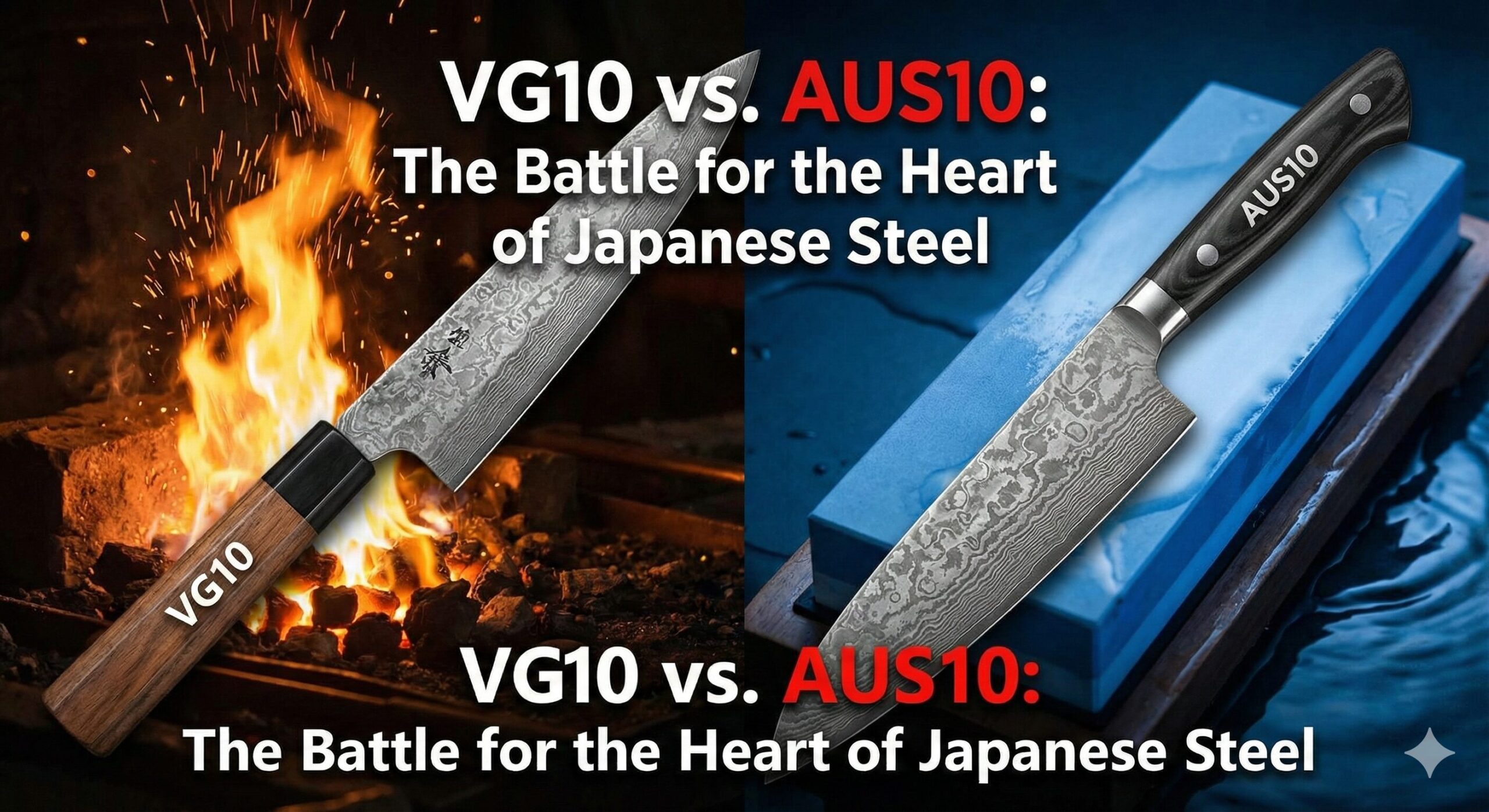
In the vast, meticulous world of premium Japanese cutlery, two specific alphanumeric codes completely dominate the mid-to-high-end consumer market: VG10 and AUS10. Whether you are actively shopping for a beautifully crafted Gyuto chef’s knife for your kitchen block or a high-performance, everyday carry (EDC) folding pocket knife, you will inevitably face this distinct metallurgical crossroads.
For several decades, VG10 was the absolute, undisputed “Gold Standard” of Asian export steel. It quite literally defined what a modern, premium Japanese knife should look, feel, and cut like for Western audiences. However, over the last few years, AUS10 has rapidly emerged as a formidable, highly respected rival. It promises to deliver incredibly similar hardness levels and edge geometries, but with a structural matrix that offers potentially superior impact toughness and a more forgiving price tag.
Is the reigning king officially dead, or does the secret “Cobalt” formula of VG10 still reign supreme? In this exhaustive, highly technical review, we will brutally strip away the marketing romance and dive directly into the microscopic carbide structures to find out.
If you are looking for a broader, high-level perspective on how these specific steels fit into the overall culinary hierarchy before diving into the chemistry, we highly recommend checking out our comprehensive guide to the best Japanese kitchen knives currently on the market.
The Contenders: History of the Forges
You cannot fully understand a steel without understanding the distinct corporate philosophy and industrial history of the foundry that pours it.
VG10 (V-Gold 10): The Artisanal Benchmark
VG10 is meticulously manufactured exclusively by Takefu Special Steel Co., Ltd., located in the Fukui Prefecture of Japan (an area historically famous for the Takefu Knife Village, a cooperative of master blacksmiths). The “G” literally stands for “Gold,” a nod to its premium status.
VG10 is universally famous for its unique addition of Cobalt, which massively strengthens the steel matrix. Because it is highly sought after and somewhat expensive to produce, it is almost entirely utilized in high-end culinary tools. It is the exact steel that built the global reputation of brands like Spyderco (specifically their Seki City produced lines) and the highly popular Shun Cutlery empire.
AUS10 (Aichi Steel): The Industrial Powerhouse
AUS10 is proudly produced by Aichi Steel Corporation, an absolutely massive, high-tech industrial conglomerate headquartered in Tokai, Japan (notably, a core company of the Toyota Group). AUS10 represents the absolute top-tier pinnacle of their highly successful “AUS” series (which includes the budget-friendly AUS-6 and the ubiquitous AUS-8).
It was specifically and aggressively engineered to compete directly head-to-head with VG10. While heavily utilized in newer Japanese kitchen knife brands, its slightly tougher nature makes it exceptionally popular in the hard-use outdoor and tactical folding knife market, most notably favored by companies like Cold Steel.
Chemical Composition: Cobalt vs. Vanadium Matrices
The true difference between these two metals lies entirely in their proprietary additives. Both are officially classified as high-carbon stainless steels, but they achieve their final performance metrics through fundamentally different chemical pathways.
| Element | Takefu VG10 | Aichi AUS10 | The Metallurgical Effect |
|---|---|---|---|
| Carbon (C) | 0.95 – 1.05% | 0.95 – 1.10% | Dictates overall potential hardness (HRC) and primary edge-holding ability. AUS10 peaks slightly higher here. |
| Chromium (Cr) | 14.5 – 15.5% | 13.0 – 14.5% | Provides critical corrosion and rust resistance. VG10 has a noticeable advantage. |
| Cobalt (Co) | 1.30 – 1.50% | 0.00% | The VG10 Secret: Cobalt bonds the matrix together, allowing quenching at higher temperatures without grain growth, enhancing structural rigidity. |
| Molybdenum (Mo) | 0.90 – 1.20% | 0.10 – 0.31% | Increases strength at high temperatures and drastically improves machinability. |
| Vanadium (V) | 0.10 – 0.30% | 0.10 – 0.27% | Forms microscopic, ultra-hard vanadium carbides that provide wear resistance and refine grain structure. |
| Nickel (Ni) / Manganese (Mn) | Trace | 0.49% (Ni) / 0.50% (Mn) | The AUS10 Secret: These additions drastically increase the steel’s toughness and impact resistance, compensating for the lack of Cobalt. |
The Core Takeaway: VG10 relies heavily on an expensive dose of Cobalt to rigidly strengthen the steel matrix, allowing for extremely high hardness without crumbling. AUS10 entirely lacks Cobalt, but compensates by slightly bumping the Carbon content and utilizing Nickel and Manganese to achieve similar hardness with greater ductility (toughness).
Heat Treatment & The HRC Scale
A steel’s raw chemical recipe is meaningless without a masterful heat treatment. Both VG10 and AUS10 are typically quenched and tempered to reach an optimal Rockwell Hardness (HRC) of 59 to 61.
This is significantly harder than standard Western kitchen steels (like German X50CrMoV15, which sits at 56-58 HRC). This elevated 60+ HRC is precisely what allows Japanese blacksmiths to grind these blades down to a terrifyingly acute 9 to 12-degree angle per side. A softer German steel ground that thin would instantly roll or fold over like tin foil upon contacting a cutting board.
Premium manufacturers of both steels will often utilize Cryogenic Quenching (submerging the heated steel into liquid nitrogen). This deep-freeze process flawlessly completes the transformation of austenite into martensite, squeezing every last drop of performance and edge stability out of the alloy.
Construction Methods: San Mai vs. Mono-Steel
How the knife is physically built heavily dictates which steel a manufacturer will choose.
Because VG10 is relatively brittle at 61 HRC, it is almost exclusively utilized in a San Mai (Laminated) construction in the culinary world. This means a thin, ultra-hard core of VG10 is physically sandwiched between outer layers of much softer, highly stain-resistant steel (like 420J2) or gorgeous, folded Damascus steel. The soft outer jacket protects the brittle VG10 core from snapping under lateral stress. If you see a stunning Damascus kitchen knife under $200, it almost certainly features a VG10 core.
AUS10, due to its slightly superior toughness and impact resistance (thanks to the Nickel), is frequently trusted to be utilized as a Mono-steel (a solid, single piece of steel). This makes it incredibly popular for folding pocket knives and heavy-duty EDC gear where lamination is too expensive or structurally impractical.
Edge Retention: The Marathon Slicers
Edge retention dictates how long a knife will continue to cut cleanly through abrasive materials before requiring sharpening.
Winner: Statistical Tie (Slight Edge to VG10). In rigorous, machine-controlled CATRA (Cutlery & Allied Trades Research Association) testing—where the blade repeatedly cuts through silica-impregnated cardstock—the difference is virtually negligible. Both will easily hold a highly functional working edge for months of standard kitchen use. However, experienced chefs often report that VG10 has a unique characteristic: it tends to hold a slightly “toothy” or “micro-serrated” edge as it wears, making it feel aggressively sharper for longer when slicing through tough tomato skins or raw meat.

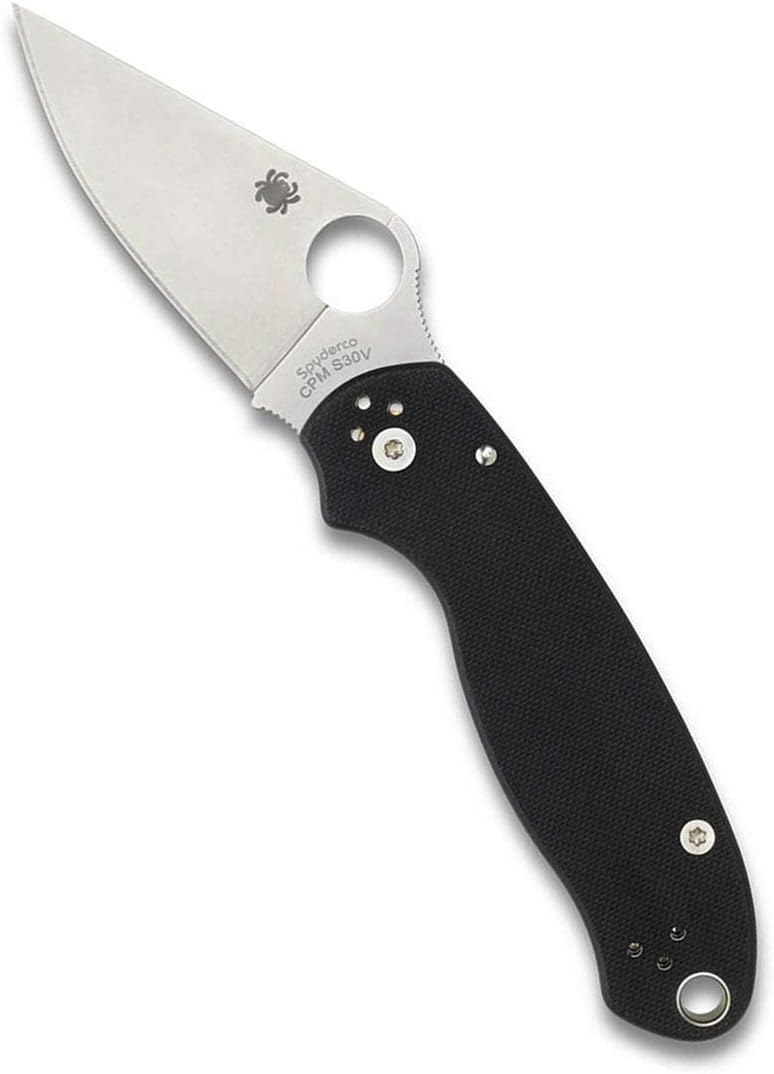
This is the exact knife that arguably defined the modern lightweight EDC genre. Manufactured flawlessly in Seki City, Japan, this VG10 blade offers the absolute perfect balance of aggressive, full-flat-grind slicing geometry and high corrosion resistance. It is a mandatory staple for any serious collector.
Check Availability on AmazonToughness and The Chipping Controversy
In metallurgy, “Toughness” specifically measures a steel’s ability to absorb shock, impact, or lateral twisting without catastrophically chipping, cracking, or breaking.
The VG10 Controversy: Over the years, VG10 has developed a somewhat unfair reputation on internet forums for being “chippy.” If you accidentally strike a chicken bone, violently twist the blade while cutting a dense winter squash, or use a glass cutting board, a thin VG10 edge will micro-chip (leaving tiny jagged divots in the blade). However, this is largely user error; consumers often treat laser-thin Japanese knives like heavy German cleavers. VG10 is a scalpel, not an axe.
Winner: AUS10 (Noticeably Tougher). Thanks to the presence of Nickel and a distinct lack of the highly rigid Cobalt matrix, AUS10 is measurably tougher. When subjected to severe abuse, AUS10 is slightly more prone to safely “rolling” or flattening its edge rather than shattering. Because AUS10 is often deployed in harder-use knives, it tends to survive accidental impacts significantly better than delicate VG10 slicers.
Corrosion Resistance: Surviving the Elements
Both VG10 and AUS10 easily meet the 13% Chromium threshold required to be officially classified as “Stainless Steel.”
Winner: VG10. With a massive 15% Chromium content, VG10 is highly resistant to environmental rust and staining. It is excellent for sweaty pockets, humid coastal environments, or cutting highly acidic foods (like lemons or onions) in a commercial kitchen. AUS10, hovering around 13-14% Chromium with higher Carbon, is slightly more reactive. If you leave an AUS10 blade wet in the sink overnight, it is more likely to develop a dark patina or minor pepper spots. Both, however, are vastly easier to maintain than true carbon steels like 1095 or Shirogami.

Absolute proof that Japanese stainless steel can be relentlessly tough. Designed by Andrew Demko, the AD-10 utilizes a massive, thick slab of AUS10A steel paired with the legendary Tri-Ad lock to create a folding pocket knife that genuinely rivals heavy fixed blades in pure, unadulterated structural strength.
Check Availability on AmazonThe Broader Market: Vs. Other Popular Steels
To fully contextualize these two Japanese titans, here is how they stack up against the broader global market of budget and mid-range steels:
- Vs. 14C28N (Sandvik): A Swedish steel that is significantly tougher (impact resistant) than both VG10 and AUS10, but possesses slightly lower edge retention. 14C28N is the reigning king of budget EDC folders.
- Vs. D2 Tool Steel: D2 holds a working edge slightly longer than both, but D2 is only semi-stainless and will rust easily. It is also a nightmare to sharpen compared to the Japanese steels.
- Vs. CPM-S30V / S35VN: These American powder-metallurgy steels are a distinct tier above VG10 and AUS10. They offer vastly superior edge retention and toughness, but at a significantly higher retail price point.
Final Verdict: Which Steel Should You Buy?
Choose Takefu VG10 If:
- You are specifically purchasing Kitchen Cutlery (Chef Knives, Santokus, Nakiris). VG10 remains the undisputed king of the kitchen, taking a scalpel-like edge for delicate food prep.
- You highly value superior corrosion resistance in humid environments.
- You desire the breathtaking aesthetic of layered Damascus cladding (San Mai construction), which is almost exclusively paired with a VG10 core.
- You want to own a piece of proven, legendary metallurgical history from Seki City.
Choose Aichi AUS10 If:
- You are purchasing a hard-use EDC (Everyday Carry) or Outdoor Pocket Knife. The slightly superior toughness makes it far more forgiving of accidental impacts, dropping, or light prying.
- You want elite, high-end cutting performance but are operating on a strict budget (AUS10 is frequently significantly cheaper than VG10).
- You prefer the sleek, utilitarian look and structural rigidity of thick, Mono-steel blades.
Expert Frequently Asked Questions (FAQ)
They are extremely close in overall performance, making a definitive “better” highly subjective. Generally speaking, AUS10 is considered slightly tougher and therefore vastly better suited for folding EDC knives and outdoor tools. VG10 possesses slightly better corrosion resistance, higher rigidity, and is universally preferred for high-end, dedicated kitchen cutlery.
VG10 is highly classified as a stainless steel due to its massive 15% chromium content, making it highly resistant to rust under normal conditions. However, in the knife world, “stain-less” does not mean “stain-proof.” If you use a VG10 knife to cut highly acidic foods (like lemons, tomatoes, or onions) and leave it wet in the sink overnight, it can absolutely develop surface rust or dark patina spots. Always hand-wash and towel-dry immediately.
The “A” simply stands for “Annealed.” It is a highly specific metallurgical term referring solely to the softened state the raw steel was in when it was shipped from Aichi Steel to the knife manufacturer (making it easier to stamp or machine). Once the knife manufacturer grinds the blade and puts it through the final, extreme heat-treatment process, there is effectively zero functional or chemical difference between a knife labeled AUS10 and one labeled AUS10A.
Fifteen years ago, VG10 was absolutely considered a premium super steel. Today, with the advent of advanced powder metallurgy steels like M390, S90V, and MagnaCut, VG10 is more accurately classified as an “Upper Mid-Tier” or “Premium Entry-Level” steel. It offers phenomenal, professional-grade performance for the price, but it no longer holds the crown for maximum absolute edge retention in the industry.