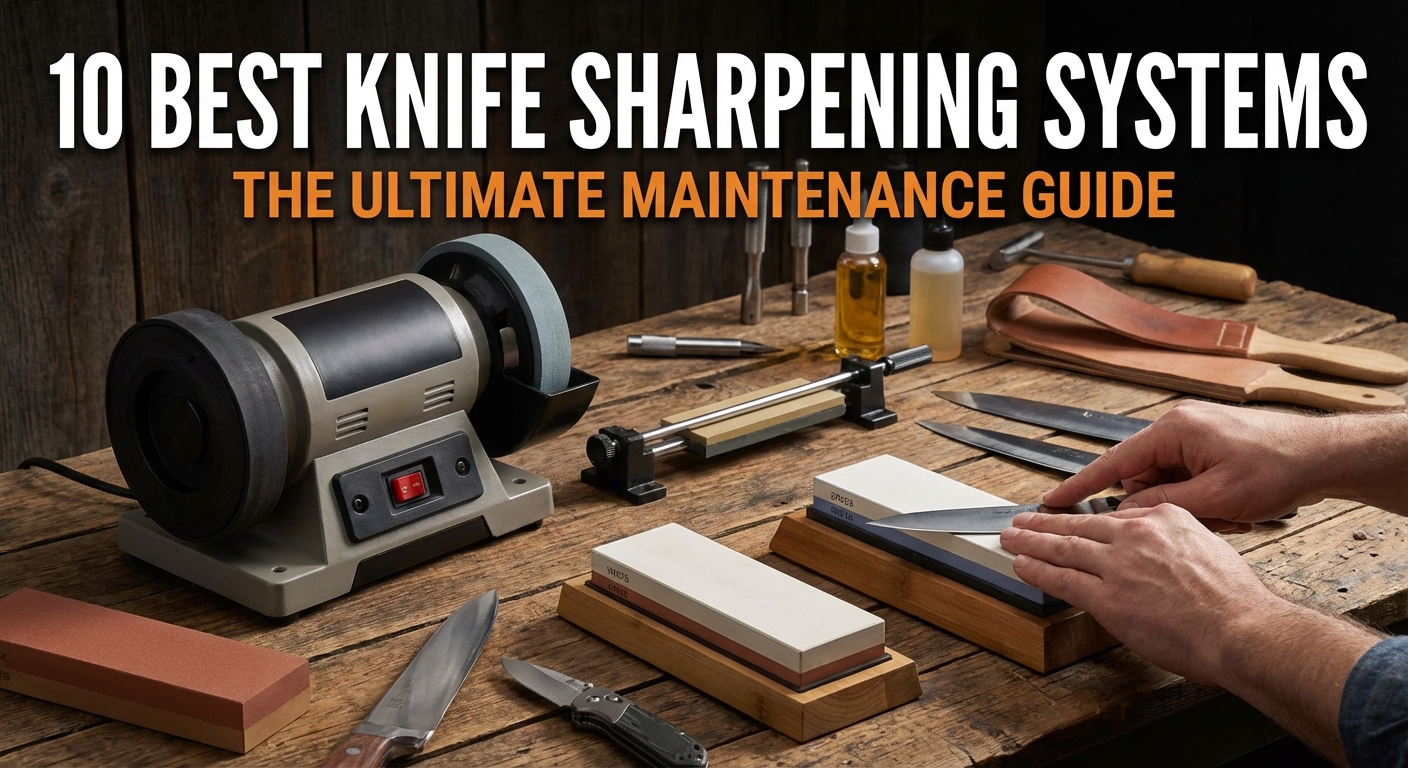
10 Best Knife Sharpening Systems: The Ultimate Maintenance Guide
A dull knife is a dangerous knife. Whether you are maintaining a high-end pocket knife or a kitchen set, these sharpening systems will restore a razor edge with precision.
Introduction: Restoring the Edge
There is a saying among outdoorsmen and chefs alike: “Don’t blame the tool, blame the maintenance.” Even the most premium blade steel—like the CPM-S30V found in our Kershaw Blur review—will eventually lose its bite. Cutting through cardboard, rope, or game hide dulls the apex of the edge, rolling it over or chipping it away.
Choosing the best knife sharpening system isn’t just about buying the most expensive machine. It’s about matching the sharpener to your skill level and your specific knives. A heavy-duty Fallkniven S1 convex edge requires a different approach than the delicate Scandi grind of a bushcraft knife or the serrations of a Spyderco Caribbean.
In this guide, we have categorized the top 10 sharpeners into electric systems (for speed), guided systems (for precision angle control), and freehand stones (for the purists). Whether you are sharpening a cheap M-Tech knife or a heirloom piece, there is a solution here for you.
Quick Comparison: Top Picks at a Glance
| System Name | Type | Skill Level | Best For |
|---|---|---|---|
| Work Sharp Ken Onion | Electric Belt | Intermediate | Best Overall Electric |
| Work Sharp Precision Adjust | Guided Rod | Beginner | Best Value Guided System |
| Spyderco Tri-Angle Sharpmaker | V-Stick System | Beginner | Serrations & Touch-ups |
| Wicked Edge Gen 3 Pro | Guided Rod | Expert | Professional Precision |
| Lansky Deluxe 5-Stone | Guided Clamp | Beginner | Budget Friendly |
| Chef’sChoice Trizor XV | Electric Slot | Beginner | Kitchen Knives |
| Shapton Glass Stones | Whetstone | Expert | Freehand Purists |
| Work Sharp Guided Field | Portable Plate | Intermediate | Field/Hunting Packs |
| Work Sharp Rolling Sharpener | Rolling System | Beginner | Ease of Use |
| KME Precision Knife Sharpener | Guided Rod | Advanced | Mirror Polish Enthusiasts |
Buying Guide: How to Choose a Sharpener
Before buying, you need to understand three critical factors: Abrasive type, Angle Control, and Material Removal Rate.
1. Guided vs. Electric vs. Freehand
Electric sharpeners use motor-driven belts or wheels. They are fast and create convex edges (great for choppers like the Cold Steel Wild West Bowie), but they remove a lot of steel quickly. Guided systems clamp the knife and force the stone to move at a specific angle, ensuring a perfect bevel every time. Freehand stones offer the most versatility but require significant muscle memory to master.
2. The Angle Matters
Most tactical folders, like the SOG-TAC XR, are sharpened at roughly 20-25 degrees per side. Kitchen knives are often 15 degrees. Buying a system that lets you adjust the angle is crucial if you have a diverse collection ranging from thick hunting blades to thin slicers like the Victorinox Cadet.
3. Abrasives
Diamond plates cut fast and stay flat (great for super steels). Ceramic stones polish the edge to a razor finish. Arkansas stones are natural and work slowly, best for carbon steels found in traditional knives like Buck Knives.
In-Depth Reviews: The Top 10 Systems
1. Work Sharp Ken Onion Edition

The Work Sharp Ken Onion Edition is arguably the most versatile electric sharpener on the market. Unlike standard pull-through electric sharpeners that use grinding wheels, this uses flexible abrasive belts. This creates a “convex” edge, which is stronger and stays sharp longer.
It features a variable speed motor and an adjustable angle guide (15° to 30°). It can handle everything from a heavy machete to delicate scissors. If you have a lot of knives and limited time, this is the answer.
Pros
- Fastest way to sharpen dull knives.
- Convex edge is superior for retention.
- Versatile (scissors, tools, axes).
Cons
- Can scratch the blade face if not careful.
- Removes material quickly (easy to round a tip).
2. Work Sharp Precision Adjust Elite

This system disrupted the market by offering a high-quality guided system at an entry-level price. It uses a clamp to hold the knife and a rod-guided abrasive that ensures you hit the exact angle every stroke. The “Elite” version comes with more stones, including ceramic and leather strops.
It is perfect for EDC enthusiasts. Whether you are touching up a QSP Hawk or re-profiling a harder steel, the Tri-Brasive rod makes switching grits instant.
Pros
- Incredible value for the price.
- Very stable clamping system.
- Foolproof angle consistency.
Cons
- Plastic construction feels light.
- Not ideal for very long kitchen knives (flex).
3. Spyderco Tri-Angle Sharpmaker
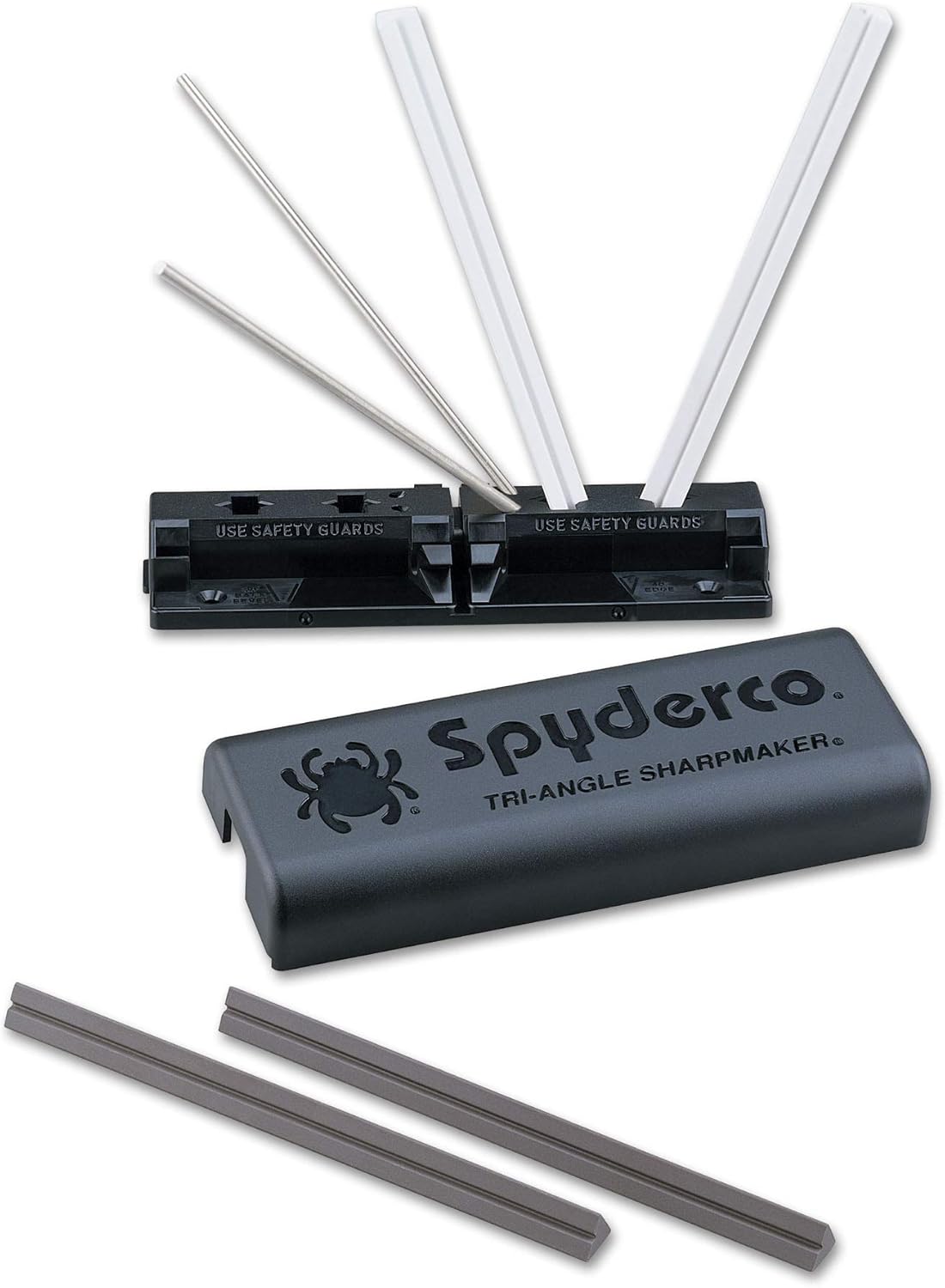
The Sharpmaker is a legend. It sets up in seconds and uses ceramic rods set at pre-determined angles (30° and 40° inclusive). You simply keep the knife vertical and slice down the rods. It is hands-down the best system for maintaining serrated edges, like those found on rescue knives or the Spyderco Caribbean.
It acts more as a honing system than a re-profiling system. It keeps sharp knives sharp but struggles to bring a butter-knife dull blade back to life without purchasing the extra Diamond rods.
Pros
- Best for serrations and recurve blades.
- No oil or water needed.
- Packable and simple setup.
Cons
- Slow material removal.
- Limited angle options (only two settings).
4. Wicked Edge Gen 3 Pro

If budget is no concern and you want the absolute sharpest edge scientifically possible, you buy a Wicked Edge. It clamps the knife vertically and allows you to work both sides of the blade simultaneously with diamond paddles. The precision is microscopic.
This is the system for the super-steel nerd. If you are trying to get a mirror polish on a ZT Knife or other high-vanadium steels, the Wicked Edge provides the stability required to not roll the edge.
Pros
- Unmatched precision and repeatability.
- Fast stock removal with coarse stones.
- Works both sides at once (symmetry).
Cons
- Extremely expensive.
- Large footprint (requires dedicated space).
5. Lansky Deluxe 5-Stone System

The Lansky system has been the entry point for guided sharpening for decades. It uses a clamp with various holes representing angles (17, 20, 25, 30). While it can be a bit finicky to set up, and the rods can bend if you aren’t careful, the results per dollar are undeniable.
It is excellent for smaller blades like keychain knives but struggles with large kitchen knives due to the narrow clamp width.
Pros
- Very affordable.
- Wide variety of hones available (diamond, Arkansas).
- Great for learning the basics of angles.
Cons
- Clamp can scratch blades (use tape).
- Setup time is slow.
6. Chef’sChoice Trizor XV
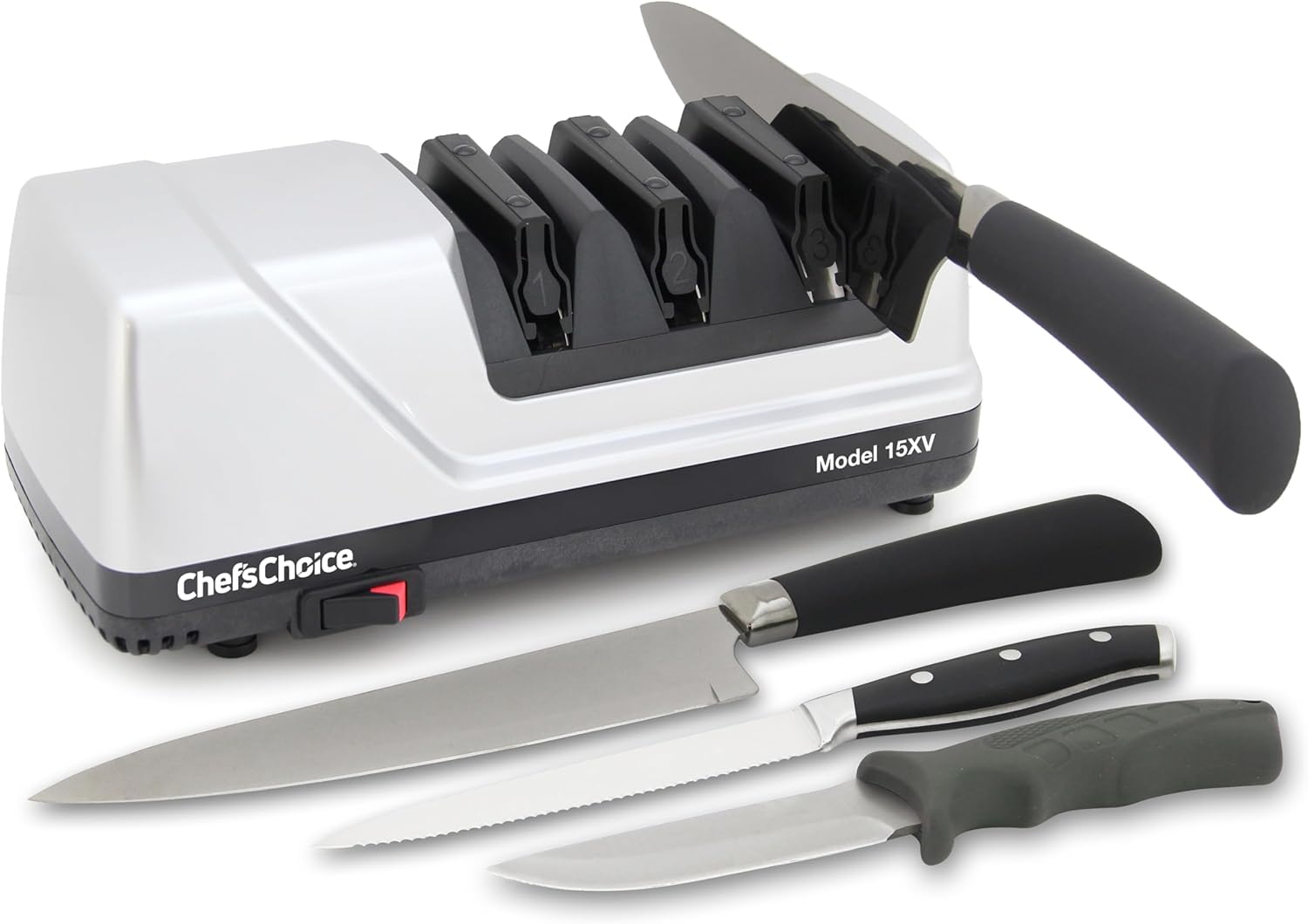
This is the king of kitchen sharpeners. The Trizor XV is designed to convert standard 20-degree factory edges into high-performance 15-degree edges (the “XV” stands for 15). It uses 100% diamond abrasives and a stropping stage.
While we usually prefer guided manual systems for hunting knives, for the culinary world, the speed and consistency of the Trizor XV are unmatched. It creates a triple-bevel edge that slices effortlessly.
Pros
- Fools-proof operation.
- Converts knives to a high-performance 15° edge.
- Polishing stage creates a razor edge.
Cons
- Removes a lot of metal over time.
- No angle adjustment (stuck at 15°).
7. Shapton Glass Stone Series

For the purist who wants to master freehand sharpening, Shapton Glass Stones are the pinnacle. Unlike traditional water stones that need soaking (and create a muddy mess), these are “Splash and Go.” You spritz water on them and sharpen immediately.
The abrasive particles are extremely uniform, cutting fast and leaving a brilliant polish. They are mounted on tempered glass, ensuring they stay flat longer than other stones. This is the choice for sharpening a classic collected knife where you want total control.
Pros
- Fast cutting and slow wearing.
- No soaking required.
- Ideal for high-hardness steels.
Cons
- Requires significant skill to hold angles.
- Expensive (sold individually).
8. Work Sharp Guided Field Sharpener
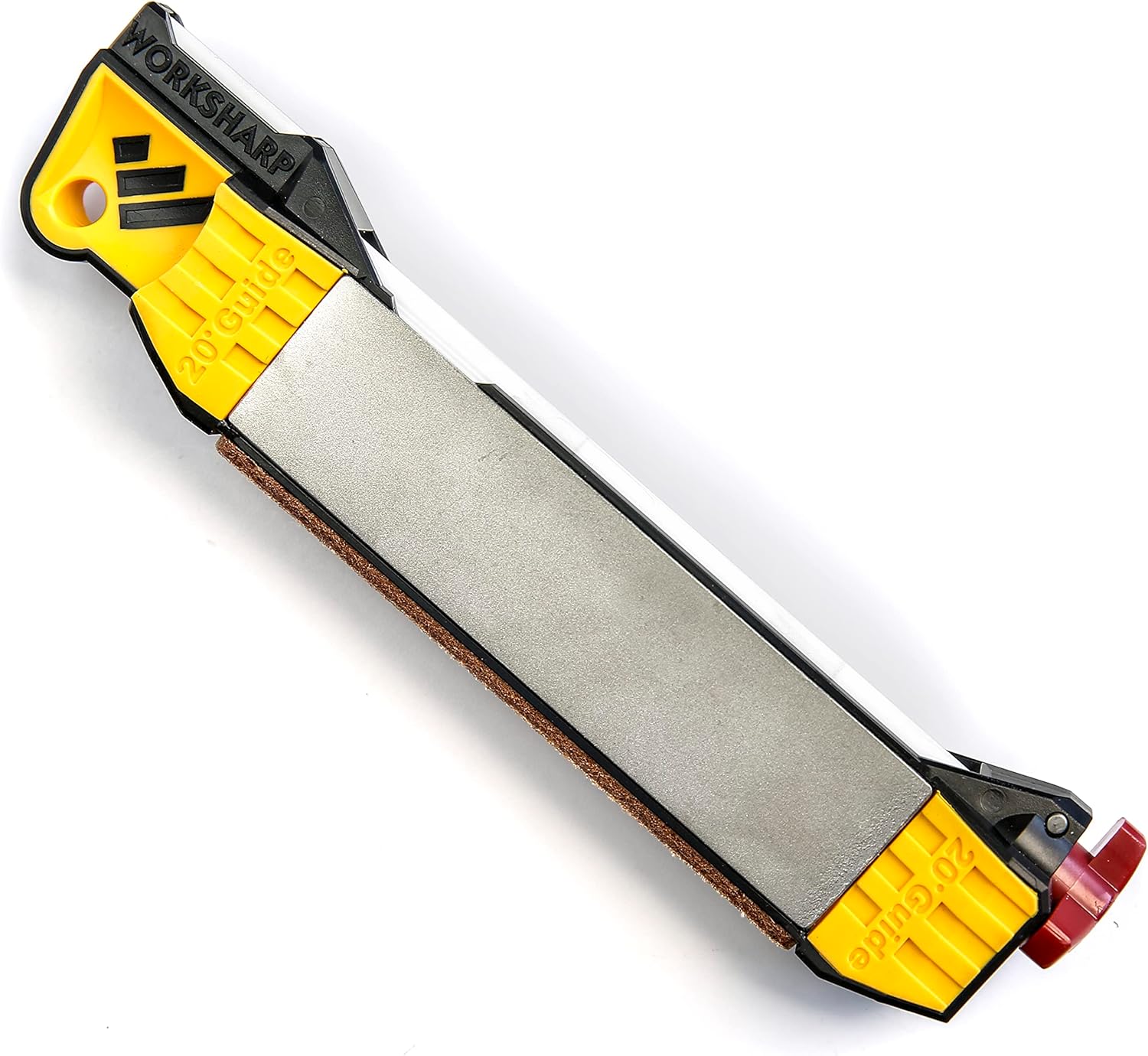
This is the sharpener you throw in your pack. It is a compact unit featuring two diamond plates (coarse/fine), a ceramic rod (with fish hook grooves), and a leather strop. Most importantly, it has built-in 20° and 25° angle guides at the ends of the plates.
If you are in the middle of processing game and need to touch up one of our recommended knives for field dressing, this is the tool. It’s rugged, lightweight, and effective.
Pros
- Complete system in your pocket (Strop included).
- Built-in guides help maintain angles in the field.
- Very durable.
Cons
- Small surface area requires short strokes.
- Not suitable for major edge repairs.
9. Work Sharp Rolling Knife Sharpener

Rolling sharpeners are the latest trend, and Work Sharp has perfected the design. You attach a magnetic block to the knife to hold the angle (15, 17, 20, or 25 degrees), and then roll the abrasive cylinder back and forth along the edge.
It bridges the gap between the simplicity of a pull-through and the quality of a stone. It looks great on a counter and is incredibly fun to use. It’s far safer and more effective than cheap alternatives.
Pros
- Zero learning curve.
- Aesthetically pleasing design.
- Magnetic angle block is very secure.
Cons
- Struggles with very small knives (like neck knives).
- Can be expensive for what it is.
10. KME Precision Knife Sharpener

The KME system is often compared to the Wicked Edge but comes in a smaller, more portable package. It uses a rotating clamp that allows you to flip the knife instantly to sharpen the other side. It is famous for its ability to create mirror-polished edges using their lapping films.
It is particularly good for reprofiling blade angles. If you have a Smith & Wesson knife with a thick uneven grind, the KME can fix it into a laser beam.
Pros
- Compact carrying case holds everything.
- Rotating clamp is a brilliant feature.
- Huge ecosystem of aftermarket stones (lapping films, curves).
Cons
- Height limit on blade thickness for clamp.
- Learning curve to get the clamp tight.
Watch: Sharpener Comparison & Technique
Seeing these systems in action is the best way to decide. Watch this expert breakdown to see the workflow differences between electric, guided, and stone sharpening.
Maintenance Tips: Keeping the Edge
Sharpening removes metal; honing realigns it. You shouldn’t be using a coarse diamond stone every week. Between sharpenings, use a leather strop or a ceramic hone.
- Clean Your Stones: Diamond plates should be cleaned with water and a toothbrush to remove metal swarf. Ceramics can be cleaned with an eraser or scouring powder.
- Don’t Overheat: If using electric sharpeners like the Work Sharp Ken Onion, use quick passes. If the blade gets hot to the touch, you could ruin the heat treatment, making the steel soft.
- Marker Trick: When learning a guided system, color the edge of your blade with a Sharpie. Do one pass with the stone. If the ink is removed at the shoulder, your angle is too low. If at the very edge, it’s perfect.
Frequently Asked Questions
Final Verdict
The best sharpening system is the one you will actually use. If you want a fast, effortless edge for your entire collection, the Work Sharp Ken Onion Edition is the clear winner. For enthusiasts who want precision and value, the Work Sharp Precision Adjust cannot be beaten for the price.
If you take pride in the meditative process of sharpening and own high-end Japanese steel, investing in Shapton Glass Stones or a Wicked Edge system will reward you with edges that defy physics. Stay sharp, and stay safe.