Chef Knife vs. Santoku Knife: Which Blade Rules the Kitchen?
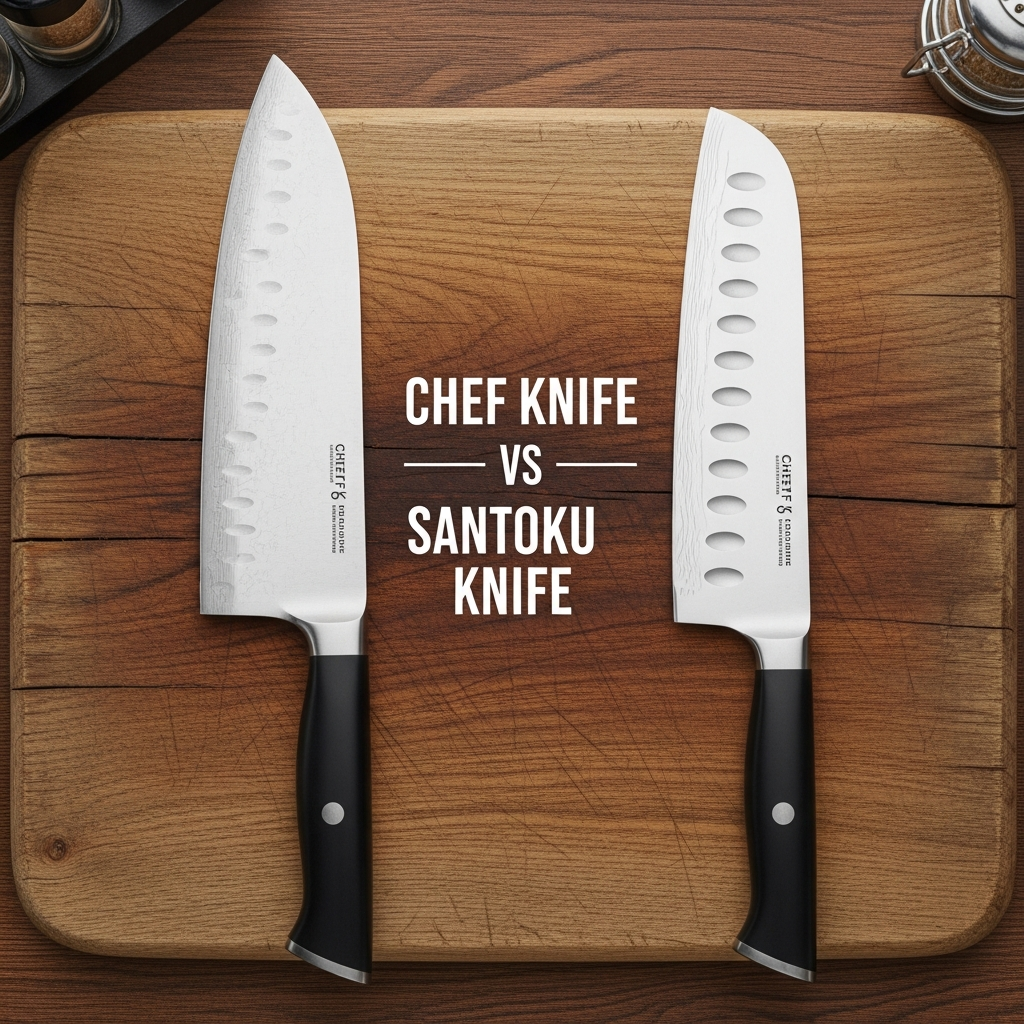
In the culinary world, there is a rivalry as old as East versus West. It is the ultimate battle for absolute supremacy on your cutting board: the heavy-duty Western Chef’s Knife up against the agile, precision-focused Japanese Santoku Knife.
If you are actively browsing KnivesReview.com looking to build or upgrade your essential kitchen kit, you might understandably be confused. At first glance, they look somewhat similar. They both claim to be the ultimate “multi-purpose” blade. They perform virtually identical tasks—chopping onions, slicing chicken, dicing carrots. Yet, they feel completely different in the hand, require entirely different physical cutting motions, and are forged using vastly different metallurgical philosophies.
Choosing the wrong one can make your daily meal prep feel like a grueling chore, resulting in wrist fatigue and poorly cut ingredients. Choosing the right one, however, can completely transform cooking into an effortless joy, making you feel like a seasoned professional.
Whether you are comparing legacy German brands like Zwilling vs. Henkel, or looking at high-end Japanese vs. Western options like Shun vs. Wusthof, this definitive, comprehensive guide will meticulously break down the history, the anatomical geometry, the metallurgy, the cutting techniques, and the absolute best use-cases for each blade style.
1. Historical Origins & Definitions: What Exactly Are We Comparing?
To truly understand how these knives function, we must first look at the culinary cultures that birthed them. A knife’s shape is heavily dictated by the diet of the people who created it.
The Western Chef’s Knife (The French & German Workhorse)
Originating primarily in Germany (specifically the legendary city of Solingen) and France (Thiers), the Western Chef’s knife is the undisputed workhorse of the European kitchen. Historically, the European diet was heavy in dense root vegetables, thick-crusted breads, and large, bone-in cuts of meat. The tools required to process this diet needed to be heavy, highly durable, and capable of brute force.
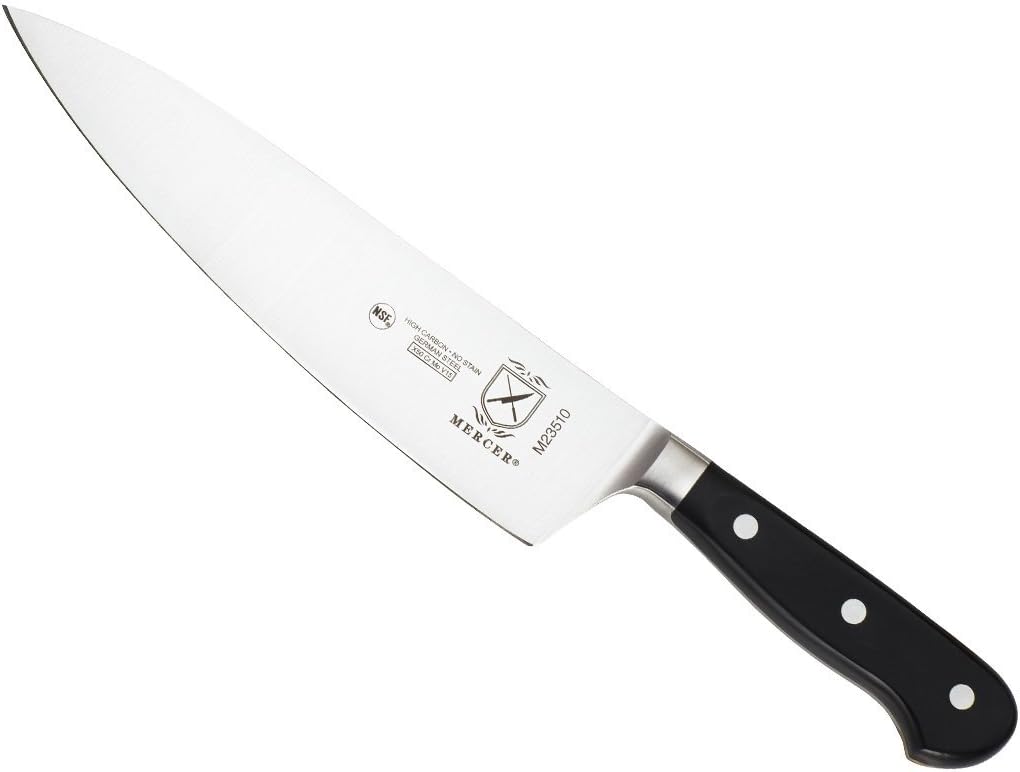
Also sometimes referred to as a “French knife” or a “Sabatier” style blade, the Western Chef’s knife typically features a broad blade that curves dramatically upward towards a sharp, pointed tip. This prominent curve—known in the culinary world as the “belly”—is specifically engineered for a distinct, rhythmic motion: rock chopping. For an even deeper dive into its myriad of functions, read our foundational guide on what is a chef knife used for.
The Santoku Bocho (The Japanese Hybrid)
The Santoku, by contrast, is a relatively modern invention originating in Japan during the post-World War II economic boom. Before this era, Japanese cooks traditionally used highly specialized knives: the Nakiri (a flat vegetable cleaver), the Deba or Yanagiba (long, thin slicers for fish), and the Deba (a thick, heavy blade for butchering fish).
As Western ingredients like beef and pork became more widely available and popular in Japanese households, home cooks grew frustrated with constantly switching between specialized blades. They needed a single, hybrid knife that could comfortably handle the traditional fish and vegetables, while also efficiently processing modern meats. Enter the Santoku Bocho.
The name directly translates to “Three Virtues” or “Three Uses” (referring to its mastery of slicing, dicing, and mincing; or its ability to handle meat, fish, and vegetables). It took the flat, straight edge of the Nakiri and added a pointed tip, resulting in a lighter, thinner blade with a rounded “sheep’s foot” nose designed for an up-and-down push-cutting motion. Learn more in our dedicated post: What is a Santoku knife used for?
External Insight
Kamikoto, a luxury Japanese steel knife brand, notes that while both knives are exceptionally versatile, the Santoku is inherently lighter, shorter, and often much better suited for home cooks with smaller hands or those who lack the counter space for an 8-to-10-inch swinging blade. Read their professional take here: Difference Between Chef’s Knife and Santoku Knife.
2. Head-to-Head Anatomy: The Geometry of the Cut
To help you decide which blade belongs on your magnetic rack, let’s look at the physical and geometric differences side-by-side. These aren’t just aesthetic choices; every millimeter of steel dictates how the knife interacts with your food.
| Anatomical Feature | Western Chef’s Knife | Japanese Santoku Knife |
|---|---|---|
| Standard Blade Length | 8 to 10 inches (Longer, requires more space) | 5.5 to 7 inches (Compact, nimble) |
| Blade Profile / Edge | Prominent curved “Belly” (ideal for rocking) | Relatively flat edge (ideal for up-and-down chopping) |
| Weight & Balance | Heavier, substantial; balance point is often at the bolster | Lighter, highly agile; balance point is often further forward |
| Tip Design | Sharp, spear-like pointed tip for piercing | Rounded “Sheep’s Foot” or K-tip; slopes down to the edge |
| Edge Angle (Bevel) | 18° to 22° per side (Thicker, more durable) | 12° to 15° per side (Thinner, razor-sharp precision) |
| Spine Thickness | Thick spine with distal taper for heavy driving force | Thin spine from heel to tip, reducing wedging in dense foods |
| Best Suited For | Heavy duty prep, disjointing chicken, rocking herbs | Precision vegetable slicing, push-cutting, delicate proteins |
3. Metallurgy: The Tale of Two Steels
The differences between these two iconic knives go much deeper than their shapes; they are forged using fundamentally different metallurgical philosophies. This affects how sharp the knife can get, how long it stays sharp, and how easily it can be damaged.
German/Western Steel: Toughness Over Hardness
Western Chef’s knives are typically forged from steel alloys like X50CrMoV15. This steel is designed to be relatively “soft” on the Rockwell Hardness scale (usually around HRC 56-58).
Why make a soft knife? Because softer steel is incredibly tough and highly ductile. If you accidentally strike a chicken bone, drop the knife in the sink, or aggressively twist the blade while cutting a dense butternut squash, the edge will safely “roll” or bend rather than chip. It is virtually indestructible, highly resistant to rust, and incredibly easy to hone back to sharpness using a standard steel rod.
Japanese Steel: Hardness Over Toughness
Santoku knives, specifically those adhering to Japanese traditions, are forged from high-carbon stainless steels (like VG-10, SG2, or AUS-10) or reactive carbon steels (like Aogami/Blue Paper Steel). These steels are heat-treated to an extreme hardness (usually HRC 60-63+).
This immense hardness allows the blade to be ground to a staggeringly thin 12-to-15 degree angle, yielding a scalpel-like edge that retains its sharpness exponentially longer than German steel. However, the trade-off is brittleness. Hard steel does not bend; it chips. If you hit a bone or pry apart frozen foods with a high-end Santoku, you risk snapping a piece of the blade off completely.
4. Ergonomics & Handles: Wa vs. Yo
How you hold the knife is just as important as the blade itself. Western Chef’s knives almost exclusively use a “Yo-Handle”. This is the classic, heavy, riveted handle with an exposed full tang of steel running through it. It provides excellent counterbalance and is incredibly ergonomic for a full-fisted grip.
Santokus can come with Western handles, but traditional Japanese models use a “Wa-Handle”. These are typically lighter, hidden-tang wooden handles shaped like an octagon, a “D”, or an oval. Wa-handles shift the balance point of the knife forward, encouraging the chef to use a “pinch grip” (pinching the base of the blade with the thumb and index finger) which drastically increases control and reduces wrist fatigue.
5. Cutting Mechanics: Rock vs. Chop
The biggest functional difference isn’t the knife itself; it’s how you must move your hand and wrist to utilize the geometry properly.
The Rock Chop (The Chef’s Knife)
Because of the highly curved belly of a Western Chef’s Knife, you can keep the tip of the blade anchored on the cutting board. Acting as a fulcrum, you lift the handle up and down, rocking the blade rapidly over the food. This technique is incredibly fast, highly efficient, and is the absolute best method for mincing massive piles of fresh herbs, garlic, or nuts. German knives, like those heavily featured in our best German kitchen knives list, excel exclusively at this motion.
The Push Cut (The Santoku)
The Santoku has a relatively flat edge. If you attempt to “rock chop” with a Santoku, the flat belly will aggressively slam into the cutting board, jarring your wrist and potentially damaging the thin edge. Instead, the Santoku requires a “push cut” or a “glide.” You lift the knife completely off the board, move it forward, and push down simultaneously in one smooth, diagonal motion.
This technique results in impeccably clean, razor-precise slices without bruising delicate herbs or tearing tomato skins. It is also significantly less tiring for your wrist if you are executing high-volume vegetable prep. Premium Japanese brands like Shun, Miyabi, and Global optimize their steel specifically for this exact cutting motion.
6. The Granton Edge: Why Does the Santoku Have Dimples?
If you look at most modern Santokus, you will notice a row of oval dimples or scallops ground into the side of the blade near the edge. This is known as a Granton edge or a hollow-ground edge.
Because Santokus have flat sides and are used for rapid up-and-down slicing, wet or starchy foods (like potatoes, cucumbers, or zucchini) tend to create a vacuum seal and aggressively stick to the side of the blade, forcing you to stop and wipe them off. The Granton dimples create tiny, microscopic air pockets between the steel and the food, breaking the suction and allowing slices to fall away cleanly. While some modern Chef’s knives now feature Granton edges, it is a staple defining feature of the Westernized Santoku.
7. Top Product Recommendations
We have rigorously tested the best chef knife brands on the market. Here are the undisputed champions of each distinct style.
 Wüsthof Classic Ikon 8″ Chef’s Knife
The definitive, heavyweight Western blade. It features flawless balance, a comfortable half-bolster that allows you to sharpen the entire length of the blade, and a beautifully sweeping curved belly for effortless, rapid rock-chopping. Forged in Solingen, Germany, it is a clear winner in our massive Wusthof vs Victorinox comparison.
Check Price on Amazon Shun Classic 7″ Santoku
The iconic Japanese entry point for Western cooks. It features an ultra-hard VG-MAX cutting core protected by 34 beautiful layers of stainless Damascus cladding. It is incredibly light, devastatingly sharp out of the box, and features deep hollow-ground indentations to prevent starchy food from sticking during rapid prep.
Check Price on Amazon8. Detailed Comparisons by Brand Philosophy
If you already possess a specific brand loyalty, here is exactly how their respective Chef vs. Santoku models stack up against one another.
Wüsthof & Zwilling (The German Approach)
It is important to note that German-made Santokus are almost always hybridized. They are significantly heavier, thicker, and softer than traditional Japanese Santokus, and they usually incorporate a slight belly curve to allow for some rocking. If you are deeply comparing Wusthof vs Zwilling vs Shun, know that the German Santokus are far tougher, require less babying, and can handle light bones infinitely better than the fragile, brittle Japanese versions.
Shun, Miyabi, & Global (The Japanese Approach)
These brands manufacture “true” Santokus (or at least, much closer to the Japanese ideal). They are laser-thin, aggressively tapered, and forged from exceptionally hard steel (VG10, SG2, or Cromova 18). They will hold an edge for months of heavy use, but they will absolutely chip if you abuse them or use improper cutting boards. See our Miyabi vs Shun battle for a hyper-detailed breakdown of their premium steel types.
Budget & Commercial Options (Victorinox & Mercer)
If you are on a strict budget, or equipping a commercial kitchen line, the Victorinox Fibrox is available in both shapes. The Mercer Culinary Millennia Santoku is also an absolute favorite among culinary students. Because these are stamped blades (cut from a sheet of steel rather than forged), they are very light and highly affordable. (See Mercer vs Victorinox for the ultimate budget showdown).
9. Real-World Application: When to Use Which?
Reach for the Chef’s Knife When:
- Breaking Down Meat: Disjointing a whole raw chicken, slicing through thick cartilage, or portioning a massive beef roast. (Though for eating at the table, ensure you have proper steak knives).
- Tackling Hard Vegetables: Splitting a dense butternut squash, a massive sweet potato, or a watermelon. The heavy weight of the German blade helps drive the steel through the resistance.
- High-Speed Mincing: Rhythmically rocking through a large pile of parsley, cilantro, or garlic cloves.
Reach for the Santoku When:
- Precision Vegetable Prep: Thinly slicing cucumbers, julienning onions, or uniformly dicing bell peppers without crushing the cellular walls. (For bulk, purely vegetarian prep, you should also heavily consider researching what is a Nakiri knife used for).
- Slicing Boneless Proteins: Gliding through raw chicken breast for a stir-fry, or slicing seared flank steak paper-thin.
- Delicate Fish: The exceptionally thin blade moves easily through delicate fish flesh without tearing the grain, making it adequate for crude sashimi preparation.
10. Forged vs. Stamped Construction
The manufacturing process heavily affects both blade types. A fully forged Wusthof Chef’s knife with a thick bolster will be remarkably heavy and handle-balanced, giving you a sense of authoritative power. A stamped Victorinox Santoku will feel feather-light and highly agile, but might lack the momentum needed for heavy cuts. It is critical to understand the long-term trade-offs in our dedicated guide: Difference Between Stamped and Forged Knives.
11. Maintenance, Care, and Proper Sharpening
Regardless of which blade geometry you choose, proper maintenance is entirely non-negotiable if you want the knife to last more than a few months.
- Sharpening Angles Matter: Western Chef’s knives are typically sharpened to a sturdy 20° angle per side. Japanese Santokus are sharpened to a delicate 15° angle. You cannot treat them the same. Ensure you have the best knife electric sharpeners that feature adjustable angle guides, or ideally, learn the meditative art of using a water whetstone.
- The Art of Honing: Use a honing rod before every single use to micro-align the edge. *Crucial Note:* Use a steel, grooved honing rod for softer German Chef’s knives, but you MUST use a smooth Ceramic honing rod for hard Japanese Santokus to prevent chipping.
- Rust Prevention & Care: If you purchase a high-carbon Santoku (like a traditional Dalstrong or Shun), you must wash and dry it immediately after touching acidic foods like lemons. Never leave it in a wet sink. If you slip up, learn how to remove rust safely without ruining the blade finish.
- Safe Storage: Never toss a premium knife loosely into a utensil drawer without a plastic guard (saya). The edges will bang against spoons and dull instantly. Use a wall-mounted magnetic holder or a dedicated wooden knife block.
- Cutting Board Material: The board you cut on is just as important as the knife. Never cut on glass, marble, granite, or highly dense bamboo. These will destroy a 15-degree Santoku edge in minutes. Use end-grain wood (walnut, maple) or professional rubber boards like Hasegawa.
12. What About Other Specialty Knives?
While the Chef’s Knife and the Santoku are the indisputable stars of the show, you should not try to force them to do absolutely everything in the kitchen.
Need to peel an apple, core a strawberry, or devein shrimp off the cutting board? You need a smaller blade. Read what is a paring knife used for.
Need to cut through a crusty artisan sourdough boule or a delicate sponge cake without crushing it? A straight edge will fail. Read what is a serrated knife used for (or check out our rankings for the best bread knife).
Are you a culinary student taking your tools on the go? Protect your investment and get a professional knife bag.
Frequently Asked Questions (FAQ)
For roughly 90% of home cooks, the answer is yes. If you do not regularly butcher whole chickens, slice through dense bones, or chop massive winter squashes, the lighter, shorter, and highly nimble Santoku is often much more comfortable, precise, and significantly less intimidating to use on a daily basis.
Those oval indentations are officially called a “Granton edge” or a hollow-ground edge. Because the Santoku is used for rapid, flat slicing, wet foods tend to suction onto the steel. The dimples create tiny air pockets between the blade and the food, which effectively breaks the vacuum seal and stops wet vegetables (like potatoes and cucumbers) from sticking to the knife while you chop.
The Santoku is almost universally considered better and safer for absolute beginners because it possesses a shorter blade (typically 7 inches versus a daunting 8-10 inches), making it far easier to control. The rounded sheep’s foot tip is also less likely to accidentally puncture something (or someone) than the needle-sharp tip of a Chef’s knife. However, learning to use the Chef’s knife correctly teaches the fundamental “rocking” skill that is mandatory in fast-paced professional commercial kitchens.
It entirely depends on your aesthetic preferences and cutting style. Wusthof represents traditional, heavy-duty, no-nonsense German excellence with a proven track record lasting over a century. Dalstrong is a modern disruptor offering highly aggressive, flashier designs and highly varied imported steel types at competitive prices. See our exhaustive Dalstrong vs Wusthof metallurgical comparison for a deep dive to see which philosophy suits your kitchen.
Conclusion: The Final Verdict
The ultimate choice between a Western Chef Knife vs. a Japanese Santoku is a deeply personal one. There is no objective “best” knife—there is only the best knife for you. It depends entirely on the size of your hands, the height of your counters, the type of food you cook most frequently, and your natural wrist mechanics.
Choose a Western Chef’s Knife If: You prefer a heavy, substantial tool that relies on weight and gravity to do the hard work for you. You frequently cook large meat roasts, tackle incredibly tough, dense root vegetables, and you vastly prefer the fast, rhythmic, fluid rocking motion of mincing herbs with the tip anchored to the board.
Choose a Japanese Santoku If: You highly value lightweight agility and razor-sharp precision over brute force. You prep massive volumes of vegetables for stir-frys or salads, you possess smaller hands, or you naturally prefer a clean, straight up-and-down push-cutting motion.
Ideally? A well-stocked, highly functional kitchen should absolutely have both. But if you can only afford to pick one right now, start with the one that feels like a natural, ergonomic extension of your own hand. We highly recommend checking out our comprehensive budget knife guide to find an inexpensive, highly-rated version of each style so you can affordably test them out on your own cutting board before investing hundreds of dollars in a premium lifetime blade.