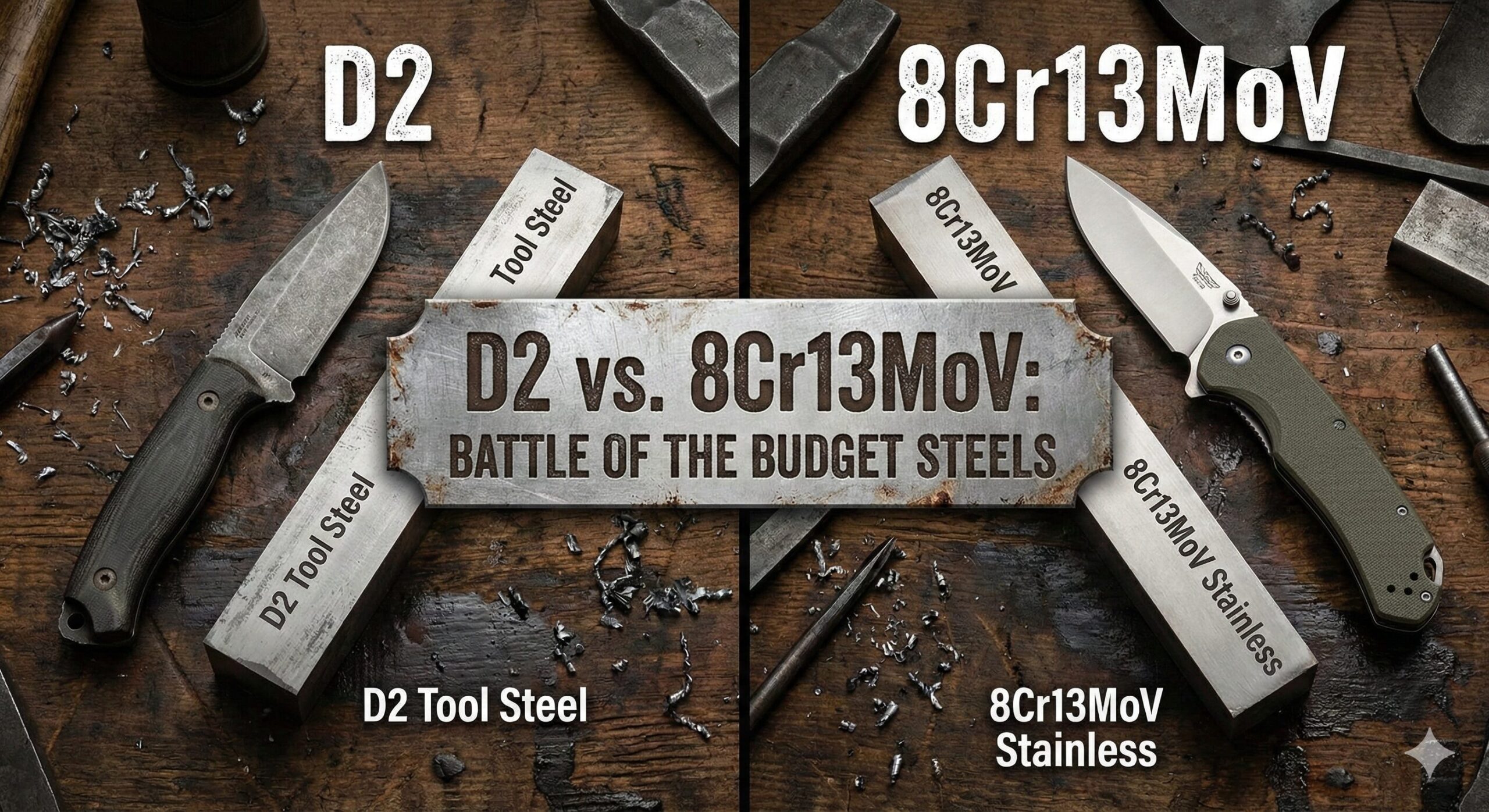
D2 vs. 8Cr13MoV: The Ultimate Battle of the Budget Steels
The Evolution of the Budget Knife Debate
If you are currently browsing for an everyday carry (EDC) pocket knife or a reliable hard-use fixed blade under the $60 price point, you will inevitably smash headfirst into a critical decision: D2 Tool Steel or 8Cr13MoV. For the better part of the 2010s, 8Cr13MoV was the absolute gold standard for affordable knives from massive production brands like Kershaw, CRKT, and Spyderco’s budget lines. It was cheap to produce, wildly easy to sharpen, and universally accepted as “good enough” for opening Amazon boxes and cutting zip ties.
However, the knife manufacturing industry—particularly operations based in China—has evolved at a breakneck pace over the last few years. High-tech CNC machining and advanced heat treatment protocols have allowed manufacturers to mass-produce blades using D2. Historically, D2 was a high-hardness tool steel reserved exclusively for expensive custom makers and premium mid-tech brands like Benchmade. Today, the market is flooded with meticulously machined D2 knives from brands like Civivi, CJRB, and QSP that directly compete with 8Cr13MoV in price.
So, is upgrading to D2 an absolute no-brainer? Or does the highly forgiving, classic 8Cr13MoV still legitimately hold a strategic place in your pocket? To find out, we must go beyond the marketing hype and aggressively break down the raw metallurgy, heat treatment science, and real-world cutting performance.
What Exactly is D2 Steel?
D2 is an extraordinarily old-school, tried-and-true “Tool Steel” that first appeared during World War II. It was originally engineered to construct industrial stamping dies and heavy machine parts used to cut, slice, and form other steels on factory assembly lines. To survive that kind of industrial violence, D2 relies on a massive amount of Carbon (up to 1.5%) and a very high level of Chromium (11-12%).
Because it possesses 11-12% Chromium, it hovers just below the universally accepted 13% threshold required to officially be classified as a “stainless steel.” Hence, D2 is widely known in the knife community as a “Semi-Stainless” steel. It is famous for forming massive, ultra-hard chromium carbides within its molecular matrix. These carbides act like microscopic diamond teeth, allowing D2 to hold a viciously aggressive cutting edge for a very long time, but they also make the steel relatively brittle and notoriously difficult to sharpen on traditional whetstones.
For a deeper understanding of where D2 sits in the grand hierarchy of cutlery materials, check out our exhaustive comparison of stainless steel vs. carbon steel knives.
What is 8Cr13MoV?
8Cr13MoV is an ingot-based stainless steel manufactured in China. It was originally formulated to act as a direct, highly cost-effective competitor to the famous Japanese AUS-8 steel. The name itself is actually a chemical recipe: it contains roughly 0.8% Carbon and 13% Chromium, along with trace additions of Molybdenum and Vanadium to aid in grain refinement.
In the knife enthusiast community, 8Cr13MoV is the very definition of “adequate.” It takes a screaming, hair-popping sharp edge very quickly, resists environmental rust exceptionally well, and keeps production costs incredibly low. However, it is relatively soft. If you spend an afternoon breaking down heavy, double-walled corrugated cardboard, you will absolutely need to sharpen it by evening. It serves as the baseline metric against which virtually all other budget steels are measured, such as in our AUS-10 vs. VG10 breakdown.
Metallurgical Chemistry Breakdown
To truly understand why these two steels behave so differently on the cutting board and the sharpening stone, we have to look at their chemical recipes.
| Element | D2 Tool Steel (%) | 8Cr13MoV (%) | What It Does For The Knife |
|---|---|---|---|
| Carbon (C) | 1.40 – 1.60 | 0.70 – 0.80 | Dictates overall hardness and wear resistance. D2 has nearly double the carbon. |
| Chromium (Cr) | 11.00 – 13.00 | 13.00 – 14.50 | Provides corrosion (rust) resistance. 8Cr crosses the “stainless” threshold. |
| Molybdenum (Mo) | 0.70 – 1.20 | 0.10 – 0.30 | Increases strength and high-temperature stability during heat treat. |
| Vanadium (V) | 0.90 – 1.10 | 0.10 – 0.25 | Forms incredibly hard vanadium carbides, boosting edge retention massively. |
The Takeaway: D2 is packed with significantly more Carbon and Vanadium. This creates huge, hard carbides that make it a cutting monster. 8Cr13MoV relies on higher Chromium and lower Carbon to prioritize rust resistance and ease of machining.
The Hidden Variable: Heat Treatment
You can have the most expensive steel chemistry in the world, but if the heat treatment is poor, the knife will perform like cheap tin. Heat treatment involves heating the blade to extreme temperatures, quenching it rapidly to lock the molecular structure, and then tempering it to relieve internal stress.
D2 is notoriously finicky to heat treat correctly. If it is rushed or improperly tempered, it becomes terrifyingly brittle and will snap under pressure. However, when done right (often involving a sub-zero Cryogenic quench to maximize hardness), D2 easily reaches 60-62 HRC (Rockwell Hardness). 8Cr13MoV is much more forgiving for manufacturers to heat treat, typically maxing out at a softer 56-58 HRC. This difference in Rockwell hardness directly correlates to how the knife will perform in the real world.
Head-to-Head Performance Stats
Here is how the chemistry and heat treatment translate into tangible, real-world utility.
| Performance Category | D2 Tool Steel | 8Cr13MoV | Clear Winner |
|---|---|---|---|
| Edge Retention | 8/10 (Excellent) | 4/10 (Low/Average) | D2 (By a landslide) |
| Toughness (Impact) | 4/10 (Brittle) | 6/10 (Moderate) | 8Cr13MoV |
| Corrosion Resistance | 4/10 (Semi-Stainless) | 6.5/10 (Decent) | 8Cr13MoV |
| Ease of Sharpening | 3/10 (Stubborn/Hard) | 9/10 (Incredibly Easy) | 8Cr13MoV |
Edge Retention: The D2 Dominance
This is the primary reason knife enthusiasts heavily favor D2. Because of its massive, ultra-hard chromium and vanadium carbides, combined with a high Rockwell hardness (60-62 HRC), D2 cuts aggressively for a very long time. In standardized CATRA (Cutlery & Allied Trades Research Association) testing—where a machine repeatedly cuts abrasive silica-impregnated cardstock—a properly treated D2 blade will routinely execute double or even triple the number of cuts compared to 8Cr13MoV before losing its working edge.
If you absolutely despise sharpening your knife, or if your job involves cutting miles of abrasive warehouse cardboard, fiberglass straps, or dirty rope, D2 is the undisputed champion here. A legendary example of a high-performance D2 folder is the Ontario Rat 1 (D2 version), which has built an empire on its relentless workhorse capabilities.
Toughness: The Battle of Chipping vs. Rolling
In knife metallurgy, “hardness” (edge retention) and “toughness” (resistance to breaking) are usually inversely correlated. Because D2 is so incredibly hard, it is also relatively brittle. If you use a thin D2 blade to pry open a paint can, twist it aggressively while carving hard wood, or accidentally strike a hidden staple inside a cardboard box, the edge is highly prone to micro-chipping. Small, jagged divots will break off the blade, which requires significant time on a sharpening stone to grind out.
Conversely, because 8Cr13MoV is much softer (56-58 HRC), it is significantly “tougher” and more ductile. If you abuse an 8Cr13MoV blade by hitting a staple, the edge will safely roll or flatten to the side rather than snapping off. A rolled edge can often be fixed in 30 seconds by simply running it over a leather strop or a steel honing rod, making 8Cr13MoV the far better choice for a pure “beater” knife that will suffer severe lateral abuse.
Corrosion Resistance: Managing the Rust Risk
If you are someone who expects to use a knife, throw it in a drawer, and forget about it for a week, D2 will punish your neglect. You must occasionally wipe D2 down with a specialized knife oil (like KPL or mineral oil) to protect the porous surface.
8Cr13MoV, possessing the requisite 13%+ Chromium, is fully classified as a stainless steel. While it certainly isn’t 100% rust-proof like elite maritime steels (such as H1, LC200N, or MagnaCut), it handles being wet, dirty, or covered in food juices vastly better than D2. If you are lazy about cleaning your gear, or if you use your pocket knife for impromptu food prep while camping, 8Cr13MoV is the substantially safer option.

The Civivi Elementum completely disrupted the budget knife market because it offers a highly optimized, perfectly heat-treated D2 blade, frictionless ceramic ball bearings, and premium G10 scales for roughly $50. It represents the absolute pinnacle of modern budget D2 manufacturing.
Check Availability on AmazonSpecific Use Case Scenarios
Still not sure? Let’s apply these steels to highly specific, real-world tasks:
- For the Office EDC/Warehouse Worker: You are breaking down 50 thick, dusty cardboard boxes a day. Cardboard is highly abrasive and destroys knife edges. Winner: D2. It will outlast 8Cr by days.
- For the Hard-Use Bushcrafter: You are in the woods, batoning your knife through logs, striking ferro rods, and scraping bark in the rain. Winner: 8Cr13MoV (or SK5/1095). D2 is too brittle for heavy impact and will rust quickly in the wet outdoors; 8Cr will bend rather than snap.
- For the Camp Chef / Fisherman: You are cutting limes, gutting trout, and slicing tomatoes in a highly humid, wet environment. Winner: 8Cr13MoV. The acid and water will severely pit and rust D2 in a matter of hours.
Final Verdict: Which Steel Belongs in Your Pocket?
Choose D2 Tool Steel If:
- You absolutely demand maximum cutting longevity and edge retention per dollar spent.
- Your primary cutting tasks involve highly abrasive materials like thick cardboard, heavy zip-ties, carpet, or sisal rope.
- You are disciplined enough to wipe down and lightly oil your blade periodically.
- You already own (or are willing to buy) aggressive diamond sharpening stones.
Choose 8Cr13MoV Stainless Steel If:
- You are operating on a strict, highly affordable budget (routinely finding great options under $30 from brands like Kershaw).
- You are a beginner at free-hand sharpening and need a forgiving steel to practice forming and removing a burr.
- You frequently work in wet, humid environments or use your pocket knife for impromptu food preparation.
- You tend to severely abuse your knives via light prying or twisting, heavily relying on the steel to roll harmlessly rather than shatter and chip.
Expert FAQs
Objectively, no. CPM-S30V is a true, highly advanced powder metallurgy steel designed specifically for premium cutlery. S30V offers vastly superior corrosion resistance and much better impact toughness than D2, while either matching or slightly beating D2’s edge retention. However, D2 is significantly cheaper to manufacture, which is why it dominates the sub-$60 market, while S30V dominates the $150+ market.
Yes, it can absolutely rust if severely neglected, but it is vastly more resistant than D2. 8Cr13MoV is classified as a standard stainless steel, meaning it relies on its 13% chromium content to form a passive oxide layer that resists general staining from water and air. However, it is not completely immune to highly corrosive saltwater or concentrated fruit acids left on the blade overnight.
Massive improvements in overseas manufacturing infrastructure and computer-controlled heat treating, particularly in Chinese factories supplying brands like Civivi, CJRB, and Artisan Cutlery, have made D2 highly affordable to mass-produce. This technological shift allows budget-conscious buyers to experience “premium” tool-steel edge retention without paying the exorbitant premium price tag once associated with D2 customs.
You theoretically can, but you must be extremely careful and diligent. Highly acidic foods like lemons, onions, or tomatoes will force a dark patina onto the blade very quickly. Furthermore, because D2 is highly reactive, it can occasionally impart a faint metallic taste to acidic foods if it reacts strongly. If you use it for food, you must wash and bone-dry the blade immediately after slicing.