Fiskars X11 vs X7: Chopper vs. Splitter Showdown
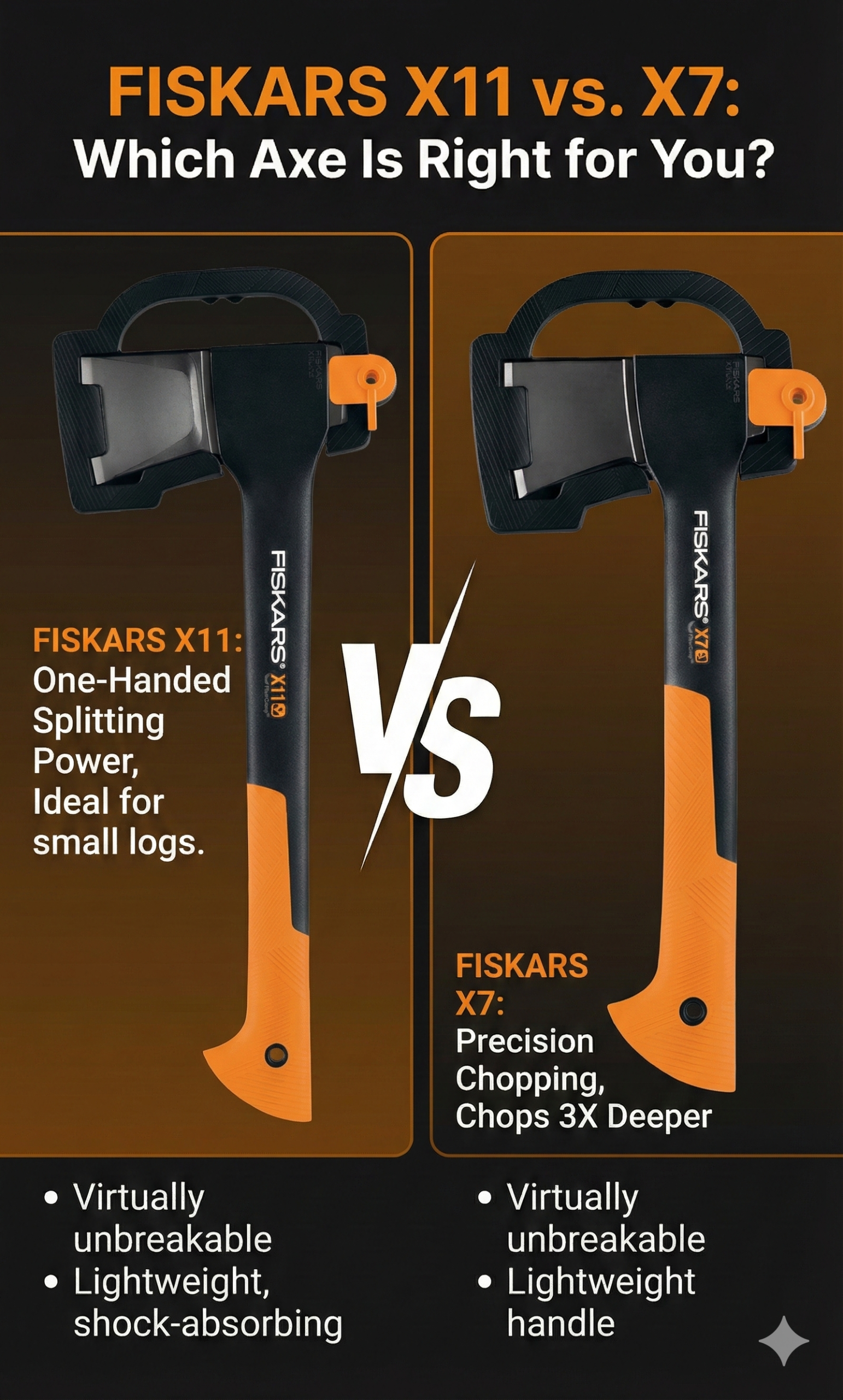
Two orange handles, nearly identical lengths, but completely different purposes. We break down the physics, performance, and best use cases for the Fiskars X7 Hatchet and the X11 Splitting Axe.
Introduction: The Identity Crisis
If you are standing in the hardware store aisle or scrolling through Amazon, looking at the iconic orange-and-black handles of Fiskars axes, you might be confused. The Fiskars X7 and the Fiskars X11 look almost exactly the same at first glance. They are both compact, lightweight, and built with Fiskars’ practically indestructible FiberComp handles.
However, buying the wrong one can lead to immense frustration in the field. Why? because one is a scalpel, and the other is a wedge.
In this detailed Fiskars X11 vs X7 comparison, we are going to dissect the nuances of head geometry, weight distribution, and cutting physics. Whether you are a bushcrafter needing to carve tent pegs or a homeowner needing to pop apart seasoned oak for the woodstove, understanding these differences is critical.
We will also touch upon how these compare to other market leaders like the Estwing Fireside Friend and traditional options from Swedish forges.
Quick Comparison: At A Glance
Before we dive into the deep review, here are the raw specs. Notice the weight difference despite the similar length.
| Feature | Fiskars X7 Hatchet | Fiskars X11 Splitting Axe |
|---|---|---|
| Primary Role | Chopping, Carving, Limbing | Splitting small logs & kindling |
| Total Length | 14 inches (355 mm) | 17 inches (431 mm) |
| Total Weight | 1.4 lbs (640 g) | 2.43 lbs (1100 g) |
| Head Weight | 1.03 lbs (470 g) | 1.85 lbs (840 g) |
| Blade Geometry | Thin, sharp cutting edge | Thick, convex splitting wedge |
| Balance Point | Near the head (agile) | Very head-heavy (momentum) |
| Best For | Hiking, Bushcraft, Backpacking | Car Camping, Wood Stoves, RVs |
The Challenger: Fiskars X7 Hatchet

The Fiskars X7 is arguably the most popular camping hatchet in the modern world. It is designed for cutting fibers. The blade is thin, allowing it to bite deep into wood. It is lightweight enough to carry on a belt or in a pack all day without fatigue.
If you want a detailed breakdown of its bushcraft capabilities, check out our full Fiskars X7 Hatchet Review.
See Fiskars X7 on AmazonThe Challenger: Fiskars X11 Splitting Axe

The Fiskars X11 is the smallest member of Fiskars’ splitting series (which ranges up to the massive X27). It is designed to push fibers apart. The head is heavier and features a distinct wedge shape. It is essentially a handheld splitting maul. It is not meant for felling trees; it is meant for processing rounds into firewood.
For those interested in larger splitting tools, see how the X-series scales up in our Fiskars X27 vs X25 comparison.
See Fiskars X11 on AmazonDeep Dive: Head-to-Head Comparison
1. Blade Geometry: The “Bite” vs. The “Pop”
The single most important difference between the X7 and X11 is the shape of the head (the cheek geometry). This dictates the physics of the tool.
The X7 Hatchet has a thin, flat profile. When you swing it at a tree branch or a small log, it slices. This makes it excellent for limbing (cutting branches off a fallen tree) or carving feather sticks for a fire. However, if you strike a thick log vertically, the thin blade tends to bite deep and get stuck, acting like a nail rather than a wedge.
The X11 Splitting Axe has a head that flares out rapidly immediately behind the cutting edge. It looks almost bulbous from the top. When this head strikes a log, it doesn’t want to cut; it wants to force the wood apart. The kinetic energy is transferred laterally, “popping” the wood open. It rarely gets stuck because the wedge shape forces the wood away from the steel.
2. Weight and Swing Dynamics
The X11 is significantly heavier than the X7—about a pound heavier. In the world of hand tools, a pound is massive.
- X7 (1.4 lbs): You can swing this with wrist action. It feels like an extension of your arm. You can use it for hours without your shoulder burning. It is precise.
- X11 (2.4 lbs): This requires more arm and shoulder engagement. It is top-heavy. When you swing it, the head “pulls” the handle down, generating more momentum. This is great for splitting because gravity helps you, but it is terrible for tasks that require finesse, like making tent stakes or carving.
3. Handle Length and Safety
The X11 is slightly longer (17 inches vs 14 inches for the X7). This extra 3 inches gives you a longer lever arm, increasing the velocity of the head at impact. For splitting, velocity + mass = force. This makes the X11 far superior for stubborn, knotty wood.
However, 17 inches is an awkward size for packing. It doesn’t fit inside a standard daypack as easily as the 14-inch X7. If portability is your main concern, the X7 wins.
4. Durability and Materials
Both tools use Fiskars’ proprietary FiberComp handle—a carbon fiber reinforced polyamide. It is lighter than wood and stronger than steel in terms of shock absorption. You can overstrike (hit the handle against the log) without snapping it, a common failure point for wooden axes like those discussed in our Hultafors hatchet review.
Both heads are insert-molded, meaning the plastic is molded around the steel head. The head will never fly off. This makes both tools incredibly safe compared to traditional wedged axes.
Performance Scenarios: Which One Do You Need?
Let’s simulate some real-world situations to help you decide.
Scenario A: The Backpacker
You are hiking 10 miles into the backcountry. Every ounce counts. You need a tool to process fallen branches for a small campfire and maybe hammer in a tent stake.
Winner: Fiskars X7. The X11 is dead weight here. The X7 can split small branches (up to 3 inches) just fine and is light enough to carry.
Scenario B: The Car Camper / RV Owner
You are driving to a campsite. You bought a bundle of firewood from the camp host, but the logs are huge quarters that won’t catch fire easily. You need to break them down into kindling.
Winner: Fiskars X11. The X7 will struggle with seasoned hardwood logs. It will get stuck. The X11 will pop those logs apart with a single strike. Since you aren’t carrying it on your back, the extra weight is a benefit, not a burden.
Scenario C: The Bushcrafter
You want to build a shelter, carve a spoon, and process game. You value control over brute force.
Winner: Fiskars X7. The X11 is too clumsy for carving. You cannot choke up on the head effectively for fine work because of the bulk. For bushcraft purists who prefer wood, you might look at Gransfors Bruk vs Hults Bruk, but in the Fiskars lineup, the X7 is the bushcraft choice.
Scenario D: The Home Wood Stove
You have a wood stove and a pile of large rounds already split by a hydraulic splitter or a large maul (like a Super Splitting Axe). You need a tool by the hearth to make kindling every night.
Winner: Fiskars X11. Or potentially the Estwing Fireside Friend. The X11 is perfect for “one-hand” splitting of small rounds on a chopping block.
Pros and Cons
✅ Fiskars X7 Pros
- Extremely lightweight (1.4 lbs).
- Razor-sharp cutting edge for slicing/carving.
- Perfect balance for one-handed use.
- Fits in almost any backpack.
- Great for limbing green wood.
❌ Fiskars X7 Cons
- Gets stuck in thick logs (binding).
- Lacks the mass to split hardwoods easily.
- Not efficient for processing large volumes of firewood.
✅ Fiskars X11 Pros
- Superior splitting wedge geometry.
- Heavy head generates great kinetic energy.
- Rarely gets stuck in wood.
- Longer handle (17″) offers more leverage.
- Textured grip for better control with gloves.
❌ Fiskars X11 Cons
- Too heavy for long-distance hiking.
- Terrible for carving or fine bushcraft tasks.
- Utility edge is not as sharp as the X7 (by design).
Alternatives to Consider
If neither of these fits your exact needs, consider these competitors:
- For Maximum Splitting Power: The Estwing Fireside Friend is a 4lb beast. It is heavier than the X11 and virtually indestructible. If you don’t care about weight and just want to smash wood, get the Estwing. Read our Fiskars vs Estwing comparison for more.
- For Traditional Feel: If you hate plastic handles, the Hultafors Hatchet offers classic Swedish steel and a hickory handle. It requires more maintenance but has a “soul” that composite axes lack.
- For Premium Bushcraft: If budget is no issue, look into the battle of Hultafors vs Hults Bruk. These are heirloom tools.
Frequently Asked Questions (FAQ)
Can I use the Fiskars X7 for splitting wood?
Yes, but with limitations. The X7 works well for splitting straight-grained softwoods or very small logs (under 3-4 inches diameter). For anything larger or knotty, the thin blade will get stuck, requiring you to wrestle the axe free.
Is the Fiskars X11 sharp enough to cut paper?
Out of the box, usually not. The X11 has a steeper grind angle (convex) designed for durability and splitting, not shaving. While you can sharpen it to a razor edge, it is not recommended as a fine edge will roll or chip when hitting hard knots.
Does the Fiskars plastic handle break easily in cold weather?
No. Fiskars FiberComp handles are tested in extreme temperatures (down to -40°F). They are widely used in Nordic countries and are less prone to becoming brittle in the cold compared to standard plastics.
Which axe is better for a bug-out bag?
The Fiskars X7 is generally preferred for bug-out bags due to its lighter weight (1.4 lbs) and versatility as a cutting tool, knife substitute, and hammer. The X11 is too specialized and heavy for a general-purpose survival kit.
Can I use the back (poll) of these axes to hammer tent stakes?
Yes, both the X7 and X11 have a hardened polymer reinforcement over the poll, but the steel is exposed in the center. They work fine for plastic or wood stakes. Do NOT use them to strike metal wedges or other steel tools, as the poll is not hardened for that and can deform or chip.
Final Verdict: The Winner Is…
There is no single winner because they are playing different sports. The choice comes down to one question: Are you carrying it, or is your car carrying it?
Get the Fiskars X7 IF:
- You are hiking, backpacking, or canoeing.
- You need a general-purpose tool for cutting branches, making kindling, and camp chores.
- You value agility and light weight.
Get the Fiskars X11 IF:
- You are car camping, RVing, or stay at a cabin.
- Your main job is processing firewood logs into smaller fuel.
- You encounter hardwoods (Oak, Maple) that require a wedge to split.
If you can afford it, the best solution is actually to own both. Keep the X11 in the truck for heavy work, and strap the X7 to your pack for the trail.
Ready to Buy?
Don’t settle for a dull blade. Grab the right tool for the job today.