How to Store Knives Without a Block: The Ultimate Guide to Kitchen Organization
For generations, the hefty, slanted wooden knife block has been an absolute countertop staple. It is the default wedding registry gift, the standard offering in big-box stores, and the recognized centerpiece of countless kitchens across the globe. However, if you are actively reading KnivesReview.com, you have likely evolved past the beginner stage of culinary appreciation and realized that the traditional wooden block harbors some very dirty, edge-destroying secrets.
Standard universal knife blocks are notorious for relentlessly dulling your carefully honed blades, acting as microscopic breeding grounds for dangerous bacteria in completely unreachable slots, and cannibalizing highly valuable food-prep real estate on your counters.
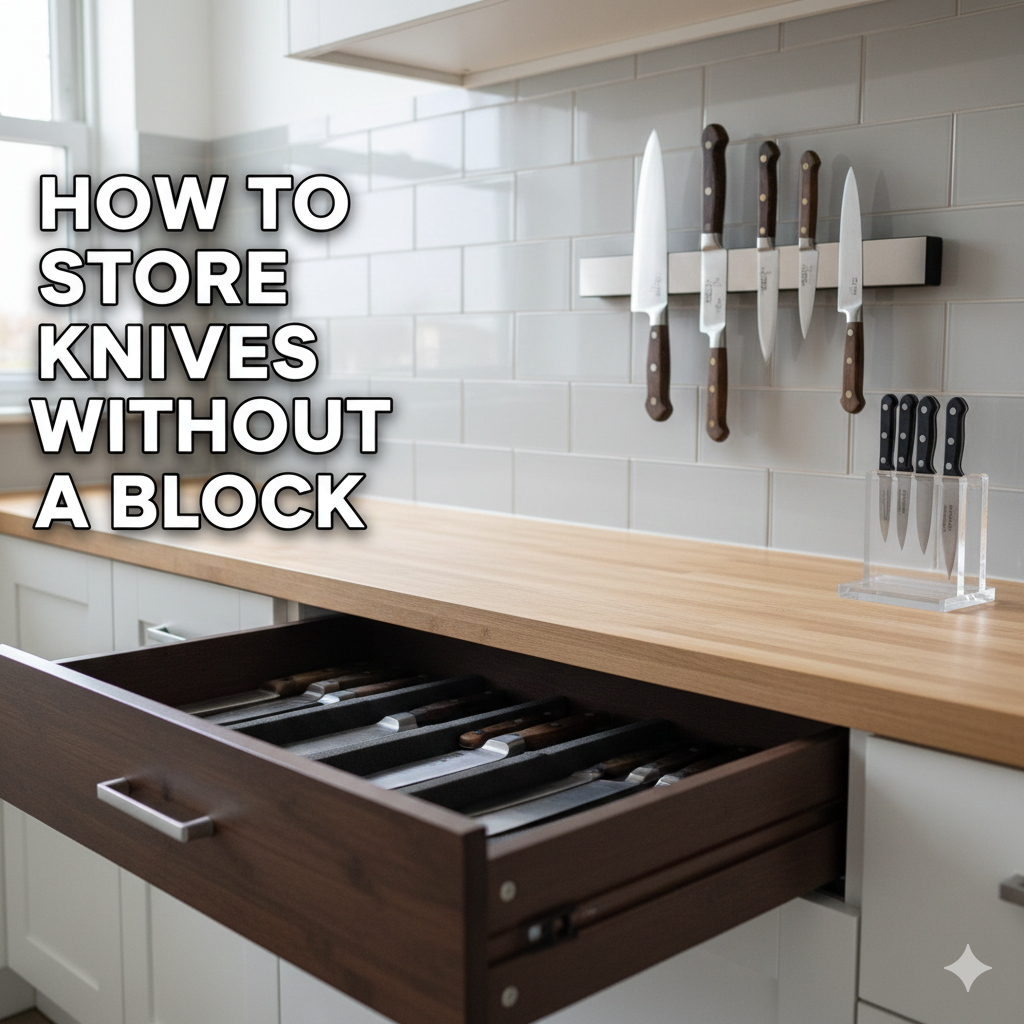
So, the pressing question becomes: how do you store knives without a block while meticulously ensuring they remain safe, instantly accessible, and razor-sharp? Whether you have recently invested a small fortune in the best chef knife brands available, or you are simply trying to better organize your affordable kitchen tools in a cramped apartment, ditching the archaic block is a massive culinary game-changer.
In this exhaustively comprehensive guide, we will explore every professional storage alternative available—from wall-mounted magnetic strips and in-drawer docks, to under-cabinet drops and traditional sayas. We will break down the precise metallurgy of your blades, environmental factors like humidity, and child safety concerns to help you definitively decide which method perfectly suits your unique kitchen layout and cooking style.
1. The Hidden Dangers: Why Ditch the Traditional Knife Block?
Before we dive into the myriad of modern solutions, it is critical to fully understand the problem. While we do occasionally review the best knife sets with blocks (because a select few modern, open-design blocks are actually quite excellent), the standard, closed-slot universal blocks suffer from three severe design flaws that actively harm your kitchen ecosystem.
The Problem (Standard Slotted Blocks)
- Severe Hygiene Risks: Deep, dark, unventilated wooden slots act as incubators. If you slide a slightly damp knife into a slot, it attracts moisture, mold, dust, and food particles. You physically cannot scrub the inside of these slots.
- Micro-Dulling the Edge: The natural act of sliding the knife in and out forces the sharp apex of the blade to drag aggressively against the hard wooden lip of the slot, micro-rolling your edge before you even make your first cut.
- Countertop Clutter: They are massive, heavy, and eat up prime countertop real estate, especially in galleys or small urban kitchens where every square inch of prep space matters.
The Solution (Modern Storage Alternatives)
- Clinical Sanitation: Open-air wall storage or easily washable, flat drawer inserts ensure your blades remain 100% dry, ventilated, and completely sanitary.
- Edge Protection: Strategic magnetic suspension or soft cork resting surfaces physically prevent the sharp edge from aggressively rubbing against hard materials during retrieval.
- Spatial Efficiency: Utilizing vertical wall space or hidden horizontal drawer space drastically clears the counter, making your kitchen look remarkably cleaner and vastly more organized.
2. Method 1: The Magnetic Knife Strip (The Professional Standard)
Walk into almost any high-end professional commercial kitchen or Michelin-starred restaurant, and you will inevitably see an array of steel knives hanging proudly on the wall. The magnetic strip is the absolute gold standard for both clinical hygiene and rapid-fire convenience. It suspends the knife by the flat of the blade, keeping the fragile edge from touching absolutely anything. This is a vital protective measure whether you heavily abuse rugged German steel or delicately slice with hard, brittle Japanese blades.
Why It Works So Well
A magnetic strip elegantly transforms your culinary tools into a visual display. It allows you to see your entire collection at a single glance. You never have to play the frustrating guessing game of repeatedly pulling out the wrong handle to find your best bread knife versus your carving knife. Furthermore, it promotes maximum 360-degree airflow, ensuring your washed knives dry completely—a crucial, non-negotiable step in preventing catastrophic rust on high-carbon steel.
Crucial Installation & Selection Tips
- Location is Everything: Mount it near your primary prep station (above the main cutting board), but ensure it is mounted high enough to be strictly out of reach of curious children. Avoid mounting it directly above the stovetop, as rising aerosolized grease and intense steam will coat the blades in sticky, unsanitary grime.
- Material Matters (Avoid Exposed Metal): You must deliberately choose wood-faced, silicone-covered, or leather-wrapped magnets. Harsh metal-on-metal contact from cheap stainless steel strips will aggressively scratch the sides of your blades, ruining the beautiful Damascus finish of premium knives like those detailed in our Shun vs. Wusthof comparison.
- Magnet Strength (Neodymium is King): Ensure the underlying magnet is strong enough. Heavy, fully forged Western knives with thick bolsters (review the difference between stamped and forged knives here) absolutely require rare-earth neodymium magnets to hold securely without dangerously slipping down the wall.
- Renter-Friendly Solutions: If your landlord strictly forbids drilling into the backsplash tile, look for premium magnetic strips that utilize heavy-duty, double-sided 3M VHB mounting tape, or opt for a heavy, freestanding magnetic countertop easel.
For specific, rigorously tested product recommendations, check out our dedicated guide to the best knife holders.
3. Method 2: In-Drawer Knife Docks & Mats (The Hidden Gem)
If you deeply prefer a minimalist, utterly clean countertop aesthetic, or if you have toddlers whose wandering hands make wall-mounting a major anxiety inducer, the in-drawer organizer (often called a “knife dock”) is vastly superior. Throwing knives loosely into a “junk drawer” is the absolute fastest way to permanently destroy a pristine edge and severely cut your own hand. Docks provide dedicated, slotted resting places that safely cradle individual blades.
Material Showdown: Cork vs. Bamboo vs. Plastic
We highly recommend cork or soft wood (like Bamboo or Acacia) organizers.
Hard plastic is exceptionally easy to throw in the dishwasher (and works perfectly for cheap dishwasher safe steak knives), but cork is the true enthusiast’s choice. Cork contains natural suberin compounds that organically resist mold, moisture, and mildew. Furthermore, cork is incredibly soft and forgiving, guaranteeing it will never dull your blade as you slide it in and out.
When selecting a drawer dock, you must physically measure your longest blade and your drawer depth. A standard dock will house an 8-inch Chef’s Knife easily, but a 10-inch slicing knife or a massive meat cleaver might protrude awkwardly. Check our exhaustive reviews for the best knife drawer organizer to find the exact dimensions that fit your specific setup.
Community Insight: The Great Drawer Debate
The online knife enthusiast community holds incredibly strong opinions on storage. A massive, recent Reddit discussion highlights that many serious home cooks actively prefer custom-cut, cork-lined drawers over any form of countertop display purely for aesthetic minimalism and child safety. Read the fascinating community breakdown here: Reddit: Favorite way to store kitchen knives other than a block?
4. Method 3: Blade Guards and Sayas (The Minimalist / Traveling Chef)
If you cannot physically install a magnetic bar, and your kitchen lacks the drawer space for a bulky wooden dock, you absolutely must rely on individual blade guards (traditionally called Sayas in the world of high-end Japanese cutlery). These are specialized, individual sheaths that slide securely over the cutting edge of the blade.
This method is utterly critical for the following scenarios:
- Small, Easily Lost Knives: Tiny Paring knives and utility blades often get lost in the dark corners of utensil drawers and become hidden, dangerous traps for your fingers without brightly colored covers.
- Highly Specialized Blades: Knives you don’t use on a daily basis, like an incredibly flat Nakiri vegetable cleaver or a curved, flexible boning knife, can be kept completely safe in a guard at the back of a cupboard until they are specifically needed.
- The Traveling Culinary Professional: If you are a chef, a caterer, or taking your knives to an Airbnb, rigid edge guards are the mandatory first line of defense inside your knife bag for chefs. A canvas roll will not stop a naked blade from piercing through.
Guards come in cheap, felt-lined friction-fit plastic (great for everyday budget knives) or gorgeous, custom-carved Magnolia wood with locking pins (essential for protecting the brittle edges of expensive Japanese carbon steel).
5. Method 4: Under-Cabinet Drop-Down Storage
If you lack drawer space and lack usable wall space (perhaps due to windows or intricate tile backsplashes), the under-cabinet drop-down rack is a brilliant, space-saving architectural hack.
These units mount directly underneath your upper kitchen cabinets. They function on a simple hinge mechanism. When closed, the knives are completely hidden, locked safely flush against the bottom of the cabinet, keeping them entirely out of sight and away from children. When you pull the latch, the rack smoothly hinges downward at a 45-degree angle, presenting your knife handles perfectly for rapid selection. It is the ultimate hidden-in-plain-sight storage solution for ultra-modern, minimalist kitchens.
6. Method 5: Universal Bristle Holders (The “Blockless” Block)
If you genuinely love the physical footprint and counter-placement of a traditional block, but hate the fact that slotted wooden blocks dull your knives and dictate exactly which knife goes in which hole, the Universal Bristle Holder (often popularized by brands like Kapoosh) is the perfect compromise.
Instead of rigid wooden slots, these containers are densely packed with thousands of flexible, food-safe plastic rods or bristles. You can physically plunge any knife, of any shape or width, directly into the block at any angle. The bristles seamlessly part to hold the blade securely without dulling the edge. The massive advantage here is hygiene: the entire bristle core can usually be removed, run through the top rack of your dishwasher, and thoroughly sanitized.
7. Storage Considerations Dictated by Knife Type & Metallurgy
Not all knives can or should be stored in the exact same manner. The specific metallurgy of the steel and the shape of the blade heavily dictate the most responsible home for the tool.
Japanese Knives (Santoku, Nakiri, Gyuto)
Knives hailing from heritage brands like Shun, Miyabi, Yoshihiro, or Global utilize significantly harder, but much more brittle steel (often ranging from 60 to 64 HRC). (Dive deeper in our Best Japanese Kitchen Knives guide).
Best Storage Protocol: Custom-fitted Wooden Sayas or completely wood-faced magnetic strips. You must aggressively avoid exposed metal magnetic strips, as the hard “snap” of the magnet pulling the blade against raw metal can instantly chip a microscopic, delicate Japanese edge.
Western/German Knives (Wüsthof, Zwilling, Victorinox)
These legacy blades are forged from slightly softer, significantly tougher, and highly corrosion-resistant steel (usually 56-58 HRC). (Learn more in our Best German Kitchen Knives overview).
Best Storage Protocol: In-drawer docks or standard, heavy-duty magnetic strips. German knives are notoriously heavy and feature thick, weighted bolsters. Ensure your magnet is exceptionally strong. If you are deeply comparing Zwilling vs Henkel, know that both thick-spined brands thrive on high-strength magnetic bars.
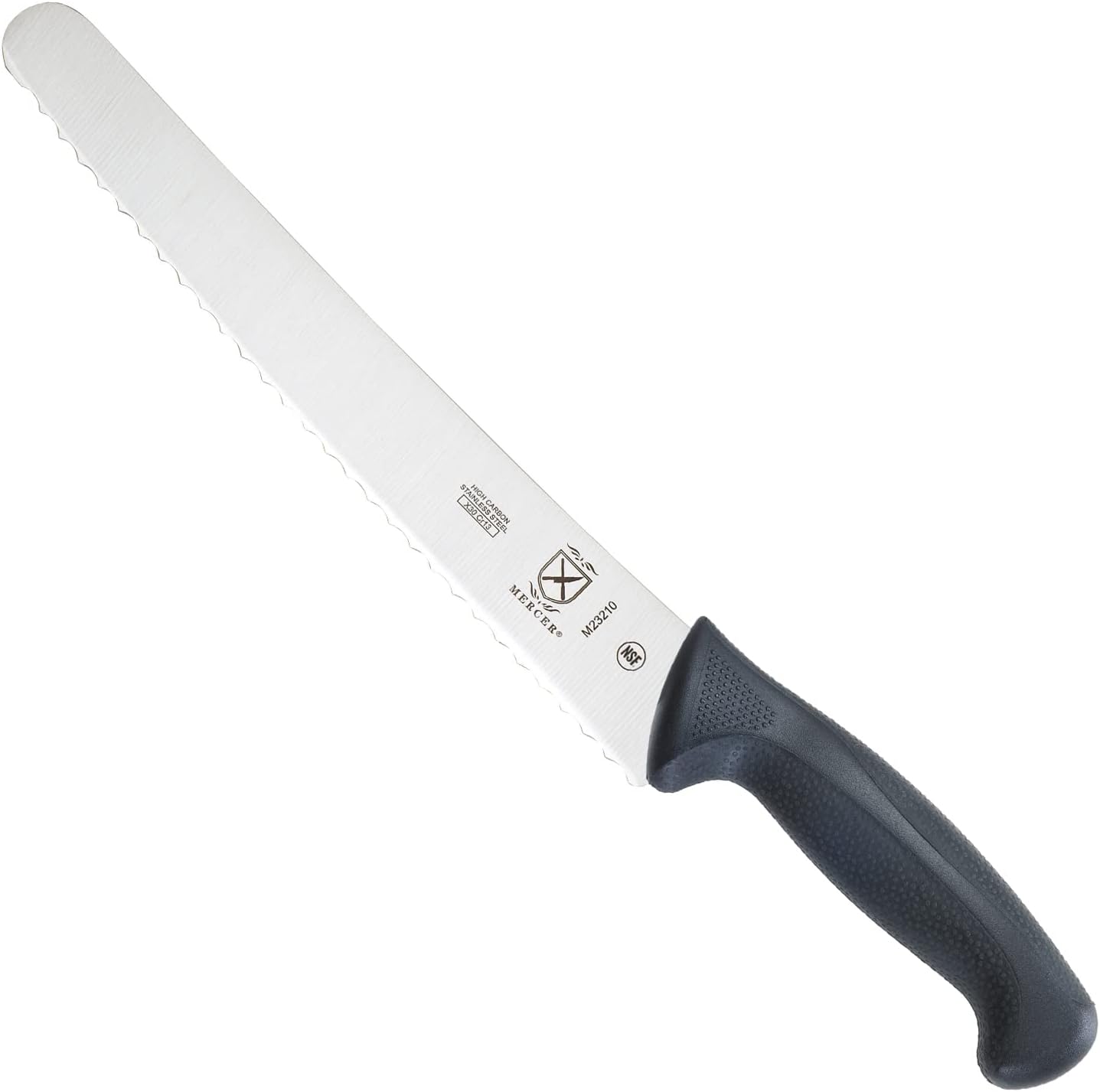
Serrated Bread Knives
Bread knives have incredibly long, jagged blades (often 10 inches or more) that simply do not fit in standard block slots or shallow drawer docks.
Best Storage Protocol: Magnetic strip. Storing them on a wall keeps the sharp, aggressive teeth from constantly snagging on wooden drawer dividers or scratching other flat-edged knives. Learn exactly how to utilize their unique edge here: What is a Serrated Knife Used For?
8. Maintenance Protocol: What You MUST Do Before Storage
The most expensive storage system in the world is completely rendered useless if the knife is put away improperly. You must never store a dirty, damp, or highly acidic knife.
- Immediate Hand Washing: Never leave a knife sitting in the sink. The acids from foods like onions and tomatoes will aggressively pit the steel. Hand wash with warm, soapy water immediately.
- Bone Dry Toweling: Dry the blade entirely with a microfiber cloth. Any residual moisture trapped inside a drawer dock or a plastic guard will rapidly accelerate rust.
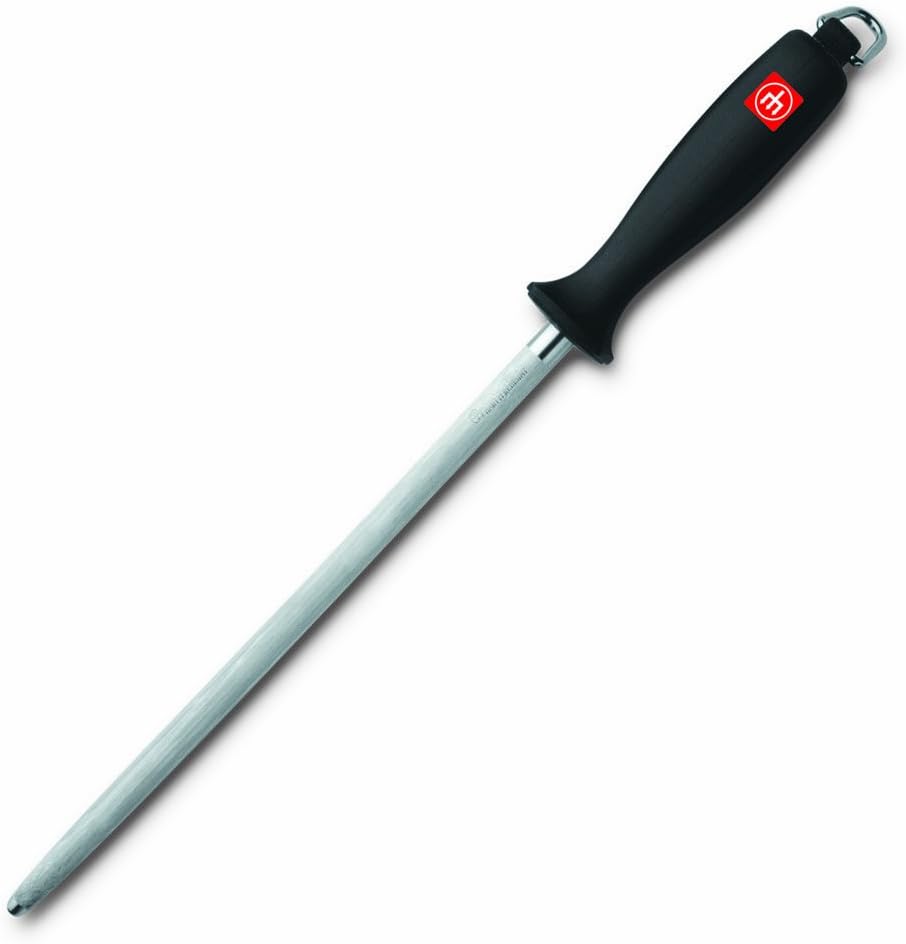
- The Pre-Storage Hone: We highly recommend honing your knife on a steel or ceramic rod before storage. This realigns the edge so that the very next time you reach for it to cook, it is performing at peak, razor-sharp efficiency. See our guide on the best manual sharpeners to master this.
- Oiling Carbon Steel: If you use reactive high-carbon steel (not stainless), you must apply a microscopic layer of food-safe mineral oil or Japanese Tsubaki (Camellia) oil to the blade before sliding it into a wooden Saya or drawer to prevent environmental oxidation.
9. Top Product Recommendations for Blockless Storage
Based on our exhaustive testing of Henckels vs. Victorinox and countless other top-tier brands, here are the absolute best, most reliable storage solutions we actively recommend for your kitchen upgrade.
 Premium Walnut Magnetic Knife Bar (16 Inch)
An exceptionally stylish, continuous wood-faced magnet powered by hidden neodymium. It holds incredibly heavy forged knives securely without ever scratching the delicate blade finish. The ultimate, hygienic space saver.
Check Availability on Amazon Noble Home & Chef Bamboo In-Drawer Organizer
Designed to fit smoothly into standard kitchen drawers, holding up to 16 knives of varying sizes. The carved, wavy design keeps heavy handles easily accessible while entirely protecting the fragile edges from banging together.
Check Availability on Amazon Messermeister Edge-Guard Set
The absolute best budget solution for the nomadic cook. These highly durable, felt-lined plastic sheaths gently pinch the blade, allowing you to safely store knives in any chaotic drawer or travel bag without fear of cuts.
Check Availability on AmazonExpert Frequently Asked Questions (FAQ)
Absolutely not. Ceramic material is entirely non-magnetic and will not adhere to the strip. You must use a slotted drawer dock or individual, hard plastic protective sheaths. Because ceramic is exceptionally hard but incredibly brittle, you must ensure it doesn’t rattle against other metal utensils in a drawer, or it will rapidly chip and shatter.
Yes, over a long period of prolonged exposure, a powerful neodymium magnet can slightly magnetize the high-carbon steel of your knife blade. This is generally harmless, though it can become mildly annoying if you are sharpening on a whetstone, as the microscopic metal filings (swarf) might stick to the side of the blade instead of washing away. Running the blade through a cheap demagnetizer instantly fixes this.
You have two excellent options. Look for lightweight, premium magnetic strips that are specifically designed to be mounted using heavy-duty, double-sided mounting tape (like 3M VHB outdoor tape) instead of metal wall screws. Alternatively, there are beautiful, freestanding magnetic wooden easels (stands) that sit directly on the counter but offer the exact same open-air, sanitary benefits as a wall mount.
It absolutely can. Natural leather absorbs and traps environmental moisture incredibly well. If you live in a highly humid coastal climate, do not store raw high-carbon knives locked in a leather roll for long-term storage. Use a highly breathable waxed canvas roll, or rigorously ensure you apply a thick coat of food-safe mineral oil to the blade before rolling it up.
The Santoku and the Chinese Cleaver possess significantly taller blade heights than a standard utility knife. You must physically measure your blades before buying. Ensure your chosen drawer dock slots are wide and deep enough so the edge doesn’t rest on the bottom of the drawer, or simply bypass the issue entirely by using a flat magnetic strip which flawlessly accommodates any width or height.
Conclusion: Elevate Your Culinary Workspace
Ditching the massive, bulky, and undeniably germ-prone wooden knife block is quite frankly one of the absolute best, most immediate functional upgrades you can possibly make for your kitchen ecosystem. Whether you ultimately choose the striking, professional, open-air aesthetic of a gorgeous walnut magnetic strip, or the sleek, discreet, child-safe organization of an in-drawer bamboo dock, the ultimate goal remains exactly the same: Protect the microscopic cutting edge, protect your wandering fingers, and keep your culinary prep station meticulously clean and efficient.
Once your organizational storage is flawlessly sorted, make absolutely sure the blades you are protecting are truly worthy of their new, upgraded home. Check out our exhaustive buyer’s guides on the best budget chef knives to expand your collection, or prepare to upgrade to the big leagues with our comprehensive Wusthof vs Victorinox deep-dive comparison. Happy, safe, and organized cooking!