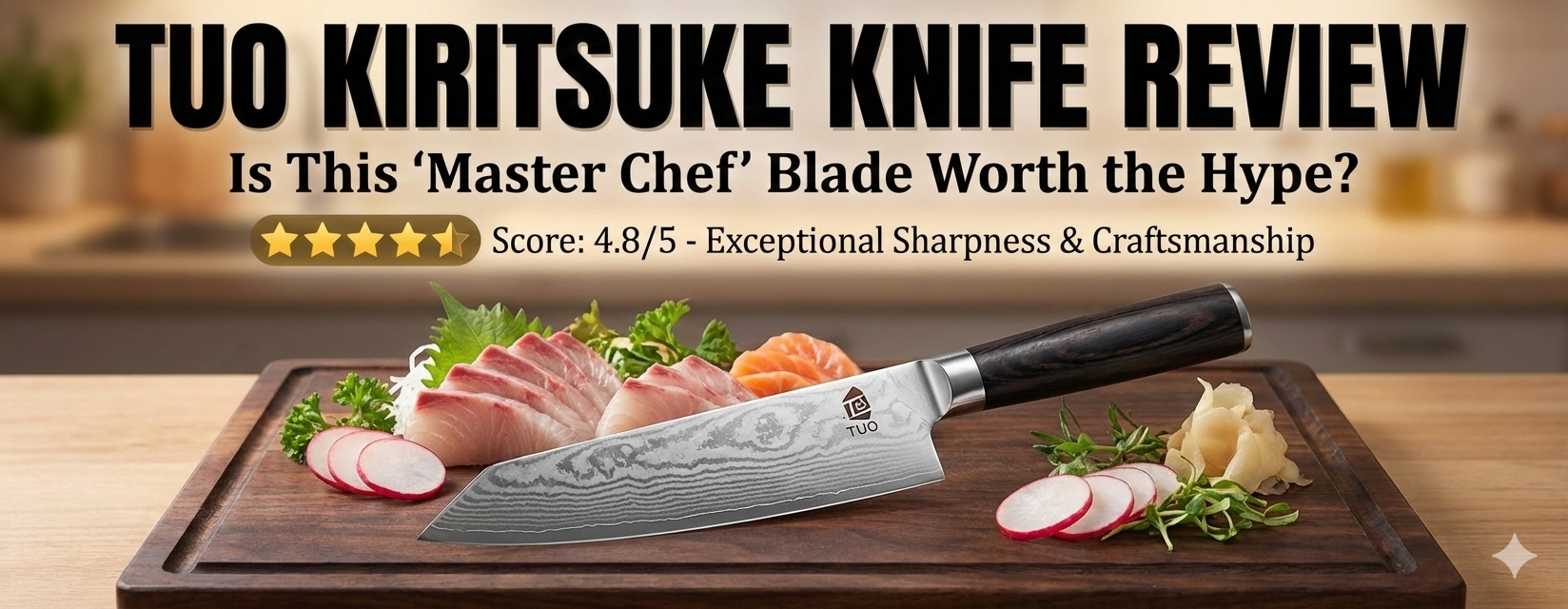
TUO Kiritsuke Knife Review: Is This “Master Chef” Blade Worth the Hype?
Introduction: The Rise of the Hybrid Master
In the hierarchy of Japanese cutlery, few blades command as much respect—and intimidation—as the Kiritsuke. Traditionally, in high-end Japanese kitchens, the Kiritsuke is a single-bevel sword used only by the Executive Chef (the Itamae). It is a status symbol, a hybrid of a Yanagiba (slicer) and an Usuba (vegetable cleaver), notorious for being difficult to master.
Enter TUO Cutlery. This brand has disrupted the market by taking this legendary profile and adapting it for the home cook. They have replaced the difficult single-bevel grind with a user-friendly double-bevel edge, bringing the aesthetic of the master chef to your kitchen counter for a fraction of the price of a traditional Japanese blade.
But does a budget-friendly interpretation of such a specialized tool actually work? Or is it just a chef knife in a costume? In this comprehensive TUO Kiritsuke Knife review, we are putting the popular Black Hawk Series 8.5-inch Kiritsuke and the premium Ring Series Damascus Kiritsuke to the test. We will analyze the steel, the ergonomics, and the cutting performance to see if TUO deserves a spot in your knife roll alongside the best Japanese kitchen knives.
Wait, What Exactly is a Kiritsuke?
Before we dive into the TUO specifically, it is vital to understand what you are buying. If you read our guide on Kiritsuke knife uses, you know that this knife is essentially a multi-purpose powerhouse.
The profile features a flat edge like a vegetable cleaver, ideal for push-cutting (chopping straight down and pushing forward). However, unlike a Nakiri, it has a “reverse tanto” tip—that aggressive, angled point—which allows for intricate work like brunoise (fine dicing) or scoring meat.
The TUO Difference: A traditional Kiritsuke is single-bevel (sharpened on one side). The TUO Kiritsuke is double-bevel. This means it cuts like a standard Western chef knife. It gives you the look and the flat profile of the Kiritsuke without the learning curve.
Product Overview: The Black Hawk Series
TUO offers several lines, but the Black Hawk Series is their flagship value proposition. It was nominated for “Best Kitchen Knife” by the Wiki Ezvid in 2016, and it remains a best-seller.
Key Specifications
- Blade Material: German HC Stainless Steel (X50CrMoV15).
- Hardness: 56±2 HRC.
- Handle: Pakkawood (Composite).
- Construction: Full Tang, Forged.
- Edge Angle: 8-12 degrees per side (advertised).
Wait, German steel in a Japanese profile? Yes. This is a common hybrid approach. By using X50CrMoV15 (the same steel found in Wüsthof), TUO ensures the blade is durable and resistant to chipping. If you want to compare this steel to others, check our article on best German kitchen knives.

Deep Dive Review: Design and Features
1. The Blade: Geometry and Aesthetics
The first thing you notice about the TUO Kiritsuke is the satin finish. It looks professional. The blade is relatively tall at the heel, providing excellent knuckle clearance—a must for those with larger hands.
The “reverse tanto” tip is not just for show. In our testing, this tip was exceptional for slicing through onion layers without piercing the root. The flat belly means you cannot “rock chop” effectively (like you would with a rounded chef knife), but for push-cutting carrots and cucumbers, it functions beautifully, similar to a Nakiri knife.
2. The Handle: Ergonomics Meets Durability
The handle is made of Pakkawood, a resin-impregnated wood composite that is impervious to moisture. This is crucial for hygiene and longevity.
The shape is unique to the Black Hawk series. It is not a traditional round Japanese Wa-handle, nor is it a blocky German handle. It is contoured, slightly square but with rounded edges, designed to fill the palm. It encourages a “pinch grip,” where your thumb and index finger grip the blade itself. This enhances control, which is vital for a blade of this length (8.5 inches).
3. Fit and Finish
For a knife in the $40-$60 range, the finish is surprising. The spine is polished (no sharp corners digging into your hand), and the rivets are flush with the handle. While it doesn’t have the hand-finished soul of a $300 artisan blade, it feels much more expensive than it is.
4. The Steel Choice: German vs. Japanese
Using German X50CrMoV15 steel is a strategic choice. Authentic Japanese steel (like VG10 or Blue Carbon) is hard but brittle. It chips easily if you twist the blade.
TUO’s choice of German steel means this Kiritsuke is tough. You don’t have to baby it. It handles squash and melon rinds without fear of micro-chipping. However, it requires more frequent honing than a VG10 blade. To understand this trade-off, read AUS-10 steel vs VG10.
Performance Evaluation: Cutting Tests
We ran the TUO Kiritsuke through a series of standard kitchen tasks.
The Paper Test
Out of the box, the knife sliced through standing paper effortlessly. TUO sharpens their knives to a 12-degree angle, which is significantly sharper than the standard 20-degree angle of Western knives.
The Tomato Test
The blade bit into the skin of a ripe tomato without sliding. This indicates a well-polished edge with good “bite.”
The Carrot Test (Hard Vegetable)
This is where the blade thickness matters. The TUO is not a “laser” (extremely thin blade). It has some heft. While it cracked the carrot slightly less than a thick German wedge, it doesn’t glide quite as effortlessly as a Kiwi knife. However, the weight of the blade helps do the work for you.
The Meat Test
Using the long flat edge to slice flank steak was a joy. The 8.5-inch length allows for long, single-stroke cuts, leaving the meat surface smooth rather than jagged. It performs almost as well as a dedicated slicing knife.
Comparison: TUO vs. The Competitors
TUO vs. Dalstrong (Shogun & Gladiator Series)
Dalstrong is the direct competitor in the “Amazon premium” space.
- Aesthetics: Dalstrong is flashier (mosaic pins, loud branding). TUO is more understated.
- Price: TUO is generally 30-40% cheaper than Dalstrong for similar steel specs (specifically comparing TUO Black Hawk to Dalstrong Gladiator).
- Verdict: If you want the “wow” factor, go Dalstrong. If you want pure value, go TUO. (See more: Dalstrong vs Shun).
TUO vs. Shun (Classic Kiritsuke)
Shun is the mass-market standard for Japanese knives.
- Steel: Shun uses VG-MAX (Harder, holds edge longer). TUO uses German Steel (Softer, tougher).
- Finish: Shun’s Damascus cladding is real and stunning. TUO’s Black Hawk is plain satin.
- Price: Shun is 3x the price.
- Verdict: Shun is a better knife, objectively. But is it 3x better? For a home cook, probably not.
TUO vs. Traditional Chef Knives
Why buy this over a standard chef knife?
- If you “rock chop” herbs heavily, stick to a curved chef knife (See: Best Chef Knife Brands).
- If you prefer push-cutting and want a cooler-looking blade that acts like a vegetable cleaver with a tip, get the TUO Kiritsuke.
Pros and Cons Summary
| Pros | Cons |
|---|---|
| ✅ Hybrid Versatility: Combines the best of a cleaver and a slicer. | ❌ Learning Curve: The flat belly requires a change in cutting technique (no rocking). |
| ✅ Incredible Value: High-end finishing for a budget price. | ❌ Steel Softness: German steel (56 HRC) loses razor edge faster than true Japanese steel (60+ HRC). |
| ✅ Ergonomics: The handle shape is exceptionally comfortable for pinch grips. | ❌ Sheath: Usually comes with a basic plastic tip guard, not a full saya (sheath). |
| ✅ Durability: Tougher and less prone to chipping than VG10 blades. | ❌ Blade Height: Might be too tall for users with very small hands. |
Maintenance: Keeping the Phoenix Flying
Even though the steel is durable, this knife requires care to maintain its performance.
Sharpening vs. Honing
Because the steel is slightly softer (56 HRC), the edge can roll over time. You should use a honing steel before every heavy use to realign the edge. When it comes time to sharpen, this steel responds beautifully to standard whetstones (1000/6000 grit combo is perfect).
Tip: Do not use a pull-through sharpener designed for 20-degree edges! It will ruin the 12-degree geometry of the TUO. Read our guide on best knife sharpeners to find an angle-adjustable option or learn to use stones.
Storage
The Kiritsuke has a very sharp, delicate tip. Do not throw this in a drawer. It will bend. Use a knife block or a magnetic strip. If you are worried about magnetism scratching the finish, read are magnetic knife strips bad for knife edges?
Cleaning
Hand wash only. The Pakkawood handle and high-carbon stainless steel will degrade in a dishwasher. Dry immediately to prevent water spots.
Frequently Asked Questions
Is the TUO Kiritsuke single or double bevel?
The TUO Kiritsuke is double-bevel. This is a crucial distinction. It means the knife is sharpened on both sides (50/50 split), making it easy to use for anyone accustomed to Western knives. It is also ambidextrous.
What steel is used in the TUO Black Hawk Kiritsuke?
It uses German X50CrMoV15 high-carbon stainless steel. This is the same steel used by brands like Wüsthof and Zwilling. It offers a great balance of rust resistance and toughness.
Is TUO a good knife brand?
Yes. They have carved a niche as a high-value manufacturer. While they don’t have the centuries-old history of Solingen brands, their manufacturing quality (CNC precision + manual finishing) is excellent for the price.
Can I use the TUO Kiritsuke for bones?
No. Despite looking like a cleaver, the edge is thin. Hacking at chicken bones will roll or chip the edge. Use a butcher knife for heavy duty work.
Final Verdict
The TUO Kiritsuke (Black Hawk Series) is a triumph of globalization. It takes a Japanese profile, builds it with German steel, manufactures it in China, and sells it at a price accessible to everyone.
It is not a “true” Kiritsuke in the traditional sense—and that is a good thing for 99% of home cooks. It is easier to maintain, tougher, and more versatile. If you are looking to break away from the boredom of a standard 8-inch chef knife and want a blade that excels at push-cutting vegetables and slicing meat, this is a fantastic entry point.
Recommendation:
- Buy the Black Hawk Series if you want the best value and a durable workhorse.
- Buy the Ring-D Series if you want the aesthetic of Damascus steel and slightly better edge retention (AUS-10 steel).
Ready to master the art of the Kiritsuke?
Check Latest Prices & Reviews