Exposing the Kitchen Legend: Comprehensive MAC Chef Knives Review
Walk into any Michelin-starred kitchen, high-end bistro, or intense culinary school environment, and you will notice a trend. Amidst the flash of expensive custom Damascus steel and the rugged reliability of heavy German beaters, there is one knife that appears with astonishing frequency. It usually has a matte black handle, a shockingly thin blade, and a simple, unassuming logo: MAC.
For decades, MAC knives have been the worst-kept secret in the culinary world. Revered by icons like Thomas Keller and Charlie Trotter, these Japanese-crafted blades have achieved a cult-like status among line cooks and executive chefs alike. But in a modern market saturated with boutique knife makers and direct-to-consumer brands, do they still hold the crown?
In this extensive MAC chef knives review, we are going deep into the metallurgy, the unique asymmetrical edge geometry, and the ergonomic design that makes these knives legendary. We will analyze the flagship Professional Series, compare them against industry titans, and help you determine if a MAC knife deserves a spot on your cutting board.
1. Introduction to MAC Knives: The Professional’s Choice
MAC knives are not designed to be display pieces. You won’t find hammered finishes (tsuchime), intricate folded Damascus cladding, or exotic burl wood handles. MAC builds pure, unadulterated cutting instruments. They are the quintessential “function over form” kitchen tool.
What makes a MAC knife exceptional is its specific hybridization. It takes the razor-thin, lightweight profile and high-hardness steel of traditional Japanese cutlery, and marries it to the familiar, curved belly and Western handle shape of a German chef’s knife. This creates a blade that feels instantly familiar in the hand but cuts with a terrifying, laser-like precision that German knives simply cannot match.
Because they strike this perfect balance, they have become the ultimate transitional knife for Western cooks looking to upgrade to high-performance Japanese steel without completely abandoning their traditional cutting techniques.
2. The History and Philosophy of MAC Corporation
The story of MAC begins in 1964 with Tatsuo Kobayashi. While studying in the United States, Kobayashi accidentally dropped a kitchen knife. It landed tip-down, and the sharp, pointed tip snapped off completely. Instead of throwing it away, he reshaped the broken end into a rounded tip. To his surprise, he found the knife safer to use and highly effective.
Returning to Japan, Kobayashi founded the MAC Corporation in Seki City—the historical epicenter of Japanese sword making. He partnered with local blacksmiths to refine his designs, ultimately securing patents for his unique edge geometry and distinctive blade shapes.
The name “MAC” stands for Macro. Kobayashi wanted to create a knife that was macro-versatile, appealing to the macro-majority of cooks around the world. Today, the company remains relatively small and intensely focused, hand-crafting and hand-sharpening their blades in Japan using the same rigorous quality control standards they established over half a century ago.

3. MAC Steel: The Proprietary Chrome Molybdenum Alloy
If you ask a knife nerd what steel a MAC is made from, you will get a frustrating answer. MAC closely guards their specific metallurgical formula. However, they do disclose that it is a proprietary, high-carbon Chrome Molybdenum Vanadium alloy, further enriched with Tungsten.
Here is why that combination matters in the kitchen:
- High Carbon: Allows the steel to be hardened significantly. MAC tempers their blades to roughly 59-61 on the Rockwell Hardness scale (HRC). This is much harder than standard German steel (usually HRC 56-58), allowing the MAC to hold a sharper edge for much longer.
- Chrome & Molybdenum: These elements provide excellent stain and rust resistance. While not 100% rust-proof, it requires far less maintenance than a pure carbon steel Japanese knife.
- Tungsten: This is the secret weapon. Tungsten adds incredible wear resistance and toughness. It allows MAC to grind their blades astonishingly thin without the edge instantly micro-chipping when it hits the cutting board.
- Sub-Zero Tempering: On their Professional lines, MAC cryogenically treats the steel, freezing it to extremely low temperatures after heat treatment. This refines the grain structure, making the blade even more durable and capable of taking a wicked edge.
4. Blade Geometry: The Legendary MAC Edge
The steel is excellent, but the geometry is where MAC truly shines. Pick up a Wüsthof or Zwilling, and look at the spine; it’s thick, tapering down to a wedge. Pick up a MAC, and the spine is shockingly thin—often around 2mm or less. This thinness allows the knife to glide through dense vegetables like carrots and potatoes without wedging or cracking them.
Furthermore, MAC utilizes an asymmetrical edge grind. Most Western knives are sharpened to a 50/50 V-edge. MAC sharpens their knives to an off-center angle, typically 60/40 or 70/30. This creates a shallower angle on the cutting side, mimicking the frictionless slicing capability of a traditional single-bevel Japanese knife, while remaining easy to steer.
The profile of the blade also features a gradual curve (belly) towards the tip. If you are deciding between different cutting styles, reading up on chef knife uses in rocking vs push cutting will help you understand why MAC’s hybrid profile is so brilliant. It is flat enough at the heel for rapid up-and-down push cutting (Japanese style), yet curved enough at the tip to allow for smooth rocking motions over herbs and garlic (Western style).

5. The MAC Professional Series (Focus on MTH-80)
The MAC Professional Series is the flagship line, and the crown jewel of this collection is the MTH-80 (8-inch Chef’s Knife with Dimples). This specific knife has won nearly every major culinary gear award in existence.
What sets the Professional series apart is the inclusion of a forged steel bolster (the metal band where the blade meets the handle). This bolster adds a slight amount of weight to the center of the knife, providing perfect, gravity-assisted balance directly at the pinch grip. The steel is sub-zero tempered, and the handles are made from premium Pakkawood.
The MTH-80 also features Granton edges (scalloped dimples) running along the blade. These dimples create tiny air pockets between the steel and the food, reducing suction and preventing starchy vegetables like potatoes from sticking to the side of the blade as you chop. It is, quite simply, a masterpiece of kitchen engineering.
6. The MAC Superior Series
If you want the legendary MAC edge but are working with a tighter budget, the Superior Series is the answer. These knives use the same high-carbon Chrome Molybdenum steel as the Professional line, but they lack the forged steel bolster and the sub-zero cryogenic tempering.
Because they lack the bolster, Superior series knives are noticeably lighter. The blade is also stamped slightly thinner. For home cooks who prioritize nimbleness and a feather-light feel over the weighted, forward-falling momentum of a professional chef’s knife, the Superior Santoku or Superior Chef’s knife is an incredible value. The handles are slightly elevated, offering excellent knuckle clearance on the cutting board.

7. The MAC Original Series
The MAC Original Series is where it all started. These knives are easily identified by their unique, fully rounded tips and the signature hole punched through the end of the blade.
While professional chefs rarely use the Original series today, they hold a special place for specific users. The rounded tip makes them incredibly safe for older cooks, children learning culinary skills, or chaotic, cramped environments (like boat galleys) where dropping a pointed knife is a major hazard. The hole at the tip allows the knife to be hung safely on a peg. They feature a very thin, flexible blade that excels at slicing soft vegetables and proteins.
8. Handle Design and Ergonomics: Comfort Meets Function
A knife is only as good as its handle, and MAC takes a decidedly Western approach to their ergonomics. While traditional Japanese knives use round or octagonal wooden “Wa” handles, MAC utilizes a classic Western shape, featuring a full tang and three metal rivets.
The handles are constructed from Pakkawood. This is an engineered material made by impregnating layers of natural hardwood with structural resin under extreme heat and pressure. The result is a handle that looks and feels like warm, natural wood, but is completely waterproof, warp-resistant, and hygienic. It won’t shrink or crack over decades of use.
MAC slightly elevates their handles relative to the blade. This ergonomic tweak provides massive knuckle clearance, ensuring you never rap your knuckles against the cutting board when completing a chop.

9. MAC vs. Wüsthof vs. Global: The Hybrid Advantage
How does MAC stack up against the other giants of the culinary world?
Vs. Wüsthof: Wüsthof represents the pinnacle of German forging. Their knives are heavy, thick, and practically indestructible. However, they wedge in hard vegetables and require frequent honing. To see how these two fundamentally different philosophies clash, read this deep dive on MAC vs Wüsthof hybrid Japanese vs German forged knives. Ultimately, MAC wins on pure cutting performance and sharpness, while Wüsthof wins on sheer durability for tasks like splitting squash or navigating bones.
Vs. Global: Global is another massively popular Japanese brand, famous for their all-steel, seamless construction. Global knives are incredibly light and feature a convex edge. However, many chefs find Global’s metal handles become slippery when wet. MAC’s Pakkawood handle offers far superior grip, and the proprietary MAC steel holds its edge noticeably longer than Global’s Cromova 18 steel.
| Brand | Steel Hardness (HRC) | Blade Profile | Best For |
|---|---|---|---|
| MAC (Professional) | 59 – 61 | Ultra-thin, Asymmetrical | Precision slicing, professional prep, laser-like cutting. |
| Wüsthof (Classic) | 58 | Thick, 50/50 V-Edge | Heavy-duty chopping, durability, rock-chopping. |
| Global (G-Series) | 56 – 58 | Thin, Convex Edge | Lightweight agility, modern seamless aesthetics. |
10. Edge Retention and Sharpening MAC Knives
Because MAC tempers their steel to HRC 60, their edge retention is stellar. A home cook can easily go six months between major sharpening sessions. However, because the blade is thin and hard, you must treat it with respect. Never use a pull-through carbide sharpener on a MAC knife; it will tear the delicate, asymmetrical edge to shreds.
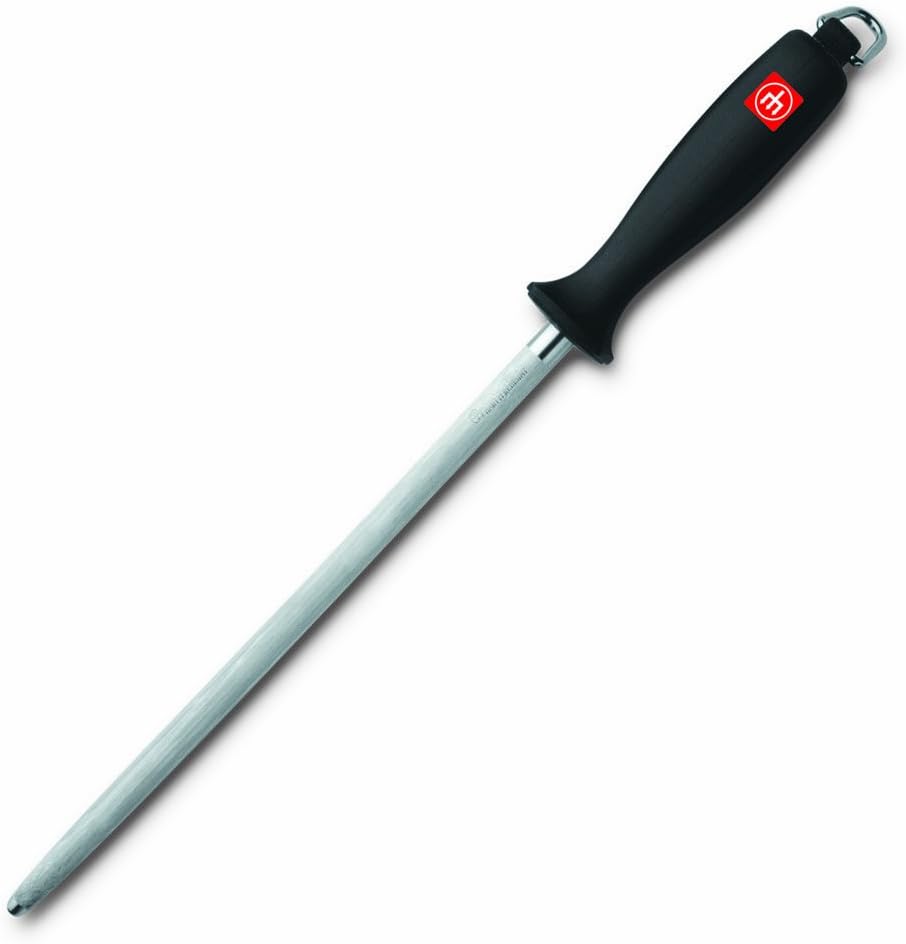
To maintain a MAC, you should hone it regularly with a fine ceramic rod (do not use a heavily ribbed steel honing rod). When it comes time to truly sharpen the blade, you must use whetstones. Because of the asymmetrical grind, you will spend slightly more time sharpening the right side of the blade than the left. If you are new to this process, studying the ultimate knife sharpening guide for professional edges is mandatory to ensure you don’t ruin the factory geometry.

11. Pros and Cons of MAC Kitchen Knives
No knife is perfect for every single user. Here is the honest breakdown of where MAC excels and where it falls short:
Pros
- Incredible out-of-the-box sharpness.
- Laser-thin geometry prevents wedging in dense root vegetables.
- Hybrid profile allows for both push-cutting and rocking.
- Pakkawood handles are exceptionally comfortable and durable.
- Lighter than German knives, reducing wrist fatigue.
Cons
- Fragile edge: Can chip if used on bones, frozen food, or hard pits.
- Utilitarian looks: Lacks the visual “wow” factor of Damascus knives.
- Asymmetrical grind requires a learning curve for sharpening.
- Not completely rust-proof; requires prompt washing and drying.
12. Final Verdict: Are MAC Knives Worth the Money in 2026?
If you are serious about cooking, the answer is a definitive yes. MAC knives, particularly the Professional MTH-80, represent the sweet spot of culinary cutlery. They offer the terrifying, laser-like cutting capability of a high-end Japanese blade, combined with the comfortable, familiar ergonomics of a Western knife.
When curating your culinary arsenal, selecting versatile tools is key. As noted in discussions regarding essential kitchen knives for a professional rotation, a MAC chef’s knife effortlessly anchors any collection, handling 90% of your daily prep work with unmatched grace and efficiency.
They aren’t flashy, and they don’t look like art pieces. They are serious tools engineered for serious cooks. If you prioritize performance, balance, and edge retention above all else, MAC is arguably the best kitchen knife brand in the world.
Frequently Asked Questions
Upgrade Your Kitchen Experience
Dull, poorly balanced knives make cooking a chore and increase your risk of injury. A MAC chef knife transforms meal prep from a tedious task into a culinary joy. By merging the best elements of Eastern precision and Western durability, MAC has crafted a tool that will elevate your skills and last a lifetime.
Stop fighting your ingredients. Experience the effortless glide of a true Japanese hybrid today.
Ready to Wield the Professional’s Secret?
Shop the legendary MAC Professional Series and feel the difference of a razor-thin, perfectly balanced blade.
Shop MAC Knives on Amazon