Are Messermeister Knives Good? The Boutique German Brand Explained
When diving into the world of premium kitchen cutlery, most conversations inevitably circle around the two massive German titans: Wüsthof and Zwilling J.A. Henckels. Their logos are ubiquitous, their marketing budgets are massive, and their knives are found in high-end department stores worldwide. But lurking just off the mainstream radar is a third German contender, a brand revered by professional chefs and knife enthusiasts alike: Messermeister.
If you are asking, “Are Messermeister knives good?” the short answer is a resounding yes. In fact, many culinary professionals argue that they offer a superior cutting experience compared to their more famous Solingen neighbors. Messermeister blends the legendary durability of traditional German steel with the refined, aggressive edge geometry typically reserved for Japanese knives.
In this exhaustive 12-section review, we are going to dissect the Messermeister brand. We will analyze their hot-drop forging process, their unique half-bolster design, the physics of their 15-degree edges, and directly compare them to the biggest names in the industry to help you decide if they belong on your magnetic knife strip.
1. Introduction to Messermeister: The Boutique Alternative
Unlike massive corporate conglomerates, Messermeister has an intimate, family-driven history. Founded in 1981 by Bernd Dressler—a German immigrant to Australia who eventually settled in California—the company was built on a simple premise: to provide professional chefs with premium German cutlery that addressed the common flaws found in mass-produced knives.
Today, Messermeister is a 100% women-owned company, helmed by Bernd’s daughters, Kirsten and Chelcea. The name itself is a portmanteau of the German words Messer (knife) and Meister (master). What makes Messermeister uniquely appealing is their “stealth wealth” status in the culinary world. They don’t spend millions on celebrity chef endorsements or flashy television commercials. Instead, they funnel their resources into manufacturing.
When you buy a premium Messermeister knife, you are buying a tool that feels distinctly handcrafted. They remain committed to hot-drop forging their flagship blades—an old-world technique that aligns the molecular structure of the steel for superior strength—rather than transitioning entirely to the cheaper, laser-cut stamped methods favored by modern mass-market brands.
2. The History and Heritage of Solingen, Germany
To understand the quality of a Messermeister blade, you must look to its birthplace: Solingen, Germany. Known globally as the “City of Blades,” Solingen has been the epicenter of European sword and knife making for over 700 years. The region’s natural resources—abundant iron ore, dense forests for charcoal, and fast-flowing rivers to power grinding wheels—created the perfect storm for metallurgical mastery.
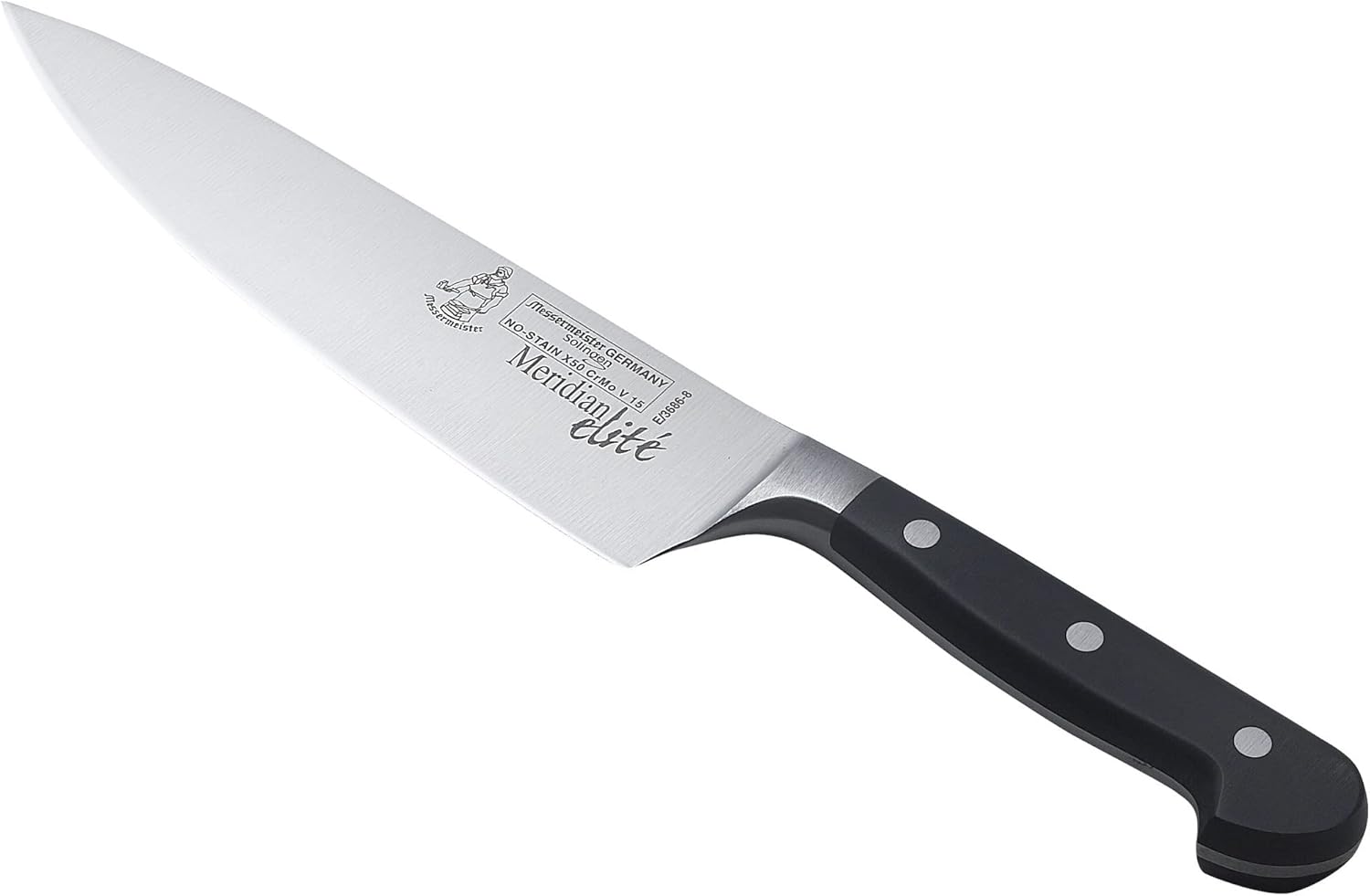
Messermeister’s premium lines (Meridian Elite, Oliva Elite, and Custom) are proudly stamped with the Solingen mark. This is not just a geographical indicator; it is a legally protected designation of quality. To bear the name “Solingen” on a blade, the knife must meet incredibly strict manufacturing standards set by the local German government regarding material quality and the forging process.
For a deeper understanding of why this region dictates the global standard for European cutlery, exploring the history of Solingen steel and the best German kitchen knives reveals the centuries of metallurgical science backing every Messermeister blade.
3. Core Characteristics: What Makes Messermeister Different?
If Messermeister uses the same German steel as Wüsthof and Zwilling, and they are forged in the exact same city, what actually sets them apart? The magic lies in the subtle design choices driven by chef feedback.
Here are the core pillars of the Messermeister philosophy:
- The 15-Degree Edge: While traditional German knives are sharpened to a blunt, durable 20 degrees per side, Messermeister pushes the envelope by sharpening their blades to a razor-thin 15 degrees, mimicking Japanese performance.
- The Half-Bolster (Cambered Bolster): They eliminate the thick, heavy chunk of steel at the heel of the blade (the full bolster), allowing you to sharpen the knife completely from tip to heel.
- Polished Spines: Run your finger along the top spine of a cheap knife, and it feels sharp and angular. Messermeister rounds and hand-polishes the spine, making pinch-gripping the knife incredibly comfortable for hours of prep work.
- Hot-Drop Forging: They continue to use traditional hammer forging, compacting the steel to create a denser, tougher blade than standard stamping processes allow.
4. Steel Quality: Analyzing the 1.4116 Stainless Alloy
The beating heart of any knife is its steel. Messermeister utilizes X50CrMoV15 (also known as 1.4116), which is the undisputed gold standard for premium German cutlery. Let’s break down what this alphabet soup actually means for your daily cooking:
| Chemical Element | Percentage | What It Does for the Knife |
|---|---|---|
| Carbon (X50) | 0.50% | Provides hardness and edge retention. While lower than Japanese carbon steel, it is high enough to take a razor edge. |
| Chromium (Cr) | 15% | Provides extreme stain and rust resistance. This makes the knife virtually maintenance-free regarding corrosion. |
| Molybdenum (Mo) | ~0.5% | Increases strength and hardness, preventing the steel from becoming brittle. |
| Vanadium (V) | ~0.1% | Refines the grain structure of the steel, allowing for a sharper, finer edge during the grinding process. |
Messermeister heat-treats this alloy to a Rockwell Hardness (HRC) of 58. This is the sweet spot for a kitchen workhorse. It is hard enough to hold its edge for months of home use, but soft enough that it will roll rather than chip if you accidentally strike a bone or drop it in the sink. When it does dull, HRC 58 steel is incredibly easy to bring back to life on a honing rod or whetstone.

5. The 15-Degree Edge Advantage (German Brawn, Japanese Sharpness)
For decades, the culinary world operated on a strict binary: you either bought a thick German knife (20-degree edge) that could survive a nuclear blast but struggled with delicate vegetable work, or you bought a thin Japanese knife (12-15 degree edge) that cut like a laser but chipped easily.
Messermeister recognized this gap and asked, “Why not both?” By putting an acute 15-degree edge on tough German X50CrMoV15 steel, they created a hybrid. Out of the box, a Messermeister chef’s knife effortlessly glides through ripe tomatoes and delicate herbs with the finesse of a Japanese Gyuto.
Furthermore, the blade geometry of their chef’s knife features a distinct, sweeping belly. This is crucial depending on how you operate on the cutting board. If you want to understand why this sweeping curve matters, exploring the dynamics of chef knife uses in rocking vs push cutting reveals why Messermeister’s profile is highly favored by Western-trained chefs who rely on the rapid rocking motion to mince garlic and herbs.
6. Half-Bolster vs. Full Bolster: A Game Changer for Sharpening
If you ask a professional sharpener what they hate most about traditional German knives, the answer is unanimous: the full bolster. The bolster is the thick band of steel where the handle meets the blade. Brands like Wüsthof Classic use a “full bolster” that drops all the way down to the cutting edge.
Messermeister was one of the first German brands to champion the half-bolster (or cambered bolster). They grind away the bottom half of the bolster, exposing the heel of the blade. Why is this so important?
First, it allows you to utilize the entire length of the blade. When cutting through wide produce like squash, you need the heel to bite. Second, and most importantly, it makes sharpening infinitely easier. With a full bolster, you cannot sharpen the back inch of the knife on a whetstone. Over years of sharpening, the blade wears away, but the thick bolster does not, eventually creating a hollow “bird’s beak” gap where the knife no longer touches the cutting board.

7. Top Messermeister Lines Compared
Messermeister offers several lines to accommodate different budgets and aesthetic preferences. Let’s break down the top contenders:
| Knife Line | Construction | Handle Material | Best For |
|---|---|---|---|
| Meridian Elite | Hot-Drop Forged | POM (Polyoxymethylene) Synthetic | The ultimate professional workhorse. Indestructible, classic triple-rivet look. |
| Oliva Elite | Hot-Drop Forged | Mediterranean Olive Wood | The luxury home cook. Stunning aesthetics, incredible warmth and grip. |
| Custom | Hot-Drop Forged | Canvas Micarta or Wood | The enthusiast. Features interchangeable handles and hardware for ultimate personalization. |
| Four Seasons | Stamped | Molded Polypropylene | Culinary students and commercial kitchens looking for high-carbon stainless on a budget. |
8. Spotlight: The Messermeister Oliva Elite Collection
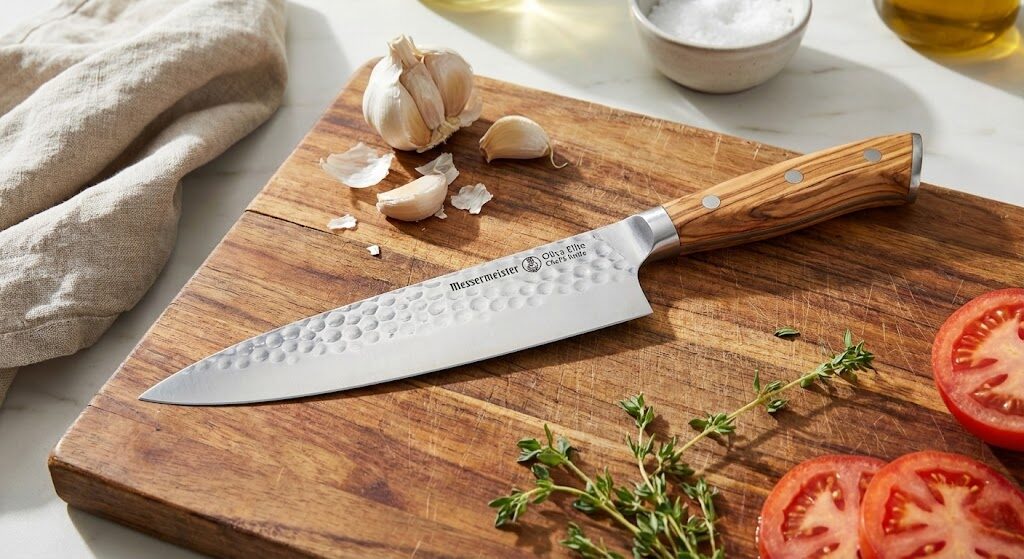
If there is one knife that defines the modern era of Messermeister, it is the Oliva Elite 8-inch Chef’s Knife. It takes the flawless forged blade of the Meridian line and replaces the synthetic handle with a stunning piece of Mediterranean olive wood.
Olive wood is uniquely suited for kitchen knives. It is incredibly dense, highly resistant to water, and naturally rich in oils, which gives it a secure, velvety grip even when your hands are wet. Visually, no two Oliva Elite knives are identical. The swirling golden-brown grain patterns ensure that your knife is a one-of-a-kind piece of functional art.
However, beauty requires maintenance. You cannot let the Oliva Elite soak in a sink, and it absolutely cannot go in the dishwasher (no good knife should, but wood handles will literally split and crack under the intense heat). You will need to rub the handle with food-safe mineral oil every few months to keep the wood hydrated and vibrant.

9. Messermeister vs. Wüsthof vs. Zwilling (The German Big Three)
How does the boutique underdog stack up against the Goliaths of Solingen?
Vs. Wüsthof: Wüsthof is the standard bearer. Their Classic line is legendary. Both use the exact same X50CrMoV15 steel. However, many Wüsthof Classic models still use a full bolster (though they have recently introduced “half-bolster” models to compete). Wüsthof utilizes PEtec (Precision Edge Technology) to laser-sharpen their blades to 14 degrees. Messermeister feels slightly more front-heavy, offering better gravity-assisted chopping power. To see how these giants hold up in extreme testing, review this Wüsthof vs Zwilling vs Shun edge retention test.
Vs. Zwilling J.A. Henckels: Zwilling’s flagship Pro line was designed by architect Matteo Thun and features a unique, wedge-shaped half-bolster. Zwilling uses a proprietary ice-hardening process (Friodur) which they claim alters the steel structure. In real-world application, the edge retention between Zwilling Pro and Messermeister Meridian Elite is virtually indistinguishable. The choice here comes down to handle comfort; Zwilling handles are often thicker and squarer, while Messermeister favors smooth, rounded contours.
10. Handle Materials and Ergonomics: The Unsung Hero
You interact with the handle far more than the blade. Messermeister understands that a sharp knife is useless if it causes blisters after an hour of dicing onions.
The Meridian Elite features POM (Polyoxymethylene), an incredibly dense synthetic polymer that is practically indestructible, resists fading, and provides a solid, weighty feel. It utilizes traditional triple rivets and a full exposed tang.
The Custom line offers Canvas Micarta. Micarta is created by soaking layers of canvas in resin and baking it under high pressure. Originally used for electrical insulation, it has become a premium knife material because it offers “grippiness.” The wetter Micarta gets, the more texture it provides, making it the safest option for messy, fast-paced kitchen environments.
11. Are Messermeister Knives Good for Professional Chefs?
The professional kitchen is a brutal proving ground. Knives are dropped on tile floors, tossed onto stainless steel prep tables, and passed between line cooks. Delicate Japanese carbon steel knives often don’t survive this environment without chipping.
Messermeister is highly revered in professional circles because it offers the perfect compromise. The HRC 58 German steel is tough enough to bash through a chicken carcass or crack open a lobster shell without the blade shattering. Simultaneously, the 15-degree edge allows for the fine brunoise cuts required for high-end plating. The lack of a full bolster means a prep cook can aggressively sharpen the blade on a stone during a quick break before dinner service without altering the knife’s geometry.
12. Final Verdict: Are They Worth the Investment?
A premium chef’s knife is an investment that, if properly cared for, will outlive the chef who bought it. Messermeister commands a premium price tag, often sitting in the $150 to $200 range for an 8-inch chef’s knife.
If you are looking for a cheap throwaway blade, look elsewhere. But if you want a heritage-quality tool that marries the indestructible durability of German forging with the precision of an acute Japanese edge, Messermeister is absolutely worth the investment. By ditching the full bolster and polishing the spine, they have eliminated the two biggest annoyances of traditional European knives.
You aren’t just paying for the Solingen stamp; you are paying for decades of thoughtful, chef-driven design from a family-owned company that prioritizes cutting performance above mass-market appeal.
Frequently Asked Questions
Transform Your Culinary Experience
Choosing the right chef’s knife is the single most important decision you can make for your kitchen. A good blade makes prep work a joy; a bad blade turns cooking into a chore. Messermeister stands out as a brand that refuses to compromise, blending old-world Solingen forging techniques with modern, performance-driven geometry.
Whether you are a seasoned executive chef slicing through a chaotic dinner rush, or an enthusiastic home cook looking to upgrade your kitchen arsenal, a Messermeister knife will undoubtedly elevate your capabilities on the cutting board.
Ready to Upgrade to the Knife Master?
Ditch the dull, clunky knives of the past. Experience the razor-sharp 15-degree edge and perfectly balanced half-bolster design of a genuine Messermeister today.
Shop Messermeister on Amazon